EN
EN English
 中文简体
中文简体 Français
Industry News
Home / News / Industry News / How to Reduce Grain Ship Loader Maintenance Costs: A Practical Guide | AOTUO

Article Directory
A mid-sized grain terminal was spending nearly 18 percent more on ship loader maintenance every year. The extra cost did not come from a single catastrophic failure. It came from dozens of small ones: a seized bearing in a dusty transfer chute, a worn belt scraper that scored the belt surface, and spilled grain that had to be cleared before the next vessel could berth. By the time the maintenance team opened the machine, the damage was already priced in.
The conclusion is straightforward: most grain ship loader maintenance cost is decided before a technician opens a panel. It is shaped by design choices, inspection discipline, spare parts strategy, and operator behaviour. This guide explains where that cost actually accumulates and how terminal managers can reduce it without sacrificing throughput.
Annual maintenance spending on a grain ship loader rarely follows a smooth curve. It spikes after prolonged wet-season operation, after high-throughput months, and after incidents where grain dust or moisture was allowed to settle on moving parts. Understanding the cost structure is the first step to reducing it.
| Cost category | Typical share | Main lever |
|---|---|---|
| Wear parts and consumables | 30–40% | Dust control, material selection |
| Labor and overtime | 20–30% | Inspection planning, training |
| Downtime and demurrage | 25–35% | Condition monitoring, spare readiness |
| Spare parts inventory | 10–15% | Critical spares analysis |
Three patterns stand out. First, wear parts and consumables are the largest single share because they are a direct consequence of steel contacting abrasive grain. Second, downtime and demurrage often exceed the repair cost itself; one unplanned stoppage during a vessel loading window can wipe out a full year of parts savings. Third, labor cost is the most controllable category because it responds quickly to how well inspections and maintenance windows are planned.
Many terminals select equipment based only on rated capacity and purchase price. Maintenance cost enters the decision later, usually when it is too late. The loader design determines how often wear liners are changed, how accessible lubrication points are, and whether a minor leak becomes a major strip-down.
Grain is abrasive and easily damaged. Every drop point, chute angle, and belt transfer that throws grain around accelerates equipment wear and produces broken kernels that become dust. A loader engineered for grain, with controlled flow paths and short free-fall distances, generates less dust and fewer blockages. This is not just a product quality issue; it is a maintenance metric.
Grain dust is combustible and hygroscopic. When it settles on bearings, gearboxes, and electrical enclosures, it forms an abrasive paste that shortens component life. Moisture makes the problem worse. Maintenance teams that simply wash down equipment often push dust deeper into seals. A better approach is to prevent dust at transfer points and use sealed enclosures where dust cannot settle in the first place.
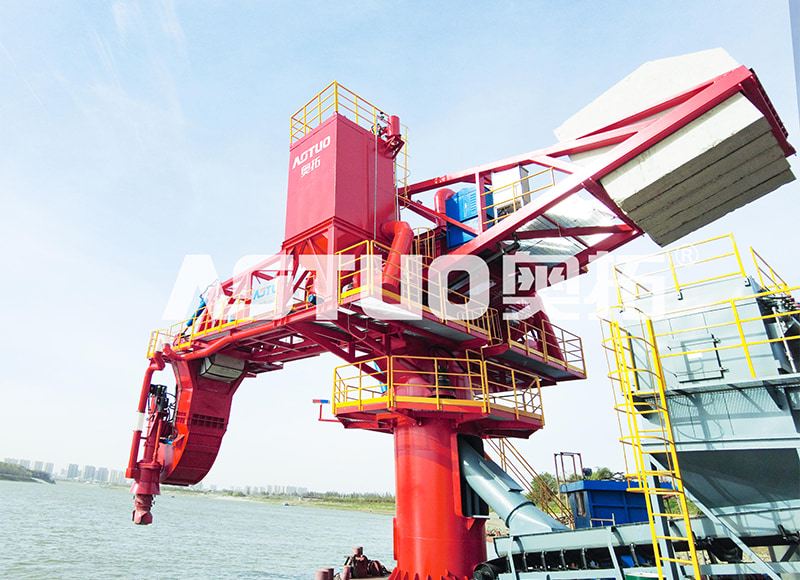
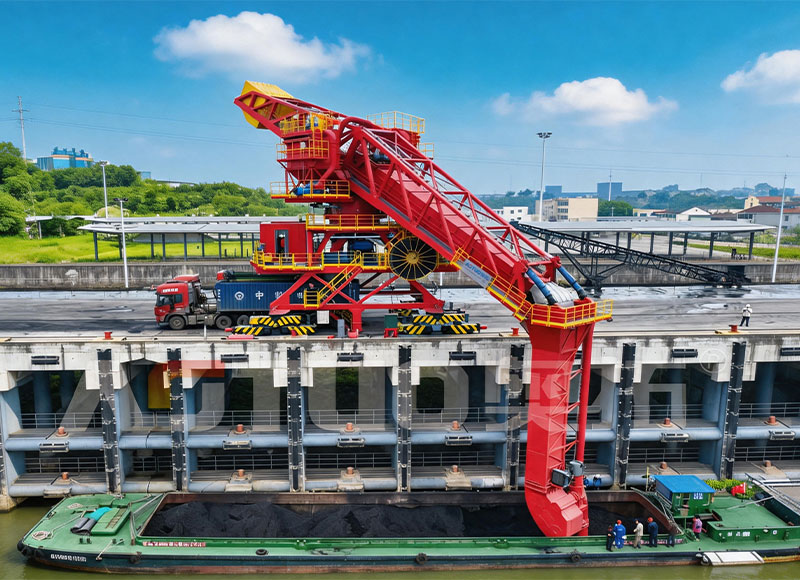
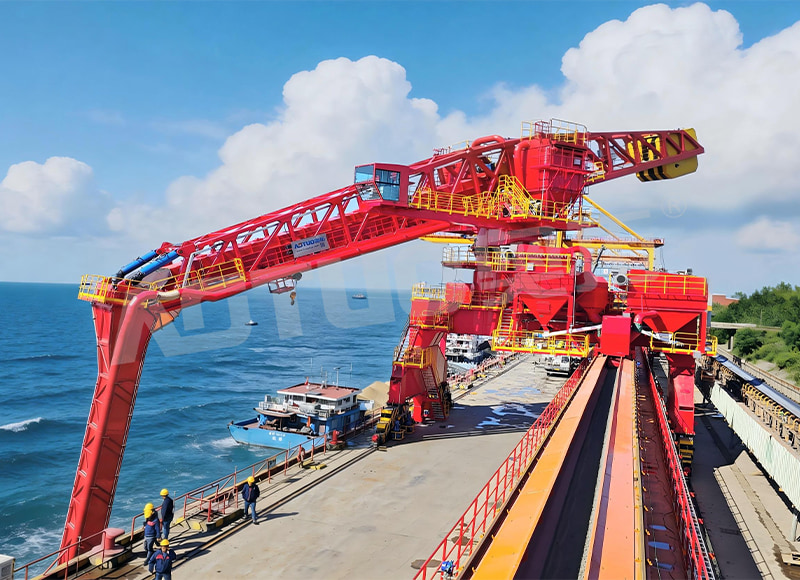
A rail mobile ship loader designed for dry bulk duty, for example, combines dust suppression at the loading head with service points that do not require full boom access for routine checks. That accessibility directly reduces the labor hours spent on every inspection.
 Custom 300-1500t/h 800-50000DWT Rail Mobile Ship Loader For Loading Bulk MateriaCustom 300-1500t/h 800-50000DWT Rail Mobile Ship Loader For Loading Bulk Materials, Hangzhou Aotuo Mechanical and Electrical Co., Ltd. is...View Product →
Preventive maintenance based purely on a fixed schedule misses the point. Grain ship loaders fail according to operating cycles: the number of shuttle movements, loading starts and stops, and the moisture content of incoming grain. A loading session with frequent stop-starts wears belt and transfer components far more than a continuous session at the same tonnage.
Vibration monitoring on the boom conveyor drive, belt alignment sensors, and bearing temperature readings are inexpensive compared with the repairs they prevent. A weekly walk-through that checks belt tracking, scraper wear, and lubrication levels takes one person about an hour. It can catch the kind of misalignment that, left for a month, destroys a belt.
Use established ship loader and unloader maintenance strategies to define intervals that match your actual operating profile, rather than copying intervals from a manual written for a different climate and throughput level.
Lead times and hold-up rates for spare parts are major drivers of downtime. But stocking every part is also a cost. The solution is a critical-spares analysis that separates parts whose failure stops the operation from parts that can be sourced quickly.
Belt scrapers, liners, idlers, and seal kits are consumables. They fail predictably. Track their replacement intervals for a year and you will know both the range and the cost. Negotiate an annual supply contract with the equipment supplier, or use min-max stock levels based on median replacement frequency.
For rotating components, seals, and electrical parts, the quality difference between original and alternative suppliers is real. A cheap replacement that fails in half the time doubles the labor cost and creates another unplanned stoppage. In most cases, it is not worth the initial saving.
Understanding how grain ship loader speed, types, and breakage patterns relate to wear gives you the data to set inspection intervals and spare stock levels on the basis of actual damage mechanisms rather than guesswork.
Operator behaviour causes more grain ship loader failures than mechanical design does. The most common pattern is rapid start-stop cycles that produce shock loads on the boom conveyor, followed by moving the loader while the spout is still inside the hopper or cargo hold. Both are preventable with a simple, enforced operating procedure.
Train the crew to follow a consistent startup sequence: check no-load startup, bring the conveyor to speed, then introduce grain. At shutdown, run the system empty for a defined period so no grain residue remains in the boot, chutes, or spout. This single practice eliminates most of the conditions that cause corrosion, caked grain blockages, and the need for extra cleaning shifts.
Automation does more than increase throughput; it reduces maintenance exposure. A PLC-controlled loading sequence limits the operator's ability to over-stress the machine. Sensors that detect belt slip, high bearing temperature, or spout blockage stop the system before damage occurs.
Saving data across loading sessions gives the maintenance team a record of actual cycles, which is far more useful than a calendar for planning interventions. The automation and intelligent technology used in modern grain ship unloaders applies equally well to loaders; the control platform, sensor set, and warning logic are essentially the same.
In a terminal where a grain ship unloader handles the receiving side and a rail mobile ship loader handles the shipping side, both machines can share the same HMI, sensor catalog, and spare parts families. That consolidation reduces inventory duplication and simplifies technician training.
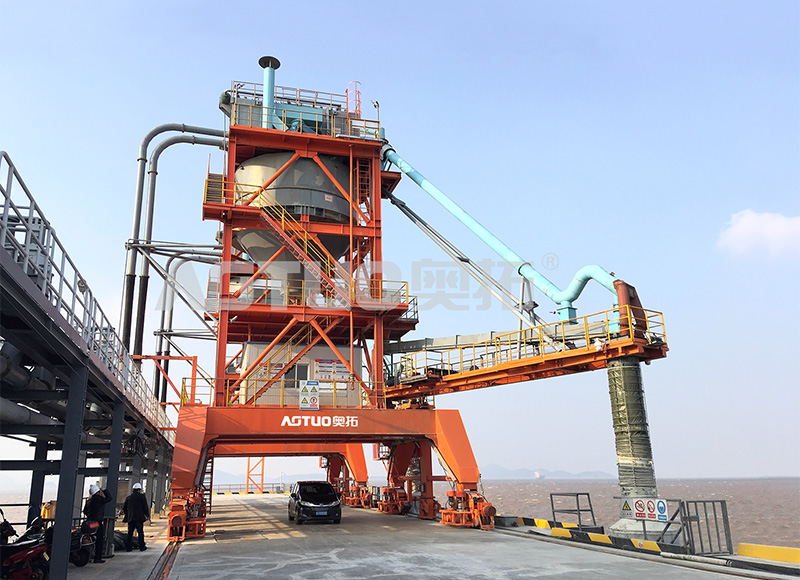
 Custom Grain Ship Unloader Manufacturers, SuppliersCustom Grain Ship Unloader, Hangzhou Aotuo Mechanical and Electrical Co., Ltd. is China Grain Ship Unloader Manufacturers and Suppliers, ...View Product →
At some point, adding inspection hours and spare parts does not reduce cost; the equipment itself is the problem. Grain ship loaders adapted from general cargo machines, or units running for more than 15 years, often justify retrofitting dust suppression at transfer points, belt alignment sensors, and remote monitoring. These upgrades typically pay back in under two years through avoided repairs and stoppages.
Terminals planning a new loader should evaluate not just the purchase price but the cost per operating hour over a ten-year life. A machine with sealed bearings, generous inspection hatches, and proven grain-handling geometry is nearly always cheaper in the long run.
Reducing grain ship loader maintenance costs is not a single initiative; it is a set of decisions spread across design selection, inspection discipline, spare parts policy, and operator behaviour. Terminal managers who treat these as one system, rather than reacting to each breakdown, report maintenance cost reductions of 20 to 30 percent within the first two years. The data needed to get there is already sitting in your operation. The only question is whether you use it to plan ahead or to explain what went wrong.
It is focused on the overall solution of dry bulk material port transfer system,
research and development, manufacturing, and service
Copyright © Hangzhou Aotuo Mechanical and Electrical Co., Ltd. All Rights Reserved.
Custom Material Conveyor Transfer Systems Manufacturers