Article Directory
Quality control standards for a grain ship loader are not written in a single code. They are assembled from several layers: a machinery safety standard, a structural design code, welding and fabrication rules, electrical safety requirements, and vessel-side carriage rules. For a buyer, the important shift is this: the loader is judged against one group of standards, and the grain operation around it is judged against another. The table below shows the typical layers and what each one controls.
| Quality control layer | Typical reference standard | What it controls |
|---|---|---|
| Overall machinery safety | EN ISO 12100 | Risk assessment, guards, emergency stopping, inspection access |
| Structural design | ISO 5049-1 | Boom and gantry strength, stability, load combinations |
| Welding quality | ISO 3834, ISO 5817 | Welder qualification, weld imperfections and acceptance levels |
| Electrical equipment | IEC 60204-1 | Wiring, protection, control panels, emergency stop logic |
| Vessel carriage rules | IMO International Grain Code, SOLAS Chapter VI | Approved loading plan, hold filling, vessel stability |
| Dust explosion protection | ATEX / IECEx classification | Motor, sensor, and enclosure selection in classified dust zones |
When a manufacturer says that a loader meets international standards, the claim is only useful if it is supported by a standards register that states which edition of which code applies to each subsystem. This register, rather than a generic certificate, is the first document a quality control review should request.
A grain ship loader is a mobile structure exposed to repeated acceleration, changing wind, and heavy cargo flows. The design phase determines most of its future reliability, which is why quality control starts before the first plate is cut.
Structural design for mobile continuous handling equipment is normally executed to ISO 5049-1 or an equivalent national code. The calculation package should combine dead load, live grain load, operational wind, out-of-service storm wind, and, where geography requires, seismic load. Deflection limits and stability are checked for every boom position. For a rail-mounted loader, wheel loads and rail reactions must be verified against the actual quay and rail specification.
Material selection is part of the same review. Steel grades should match the local temperature and corrosion environment. A loader at a saltwater port needs a corrosion allowance and an appropriate coating specification; a loader in a cold climate benefits from steel with adequate impact toughness. These decisions should appear in the design report, not only in the bill of quantities.
Welding quality is where grain ship loaders reveal the difference between a structural engineering company and an assembler of bought-in components. The welded structure carries the full working load, and grain dust settles on every surface, which can accelerate fatigue at poorly formed joints.
Fabrication should follow a recognized welding quality system such as ISO 3834, with welders qualified to ISO 9606 or a comparable national scheme. Weld imperfections are judged against acceptance levels in ISO 5817 or AWS D1.1. Critical butt welds on the boom, gantry, and chute assemblies should be covered by non-destructive examination: visual testing, ultrasonic testing, magnetic particle testing, or radiographic testing, depending on the weld class and stress level.
Buyers should ask for the following as a minimum:
These records are produced during assembly, not after painting. If they cannot be produced, they never existed.
Structural integrity proves that a loader frame will carry the load; it does not prove that a gearbox will survive a hot summer at nameplate torque. Drive train checks for a grain ship loader include rated torque, start frequency, brake holding capacity, and temperature rise. The brakes matter more than on many other machines because a loader positions itself repeatedly over hatch openings and must hold its position as wind loads change.
Interlocks between travel, slewing, and conveyor operation are verified as part of the machine safety review. Electrical systems are checked to IEC 60204-1: protection devices, wiring, earth continuity, and emergency stop logic. Panels and drives should be rated for a marine environment, with enclosure protection adequate for rain, washdown, and salt spray.
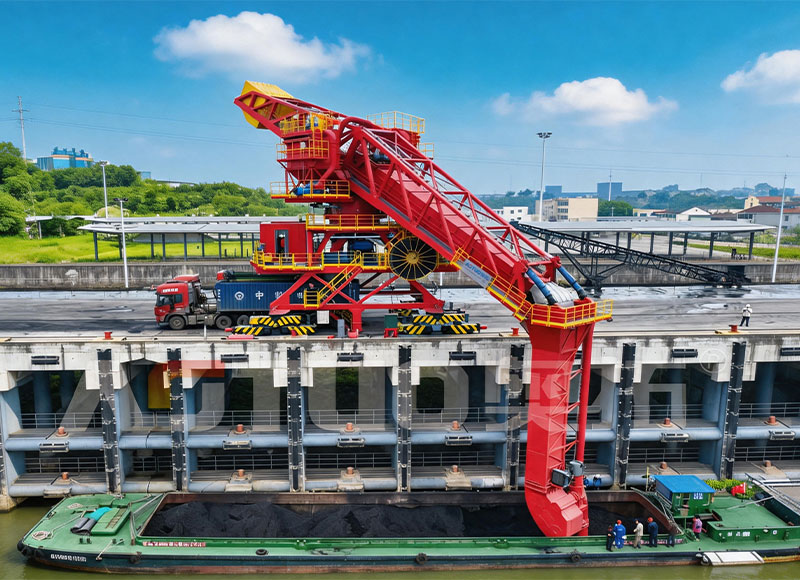
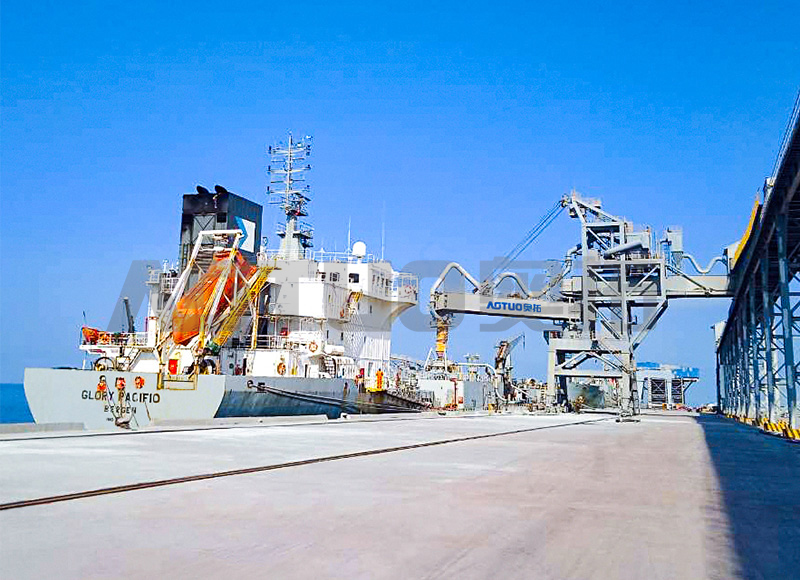
When a loader will spend its life exposed to chute dust and port rainfall, the enclosure rating of every component is not a detail; it is a maintenance forecast. AOTUO applies these checks to every machine before it leaves the workspace, including the rail mobile ship loader built for dusty and wet port conditions.
Grain introduces quality control challenges that steel and cement do not. It is moisture-sensitive, it breaks under rough handling, and its dust is explosible in confined spaces. These characteristics add checks on top of the structural and mechanical programme.
Contamination control comes first. A loader that previously handled another cargo must be cleaned down to the belt covers, chute seams, and hopper corners before grain arrives. The quality plan should define the cleaning procedure, inspection points, and who signs off the clean-out. Grain intended for food or feed use adds another requirement: the design must allow inspection of every surface that touches the cargo.
Dust control comes second. Grain dust around the loading spout is managed with closed transfer points, spillage containment, and dust extraction. Equipment installed in a classified dust zone must be selected for that zone according to ATEX or IECEx rules, which affects motors, sensors, cable entries, and earthing.
Vessel-side requirements come third. SOLAS Chapter VI and the IMO International Grain Code require loading to follow an approved plan that respects the ship’s stability limits. The loader’s control system must therefore meter grain into each hold according to the plan, rather than simply running at maximum rate. Flow control, chute position sensing, and interlock logic should be checked against this requirement. Terminal teams preparing for updated cargo rules can use the 2026 grain code ship loader compliance guide as a practical reference.
The same logic applies in the unloading direction. AOTUO’s dedicated grain ship unloader is checked for sealing, clean-out access, and dust control as part of its standard quality control sequence, because the cargo and terminal environment set the pass criteria, not only the machine’s rated capacity.
The quality of a grain ship loader becomes visible during factory acceptance testing. A serious FAT programme includes a no-load run-in over a defined duration, a load test in which the structure is loaded to at least 110 percent of rated capacity with deflection measured against design values, functional tests of all drives and interlocks, and electrical checks. Open points from the FAT are listed with owners and deadlines.
Where practical, the loading belt and dust extraction are tested with a representative material. This confirms whether design rates are realistic and whether dust suppression performs as specified. The buyer’s representative should witness the test and receive access to the raw results, not only a summary.
After installation, site acceptance testing repeats the critical checks on the real quay: alignment, travel response, chute positioning accuracy, conveyor and belt scale calibration, interlock function, and dust behavior under actual cargo. The results form the handover record.
The documentation set is a deliverable in itself: structural calculation summary, material certificates, weld maps and NDT reports, electrical test certificates, OEM certificates for motors and gearboxes, FAT and SAT protocols, an operation and maintenance manual, and a declaration of conformity. If any of these documents is missing, the loader is unproven regardless of how impressive it looks.
A loader is only as good as the quality system that produced it, and a quality system can be inspected. Start with the management baseline: ISO 9001, plus a welding shop operating under ISO 3834. Then check the people behind the records: technicians with valid qualification certificates, inspectors who are independent from production, and a documented non-conformance procedure.
Ask the supplier to walk you through the weld repair rate on recent projects. A very low repair rate can simply mean low inspection coverage. A moderate rate with clear records and root cause analysis is often more reassuring because it proves the factory is measuring and correcting.
Visit the shop floor. A reliable manufacturer is usually willing to show a machine under assembly rather than only finished photographs. AOTUO keeps its fabrication and assembly facilities open to terminal representatives who want to judge weld quality, dimensional accuracy, and housekeeping first-hand.
The most practical quality control indicator is how a manufacturer treats standards in general. A company that has participated in writing industry standards carries a different level of discipline into its own equipment.
AOTUO has direct experience in this area: it led the drafting of JC/T 2575, the Chinese industry standard for bulk cement screw ship unloaders. That document covers a related equipment family, but the discipline it builds — understanding why a standard sets a limit rather than only what the limit is — carries across product lines. Combined with over 20 years of bulk handling equipment manufacturing and more than 100 patents and software copyrights, it explains why AOTUO applies the same care to grain-handling machines as to its unloaders.
Independent evidence comes from installation history. AOTUO has delivered equipment to ports including Brisbane and Sydney in Australia, Mariveles in the Philippines, and Huizhou and Maoming in China. Those completed port installation projects show that its quality control commitments survive the distance between the factory floor and an overseas berth.
When quality control is managed as a system, choosing a grain ship loader becomes a review of documented evidence rather than a comparison of brochure claims. Carrying out that review early in the procurement process gives a terminal operator the chance to shape the standards register, design report, and inspection schedule to fit the cargo, the climate, and the real operating environment.
It is focused on the overall solution of dry bulk material port transfer system,
research and development, manufacturing, and service
Copyright © Hangzhou Aotuo Mechanical and Electrical Co., Ltd. All Rights Reserved.
Custom Material Conveyor Transfer Systems Manufacturers