EN
 English
 中文简体
 Français

Industry News
Home / News / Industry News / Ship Loader RFQ: Key Parameters to Include in Your Procurement Document

Article Directory
An RFQ, or Request for Quotation, is a procurement document that specifies the technical and commercial requirements for a ship loader and asks suppliers to submit a formal quotation within a defined deadline. A well-written RFQ removes ambiguity, shortens the tender evaluation cycle, and protects the buyer from change orders during design and fabrication.
Rated capacity and vessel compatibility are the contractual backbone of any ship loader RFQ, because they define the equipment's real capability envelope rather than its marketing headline.
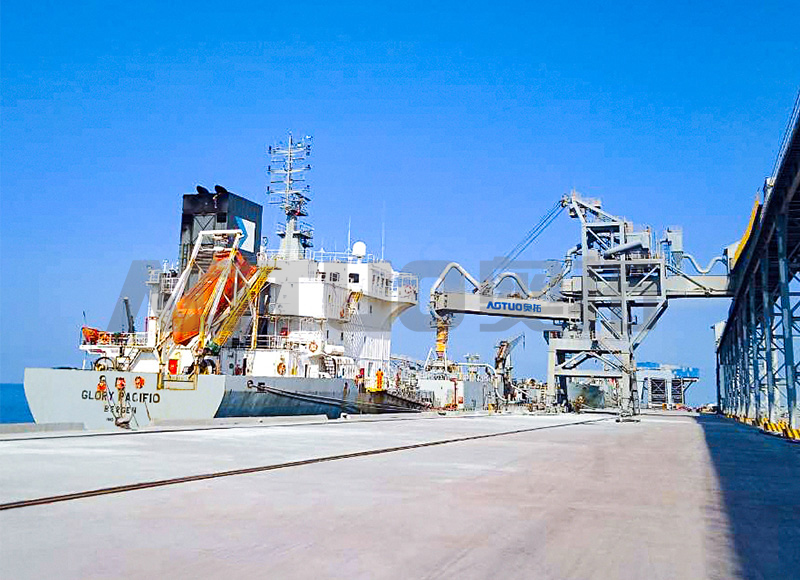
Start with the guaranteed capacity calculation. A ship loader's rated capacity is the continuous free-flowing transfer rate at the design material density and the specified trim point. Suppliers should state both the maximum achievable capacity and the sustainable capacity at the targeted vessel size. For a quick benchmark, review this comparison of bulk ship loader types and efficiency in port operations.
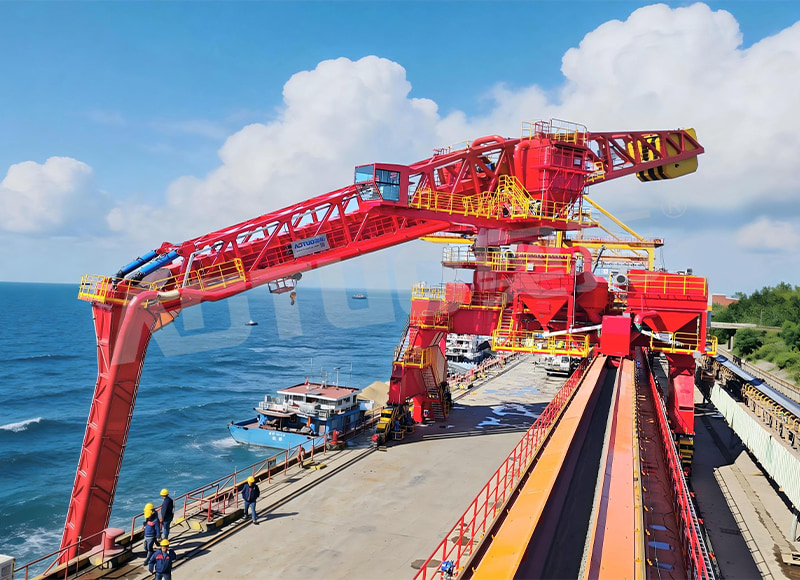
Vessel size drives several non-obvious parameters. The RFQ must list the design vessel range in deadweight tonnage, the hatch coaming height range, and the air draft of the loader at maximum boom elevation. For a rail mobile ship loader intended to serve vessels from 25,000 to 100,000 DWT, the difference in hatch coaming height can exceed 6 meters.
AOTUO's bulk handling systems are engineered for vessel classes up to 200,000 DWT and capacities up to 3,000 tons per hour, which sets a practical reference when drafting your specification.
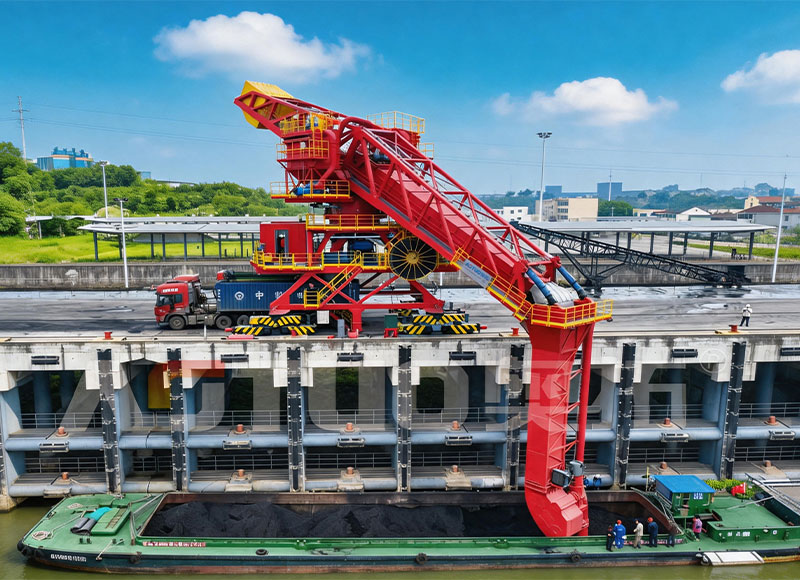
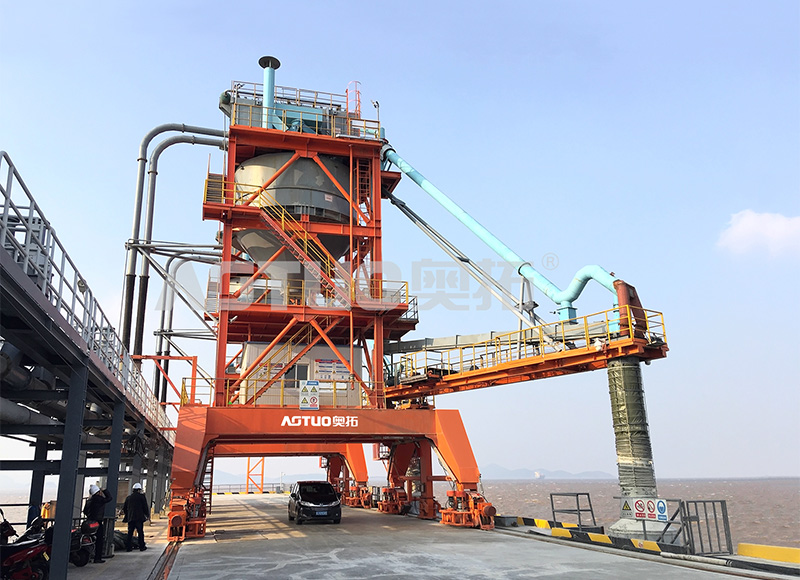 300-1500t/h 800-50000DWT Rail Mobile Ship Loader For Loading Bulk MaterialsCapacity: 300 ~ 1500 t/h (calculated by cement proportion) Applicable ship type: 800-50000 DWT Energy consumption: 0.1 kWh/T (excluding transport equipment other than ...View Product →
Include these minimum data fields in the RFQ:
The same ship loader behaves differently with cement, clinker, coal, or grain, and the RFQ must specify the material properties so the supplier can design the conveying path for the actual duty.
Bulk density, particle size distribution, moisture content, and flowability all affect the actual discharge rate and the wear rate on the belt or screw conveyor. For example, cement with a bulk density of 1.3 t/m3 and a 3 percent moisture content flows through a screw-type loader at roughly 85 percent of its free-flowing capacity. A grain loader handling wheat with a density of 0.75 t/m3 may require a different trough geometry to avoid breakage.
Environmental compliance is a gate clause for any new ship loader, and the RFQ must carry a guaranteed dust emission value rather than a list of dust control equipment.
Environmental permits in most jurisdictions require dust emission limits for bulk loading operations. For coal and cement terminals, the RFQ should reference the applicable local emission standard and require the supplier to state the achievable dust concentration at the loading point.
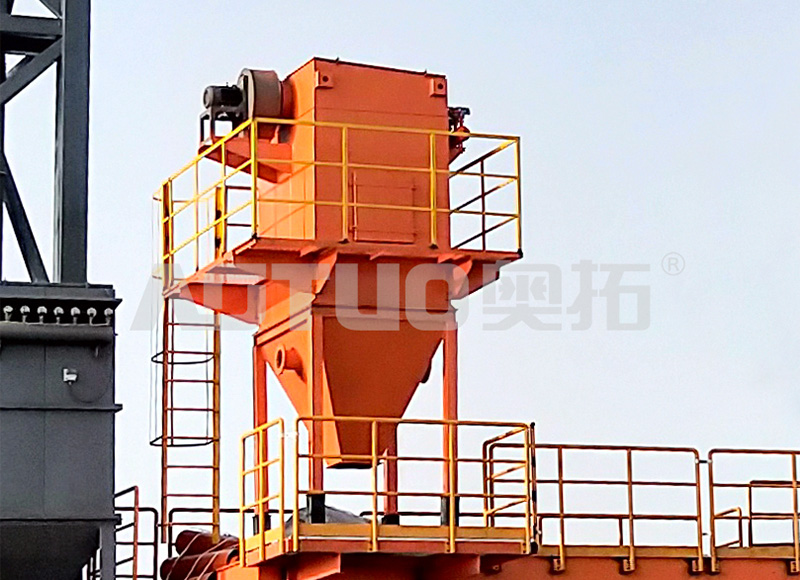
Dust control in a ship loader is not a single device; it is a system. The RFQ should specify the type of dust suppression expected: water spray with atomized nozzles, dust collection with filter bags, or a sealed loading chute arrangement. Some loaders integrate a dust suppression hopper that captures material during transfer, and this can be specified as a separate mobile unit if the berth loads into trucks or barges periodically.
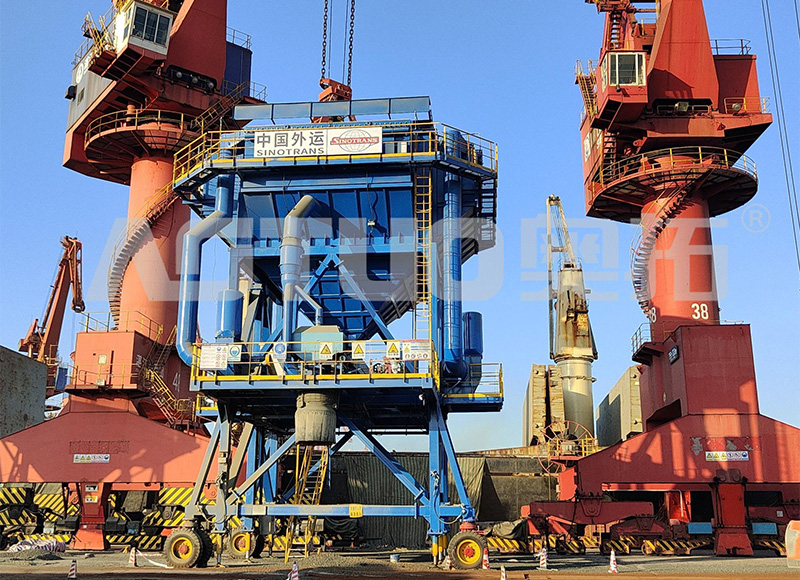 200T/H-800T/H Tire Mobile Dust Suppression Hopper LoaderEquipment specifications: 200T/H-800T/H(according to clinker, other materials according to bulk volume weight conversion) Total installed capacity: 100-250kW Traction ...View Product →
Require a guaranteed dust emission value at the loading spout and a measurable test point, not just a list of dust suppression equipment. Ports in Australia and the Philippines routinely reject loaders that cannot demonstrate compliance during commissioning.
Automation requirements belong in the RFQ as explicit interface points, not as a vague expectation of a smart machine.
Modern ship loaders integrate with the port's central control system. The RFQ should state the control protocol required, the hierarchy of control modes, and the data exchange points for the terminal management system. Ask the supplier to describe the conveyor interlocking, the overload protection logic, and the remote diagnostics capability.
Automation in AOTUO ship loaders includes PLC-based control with remote monitoring, which matters when the loader is operated from a central control room rather than a local operator cabin. Specify the level of automation as an option with a separate line item price.
A ship loader is a heavy, moving structure, and the RFQ must carry site geometry so the supplier can design the foundation and rail work before pricing.
The RFQ must include the rail gauge, the allowable wheel load on the existing rail, the foundation type, and the available electrical supply. For a retrofit project, the structural condition of the quay affects whether a rail mobile or a fixed loader can be used.
Ask the supplier to submit a foundation loading plan and an installation sequence within the RFQ response. Include the site environmental conditions: wind speed for the design storm case, seismic zone, and ambient temperature range. AOTUO's projects at Brisbane Port in Australia and Maoming Port in Guangdong involved custom foundation and rail works for the rail mobile loader configuration.
Request the following in the RFQ:
Lifecycle costs matter more than the purchase price, and the RFQ should force the supplier to quantify them.
RFQ responses should include lifecycle cost data: total installed power, annual maintenance estimates, spare parts availability, and the warranty period. A loader with a slightly higher initial price but lower specific energy consumption per ton often wins on a 10-year total cost calculation.
Specify the delivery window, the spare parts list to include in the initial supply, the number of operator and maintenance training hours, and the supplier's commissioning team composition. For international projects, state the shipping terms and whether the supplier provides local supervision.
Use the parameter matrix below as the final checklist before issuing your RFQ document.
| Parameter | Why it matters | What you should specify |
| Rated capacity | Defines the commercial throughput | t/h at design material and vessel |
| Vessel DWT range | Determines boom length and slew | Min and max DWT, hatch coaming height |
| Material properties | Affects capacity and wear | Density, moisture, lump size |
| Dust emission limit | Required for environmental permits | mg/Nm3 at loading point |
| Control interface | Enables terminal automation | PLC, protocol, data points |
| Foundation data | Prevents installation failures | Rail gauge, wheel load, seismic |
Rated capacity and vessel compatibility are the most important, because they define the commercial and technical envelope for the entire equipment package.
Yes. Environmental compliance is a gate clause for most port projects. The RFQ needs a guaranteed dust concentration value at the loading point.
Material density, moisture, and lump size directly influence achievable throughput and the wear life of conveyor components.
Demand a 10-year total cost estimate, spare parts supply terms, training hours, and a commissioning plan before final award.
A complete RFQ is a negotiation leverage tool, not a purchasing formality. The more specific your parameters are, the lower your final bid price and the fewer change orders you will face during fabrication.
It is focused on the overall solution of dry bulk material port transfer system,
research and development, manufacturing, and service
Copyright © Hangzhou Aotuo Mechanical and Electrical Co., Ltd. All Rights Reserved.
Custom Material Conveyor Transfer Systems Manufacturers