EN
EN English
 中文简体
中文简体 Français
Industry News
Home / News / Industry News / Grain Ship Loader Boom Design: Key Structural Requirements & Standards

Article Directory
The structural requirements for a grain ship loader boom can be summarized in five areas: sufficient strength, appropriate stiffness, reliable fatigue life, controlled dynamic response, and stability under extreme conditions. These constraints interact, so the design must satisfy all of them simultaneously rather than optimizing one at the expense of the others.
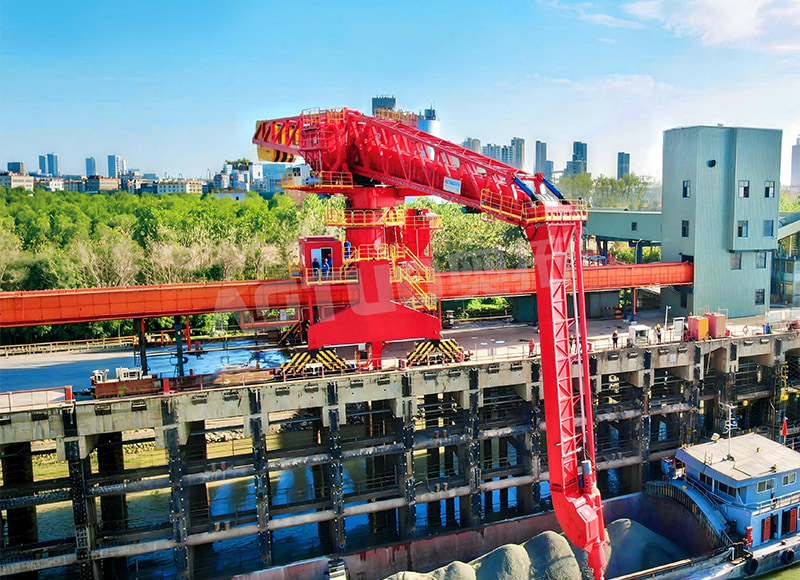
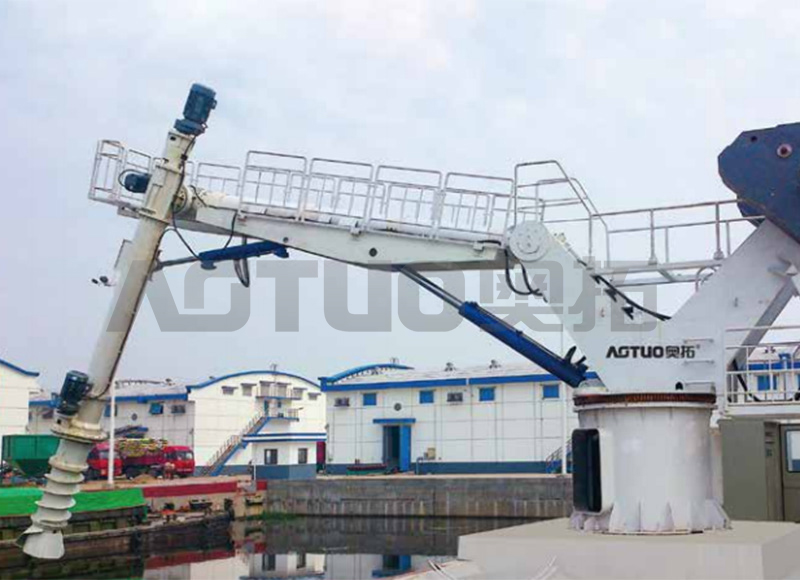
A grain ship loader boom is the steel arm system that conveys bulk grain from the quay hopper to the vessel hatch, including the conveyor column, luffing mechanism, telescoping structure, and loading spout. The design starts with vessel waterline variation, hatch dimensions, and the required loading rate.
Boom configuration itself - fixed length, telescoping, or luffing - changes how each requirement is evaluated. A telescoping boom, for example, has a higher stiffness demand at the extension joint because the moment arm grows.
Boom load cases are classified according to FEM 1.001 and GB/T 3811, with three governing conditions: ordinary operation, intensive operation, and storm anchoring. The designer must check all three. In practice, the dynamic impact factor ranges from 1.2 to 1.5, working wind pressure is taken as 250 Pa, and non-working wind pressure as 1500 Pa. The number of loading cycles in a typical grain terminal is 1,500 to 2,500 per month, so the S-N check must be based on realistic utilization, not only maximum load.
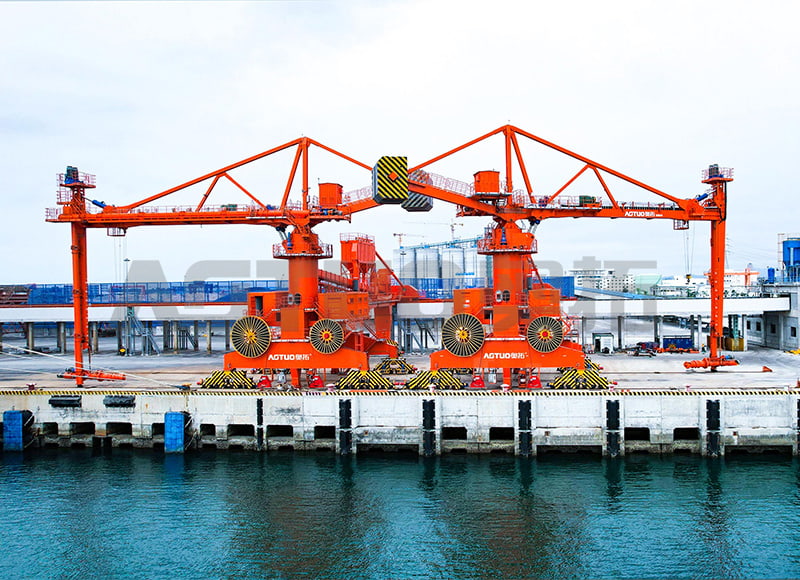
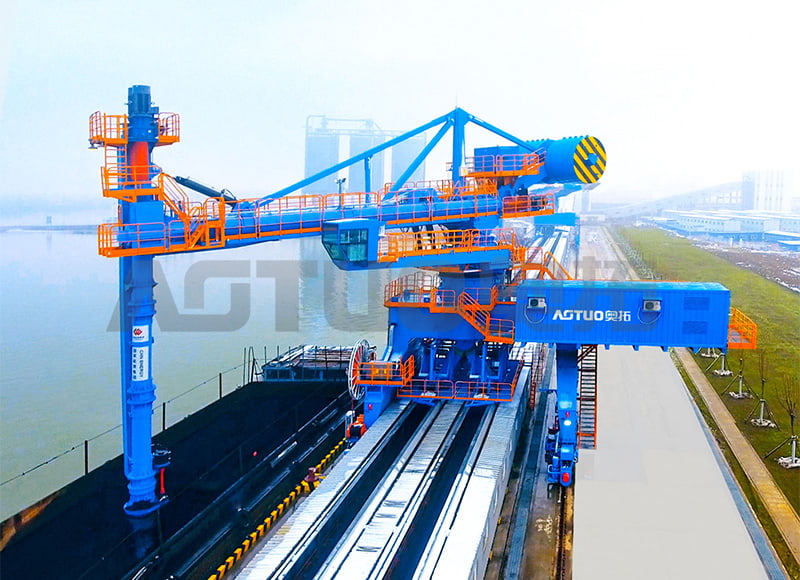
 300-1500t/h Rail Mobile Ship Loader for 800-50000DWT VesselsDesigned for bulk material loading, this rail mobile ship loader handles capacities up to 1500 t/h and vessels up to 50000 DWT. Its structural design accounts for FEM load cases, dynamic factors, and fatigue cycles, ensuring reliable operation under intensive port conditions.View Product →
| Load case | Typical value | Design factor |
| Structural dead load | Actual weight | 1.0 |
| Full material load | Rated capacity | 1.3 |
| Working wind | 250 Pa | 1.1 |
| Non-working wind | 1500 Pa | 1.0 |
| Seismic load | Region dependent | 1.0 |
Box-type sections are better suited to grain ship loaders than lattice trusses because grain handling requires smooth steel surfaces for easy cleanout, and box members provide higher torsional stiffness. Q355B is the most common steel grade, while Q460C at the boom root and other high-risk sections allows significant weight reduction. Welding quality is part of the structural equation; H4 fillet welds at the boom chord connections must be inspected by ultrasonic testing.
In tropical environments such as the Philippines, the external coating system is a structural decision because surface preparation and zinc-rich primers extend the fatigue life of the steel.
High torsional stiffness, smooth surfaces for cleanout, higher weld volume, moderate cost.
Lighter weight, larger windage area, hard to clean, used for very long spans.
| Steel grade | Yield strength (MPa) | Application | Weight saving |
| Q355B | 355 | Main chords, cross bracing | Baseline |
| Q460C | 460 | Boom root, hinge points | 10-15% |
| S355J2W | 345 | Exterior lattice elements | Corrosion benefit |
Grain ship loader booms differ from coal or cement loaders mainly in three areas: dust explosion prevention, grain breakage control, and moisture ventilation. These requirements directly change the internal chute and seal structure, and they must be designed into the boom from the start.
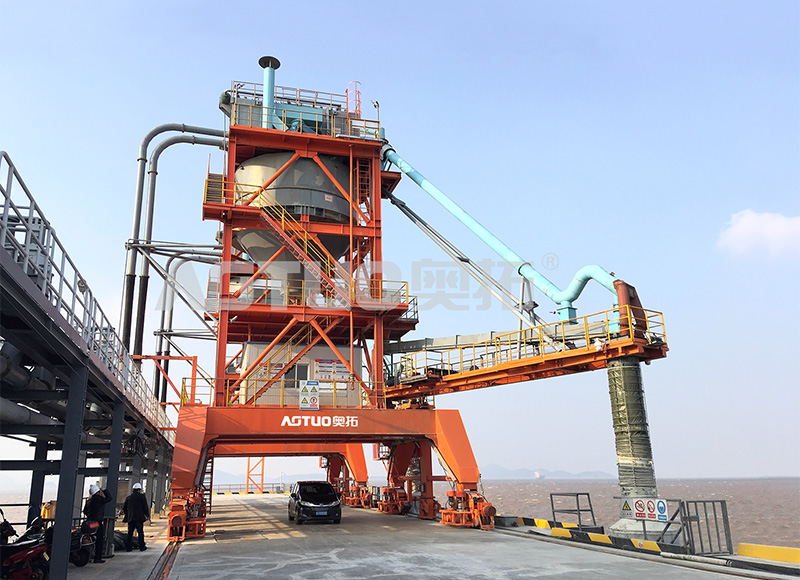
 Grain Ship Unloader for Efficient Bulk Grain DischargeSpecialized for grain unloading, this equipment addresses dust explosion prevention, grain breakage control, and moisture ventilation. Its structure is validated through finite element analysis and load testing, making it suitable for grain terminals with demanding operational requirements.View Product →
After the structural layout is complete, finite element analysis and prototype load testing are mandatory. The engineering record at Hangzhou Aotuo Mechanical and Electrical Co., Ltd. (AOTUO) confirms that the key is to fully understand the boundary conditions of the load combinations. AOTUO designs and builds rail mobile shiploaders and grain unloaders for ports in the Philippines, Australia, and Singapore, where practical constraints from real installations shape the final boom geometry.
Understanding the grain ship loader working principle and capacity specification is the first step when evaluating boom stiffness. AOTUO applies this knowledge in every project from Manila to Brisbane.
The total cost of ownership is directly affected by boom weight and structural redundancy; a heavier but more fatigue-tolerant boom can reduce maintenance downtime in the long run.
The matching relationship between tip deflection and the governing load combination is the most critical parameter. A boom that is too flexible causes spillage in the hatch, excessive belt tracking force, and accelerated wear on the luffing mechanism. It also directly affects the height of the A-frame and the gantry column cost.
The main differences are the closed dust-control chute, the breakage-reduction devices, and the ventilation system inside the boom. These elements do not appear in cement or coal loader booms and must be designed into the structure from the start. Many terminals also specify food-grade interior surfaces, which forbids zinc-rich primers inside enclosed chutes.
Fatigue life is calculated using the S-N curve for the steel grade and the load spectrum of the port. The equivalent stress range and the number of cycles, often 50,000 for a typical grain terminal, are entered into the fatigue damage formula to verify that the design meets the required service life. The resulting design life is usually 25 to 30 years at the assumed duty cycle.
The boom is anchored by a rail clamp or pin device, the luffing mechanism is locked, and the design must resist a non-working wind pressure of at least 1500 Pa without structural yielding. The rail clamp force is calculated to resist wind overturning, not just sliding.
It is focused on the overall solution of dry bulk material port transfer system,
research and development, manufacturing, and service
Copyright © Hangzhou Aotuo Mechanical and Electrical Co., Ltd. All Rights Reserved.
Custom Material Conveyor Transfer Systems Manufacturers