EN
EN English
 中文简体
中文简体 Français
Industry News
Home / News / Industry News / Bulk Ship Loader Conveyor: Key Performance Requirements for Efficient Terminals

Article Directory
Forty thousand tonnes of coal has to move from the stockyard onto a 100,000 DWT bulk carrier inside two tidal windows. The bulk ship loader conveyor sits at the centre of that operation, and the performance requirements written into its specification decide whether the berth meets the schedule or pays demurrage.
Every loader procurement starts with the same question: what must the machine actually achieve under the terminal's real operating conditions? The answer, expressed in measurable terms, is the equipment's key performance requirements.
Key performance requirements (KPRs) for a bulk ship loader conveyor are the quantified operating thresholds — rated capacity, belt speed, vessel-size envelope, emission limits, positioning accuracy, and mechanical availability — that the equipment must sustain over its service life.
These requirements interact rather than stand alone. A higher rated capacity demands a wider belt and more drive power, while a longer vessel envelope increases boom weight and travel distance. The most effective way to evaluate any loader design is to trace each KPR back to the operational target it serves.
Rated throughput, expressed in tonnes per hour (t/h), is the first performance requirement for a bulk ship loader conveyor because it sizes the belt, the drive, and the entire feeding chain upstream.
Most port-class mobile loaders operate in the 300 to 1,500 t/h range, while large fixed coal terminals push 4,000 t/h and above. The chosen rate determines belt width and speed: a design can lift capacity by going wider, faster, or both, but each option carries trade-offs. Higher belt speed, for example, increases capacity without widening the conveyor, yet it also raises dust generation, belt wear, and material degradation.
The belt conveyor that feeds the loading boom must be specified as a system, not as an isolated component. In practice, the loader is only as fast as the stockyard reclaim and feeder line that supplies it, so terminal planners should model the whole chain from reclaim hopper to ship hold.
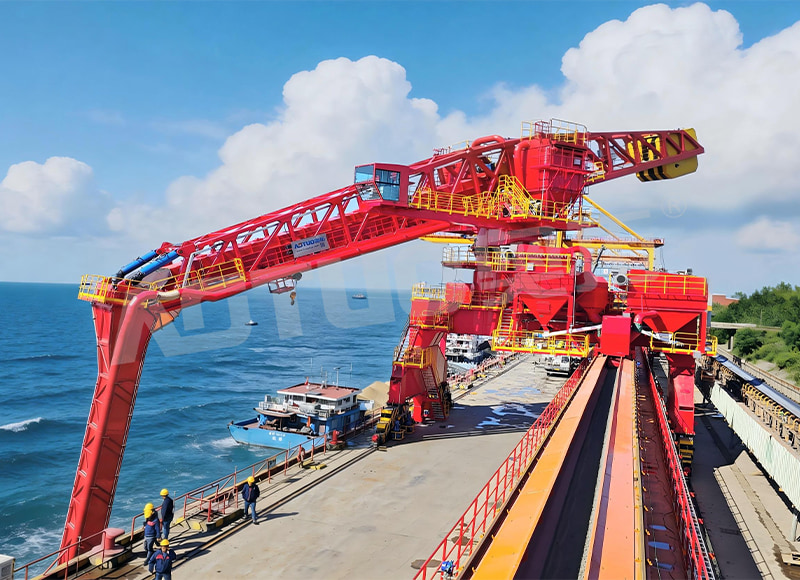
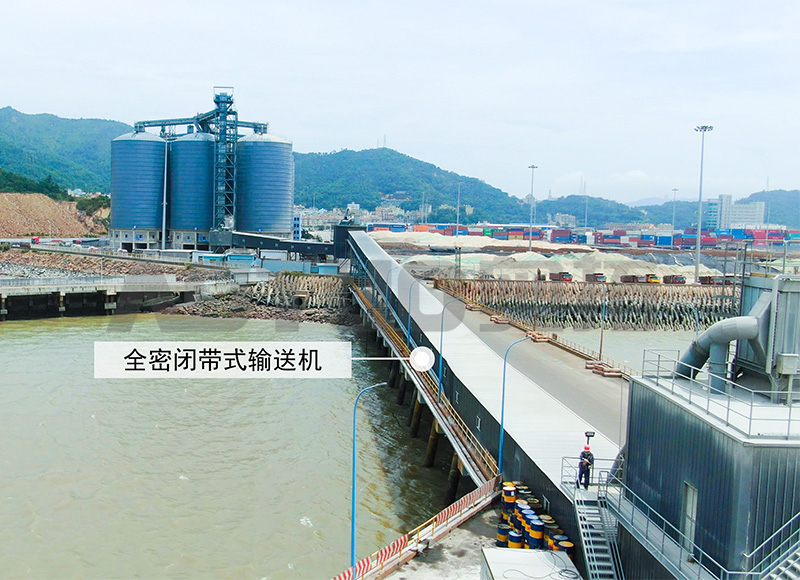 Belt Conveyor for Loose and Finished MaterialsThis belt conveyor conveys powders, granules, and small block materials with capacities from 10 to 3000 t/h and bandwidths up to B2200. It is essential for modeling the entire supply chain from reclaim to ship hold, ensuring the loader’s speed is not bottlenecked by upstream equipment.View Product →
Operators who want to close the gap between rated and realized capacity should focus on speed and loading-trajectory optimization; our guide on bulk ship loader TPH efficiency optimization covers the main levers.
The vessel-size envelope, normally expressed in deadweight tonnage (DWT), is the performance requirement that determines boom reach, hatch coverage, and how far the loader must travel along the berth.
A loader's DWT envelope must cover the complete commercial vessel mix the terminal serves, from small coasters to cape-size bulkers. The table below maps common vessel classes to the loader characteristics they demand.
| Vessel class | DWT range | Typical loading rate | Loader requirement |
| Handysize | 15,000–35,000 | 300–800 t/h | 12–18 m boom reach, single hatch |
| Handymax | 35,000–50,000 | 500–1,200 t/h | Full hatch coverage, slewing boom |
| Panamax | 60,000–80,000 | 1,000–2,000 t/h | Rail travel along the berth |
| Capesize | 100,000+ | 2,000–4,000 t/h | High-lift boom, telescopic chute |
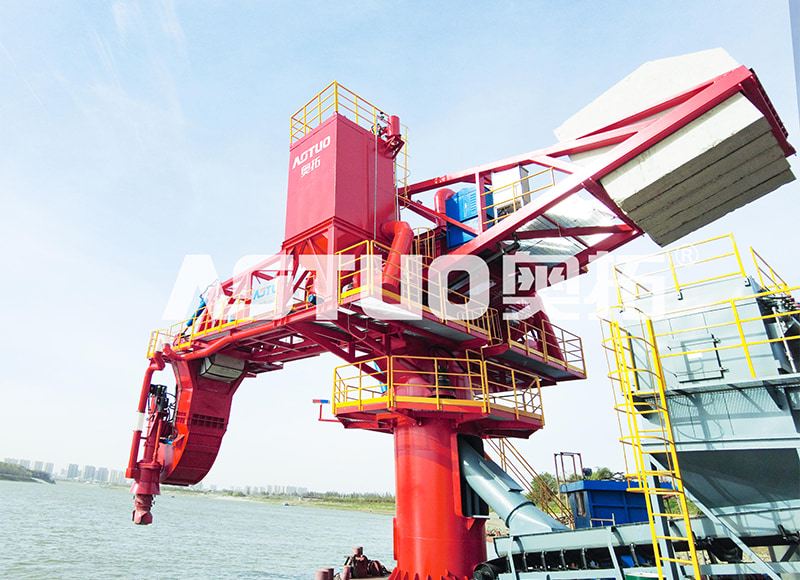
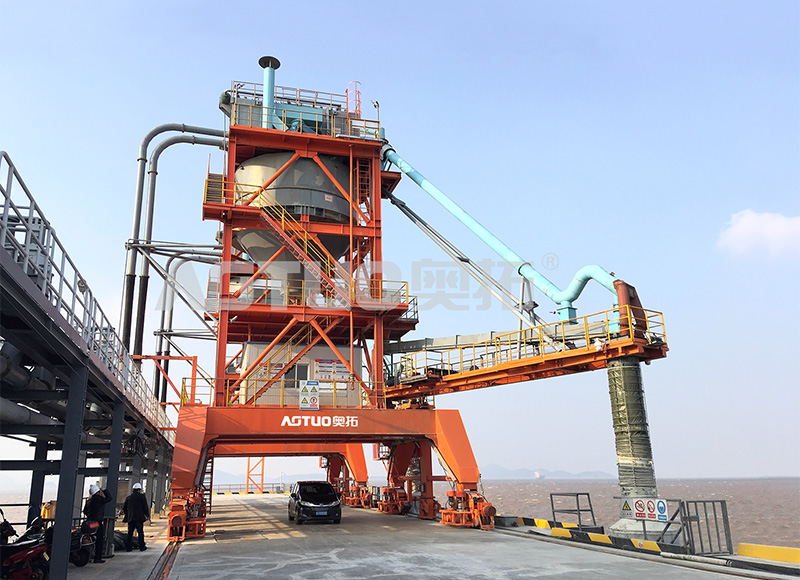 Rail Mobile Ship Loader for Bulk MaterialsThis rail mobile ship loader supports vessels from 800 to 50000 DWT with a capacity of 300-1500 t/h, suitable for cement and other bulk materials. Its low dust emission concentration of ≤10 mg/m³ addresses approval requirements, making it relevant when matching loader characteristics to commercial vessel classes.View Product →
Dust emission control is the performance requirement that increasingly dictates approvals, operating permits, and acceptance tests for bulk ship loader conveyors.
Regulators hold terminal operators accountable for visible dust and particulate emissions at the ship-hold opening. A loader that handles 1,500 t/h of coal or grain will generate measurable dust unless the loading spout, transfer points, and belt path are engineered as a sealed system.
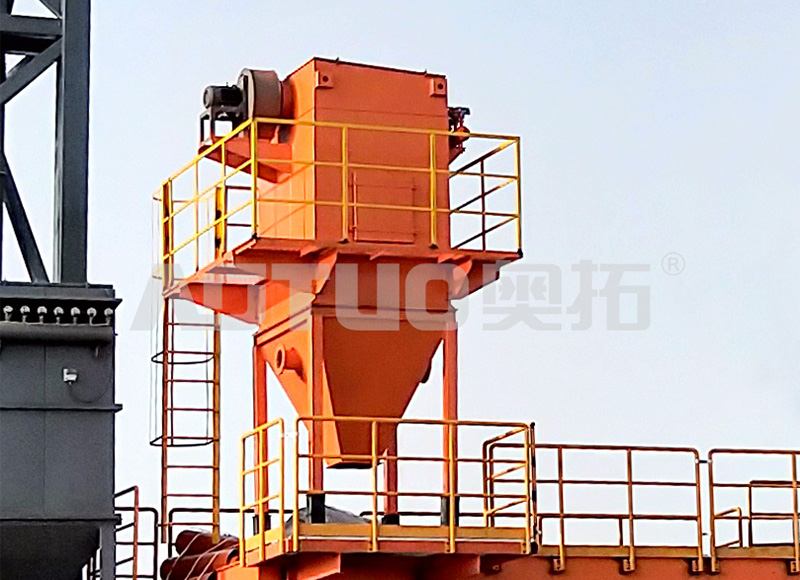 Pulse Bag-Type Dust Collector for Bulk HandlingThis pulse bag-type dust collector handles air volumes from 700 to 314000 m³/h with an export concentration of ≤10 mg/Nm³. It is designed to control dust at transfer points and loading spouts, supporting compliance with visible dust regulations at ship-hold openings.View Product →
For a detailed comparison of available suppression technologies, our reference on dust suppression technologies for modern bulk ship loaders covers the design trade-offs.
Automation is now a standard performance requirement for new bulk ship loader conveyors because it directly improves vessel turnaround time, loading accuracy, and operational safety.
Modern terminals expect the loader to run semi- or fully automatic loading sequences, especially for repetitive vessel classes. The control system integrates belt scales, positioning sensors, and operator supervision to keep hold filling uniform without manual intervention.
The material the conveyor must handle — coal, grain, cement, clinker, or aggregates — sets the belt specification, speed limit, and chute geometry more than any other selection factor.
Angle of repose is the steepest angle at which a material stays stable on a belt or in a pile. A low angle of repose, as with wet coal or smooth grain, means the belt must run flatter or the idler trough angle must rise to prevent spillage at full load.
For terminals handling more than one commodity, the conveyor must be specified for the most demanding material on the roster; the trade-off is usually a slight loss of efficiency on lighter ones.
Mechanical availability and predictable maintenance cost are performance requirements that dominate the economic result of a bulk ship loader conveyor over its working life.
Initial price covers a few years; operating cost runs for two decades. Belt replacement, idler life, drive maintenance, and the cost of unplanned downtime must be part of the specification's performance evaluation, not afterthoughts.
Typical port-class machines are rated from 300 t/h for small mobile loaders to 4,000 t/h and beyond for fixed terminal loaders. The required rate depends on vessel sizes, the berth window, and the capacity of the reclaim and feeding system upstream.
A rail-mobile ship loader commonly covers Handysize to Panamax vessels, roughly 15,000 to 80,000 DWT, with some designs extending to 100,000 DWT. The limit is set by boom reach, luffing height, and rail travel distance.
Telescopic loading chutes keep the drop height short, dust collectors extract air at transfer points, and water-spray or dry-collection systems capture airborne particles. Emission performance must be verified at rated capacity during acceptance testing.
Daily inspections cover belt tracking, chute wear, and dust-collector performance; weekly checks include idler condition and drive temperature; major belt replacement typically falls in a 5 to 8 year window depending on the material and running hours.
It is focused on the overall solution of dry bulk material port transfer system,
research and development, manufacturing, and service
Copyright © Hangzhou Aotuo Mechanical and Electrical Co., Ltd. All Rights Reserved.
Custom Material Conveyor Transfer Systems Manufacturers