Article Directory
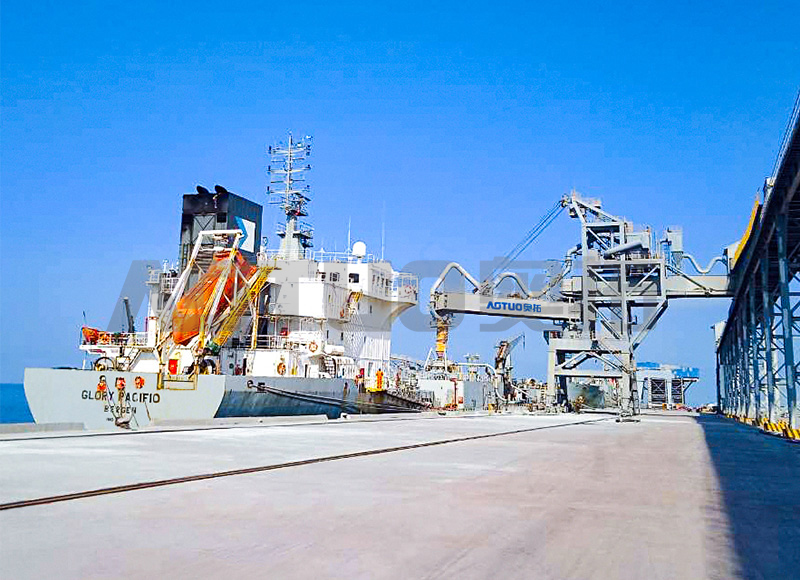
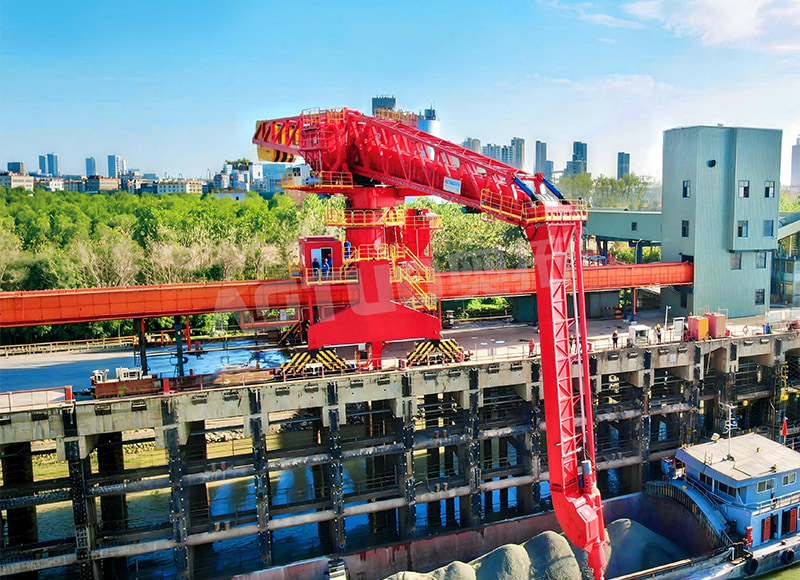
A grain ship loader is a purpose-engineered bulk materials handling machine that transfers wheat, corn, soybeans, barley, rice, or other dry grain commodities from a port terminal's conveyor infrastructure directly into the cargo holds of ocean-going or coastal grain vessels at rates that can exceed 2,500 tonnes per hour. It is the final link in the grain export supply chain — converting a continuous land-side conveyor flow into a controlled, dustless, and precisely distributed ship-hold loading operation that must satisfy strict phytosanitary, food safety, and environmental requirements that do not apply to coal or ore loading systems.
The fundamental loading machine architecture — a travelling gantry, a slewing and luffing boom, and a telescoping loading chute — is common across bulk commodity types. But grain loading imposes a distinct set of engineering, food safety, and environmental constraints that make a grain ship loader a specialist machine, not a reconfigured coal loader:
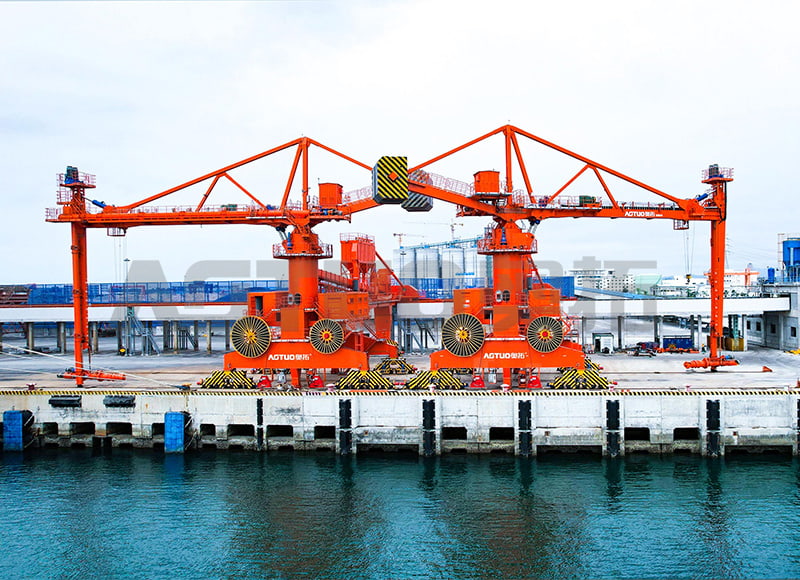
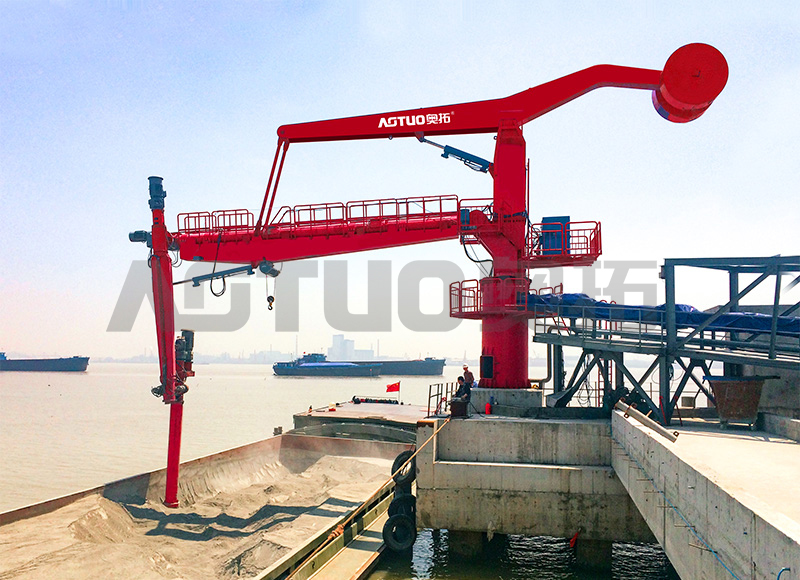
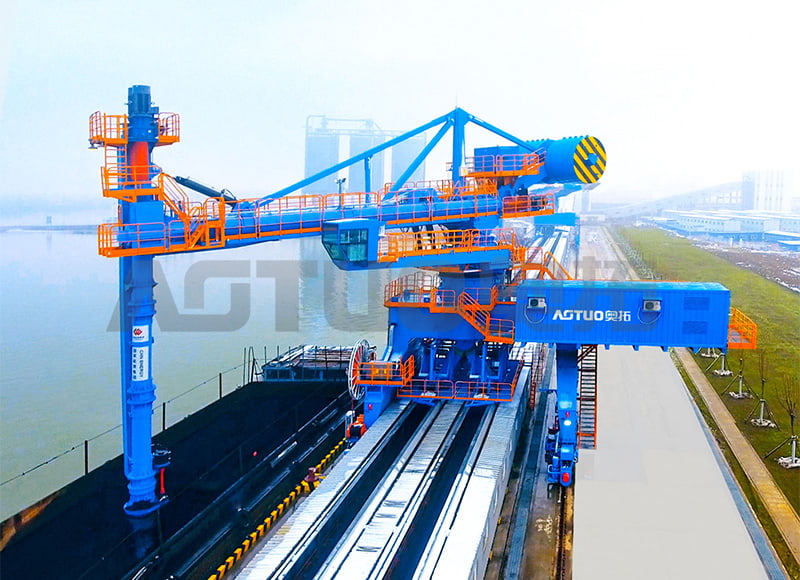
Understanding the function of each major subassembly enables informed specification, maintenance planning, and fault diagnosis. A standard rail-mounted slewing grain ship loader consists of the following principal components:
| Component | Function | Grain-Specific Feature | Maintenance Interval |
|---|---|---|---|
| Travel bogies and rail drive | Machine travel along quay to align with vessel hatches | Storm clamps and anchor bolts — grain terminals operate in coastal wind environments | Rail inspection annually; wheel flange every 5,000 operating hours |
| Portal gantry structure | Supports boom, conveyor, and chute; straddles quay conveyor | Full enclosure panels on conveyor runs; bird netting at all openings | Structural inspection every 5 years; repaint every 10–15 years |
| Slewing ring and drive | Rotates boom ±90° or ±120° to cover full hatch width | Sealed for grain dust ingress prevention; grease purge system | Grease purge monthly; ring gear inspection annually |
| Luffing boom and conveyor | Adjustable-angle arm carries enclosed belt conveyor to chute | Fully enclosed belt — no open grain sections exposed to atmosphere | Belt inspection monthly; idler replacement as required |
| Telescoping spout (chute) | Extends into hold to minimise free-fall and dust generation | Integrated dust sock / skirt at spout tip; inner liner of UHMWPE or SS | Liner inspection and replacement every 2–3 seasons |
| Dust extraction system | Maintains negative pressure inside enclosures; filters grain dust | Bag filter or cyclone at boom tip and transfer points; ATEX-rated fans | Filter bag inspection weekly; replacement per differential pressure reading |
| Control and automation system | Operates machine functions, monitors throughput, logs data | Belt weigher integration for real-time draft survey correlation | Software update annually; sensor calibration per season |
Loading a Panamax grain vessel carrying 65,000 tonnes of wheat involves a precisely sequenced operation that takes 24–36 hours at a loading rate of 1,800–2,500 t/h. Each phase of the operation has specific requirements that the ship loader must support:
Sizing a grain ship loader requires matching the machine's rated capacity to the terminal's annual throughput target, the vessel size range to be served, and the operational availability that the terminal can realistically achieve given seasonal loading patterns and vessel arrival schedules.
| Terminal Scale | Annual Export Volume | Loader Capacity | Max Vessel Size | Loading Time (per vessel) |
|---|---|---|---|---|
| Small river / coastal | 0.3–1.0 Mt/year | 500–1,000 t/h | Handysize (up to 35,000 DWT) | 20–40 hours |
| Mid-scale regional port | 1.0–5.0 Mt/year | 1,000–1,800 t/h | Supramax (up to 60,000 DWT) | 24–48 hours |
| Major export terminal | 5.0–15.0 Mt/year | 1,800–2,500 t/h | Panamax (up to 75,000 DWT) | 28–38 hours |
| Deep-water bulk grain port | 15.0–40.0 Mt/year | 2,500–4,000 t/h | Post-Panamax (up to 120,000 DWT) | 30–45 hours |
A practical capacity calculation illustrates the sizing process: a terminal targeting 3.5 million tonnes per year with 300 operating days and 20 effective loading hours per day requires a sustained throughput of 583 t/h at 100% utilisation. Accounting for vessel changeover time, weather delays, and maintenance windows at approximately 35% total downtime, the required rated machine capacity is 583 / 0.65 = 897 t/h — rounding to a standard machine class of 1,000 t/h. A second machine may be preferable to a single larger machine where vessel arrival bunching causes demand peaks that a single loader cannot absorb.
Grain dust management at ship loading operations is both a food safety requirement and an occupational health and explosion risk management obligation. The engineering approach to dust control on a grain ship loader is fundamentally different from the water spray suppression used on coal or mineral loaders, because water contamination of grain cargo is unacceptable.
Specifying a grain ship loader for a new terminal requires translating the commercial loading programme into a machine performance specification, then validating that the selected machine architecture meets all applicable food safety, structural, and environmental standards. The critical specification parameters:
It is focused on the overall solution of dry bulk material port transfer system,
research and development, manufacturing, and service
Copyright © Hangzhou Aotuo Mechanical and Electrical Co., Ltd. All Rights Reserved. Custom Material Conveyor Transfer Systems Manufacturers