EN
EN English
 中文简体
中文简体 Français
Industry News
Home / News / Industry News / Ship Loader Chute Design: Key Factors for Controlled Material Discharge

Article Directory
Ship loader chute design controls the trajectory, velocity, and dust profile of the material as it travels from the conveyor to the cargo hold. Three outputs matter most in practice. First, trajectory accuracy keeps material in the center of the hold and prevents overflow at the hatch wings. Second, velocity management protects the material from breakage and the hold structure from impact damage. Third, dust suppression prevents airborne particles from escaping the chute, which is critical for environmental compliance at coastal ports.
A well-designed chute does not merely guide material downward. It converts the horizontal momentum from the head pulley into a controlled vertical stream that fills the hold uniformly. A poorly designed chute creates a fan of material at the discharge point, which increases spillage, dust, and the need for manual cleanup in the hold. At high throughput rates, the difference between a well-designed chute and a poorly designed one becomes visible within the first few minutes of loading.
The angle of repose, particle size distribution, and moisture content of the cargo dictate the chute's slope, width, and lining material. Cement, for example, is a fine powder with a high angle of repose and a strong tendency to generate dust. A ship loader chute for cement therefore needs a steep slope, a narrow discharge opening, and a hard chrome or ceramic lining that resists abrasion.
Grain behaves differently. It is free-flowing, low in friction, and sensitive to breakage. A grain chute uses a gentler slope, a stainless steel lining to prevent contamination, and a wide, low-velocity discharge lip that minimizes grain damage. Clinker and coal sit between these extremes. Clinker is abrasive and irregular, so it needs a heavy-duty manganese steel lining and an impact cushion at the first bend. Coal varies more in moisture and particle size, which means the chute must accommodate a wider range of discharge conditions.
Moisture content deserves special attention. A material that is dry and dusty behaves differently from the same material when it is wet. A chute designed for dry cement may clog or bridge when the cargo has higher moisture. Therefore, the design must include the expected moisture range, not just the average condition.
| Material | Angle of Repose | Recommended Chute Slope | Lining Material |
| Cement | 35 degrees | 70 degrees from horizontal | Hard chrome or ceramic |
| Clinker | 33 degrees | 72 degrees | Manganese steel |
| Coal | 38 degrees | 62 degrees | Rubber or PU |
| Grain | 25 degrees | 50 degrees | Stainless steel |
Calculating material trajectory at every chute setting is the only reliable way to prevent spillage at high discharge rates. Because horizontal throw is directly proportional to belt speed, a 25 percent increase in belt speed at the head pulley moves the landing point 25 percent further away. That is why chute designers must lock down the belt speed before drawing the first line of the chute.
At 3,000 t/h, the head pulley belt speed is typically in the 3.5 to 4.5 m/s range. A small error in trajectory prediction becomes a large error at the landing point. That is why careful designers use discrete element modeling (DEM) to simulate material behavior, not just ballistics equations. DEM accounts for particle-particle interaction, which produces more realistic trajectory predictions for cohesive materials such as cement and clinker.
An adjustable chute provides better control over material spread and dust generation than a fixed chute, but it carries a higher capital cost and more moving parts to maintain. A fixed chute is a single, rigid geometry welded to the ship loader. It is simple and durable, but its trajectory is correct for only one material and one discharge rate. If the terminal handles multiple materials or variable cargo sizes, a fixed chute quickly becomes the weak link.
An adjustable chute uses a telescoping or articulating segment that the operator can position based on the material level in the hold. This keeps the discharge point closer to the cargo surface, which reduces free fall, material breakage, and dust generation. For terminals that switch between grain, coal, and clinker, an adjustable chute is often the more economical choice over the life of the equipment, despite the higher initial cost.
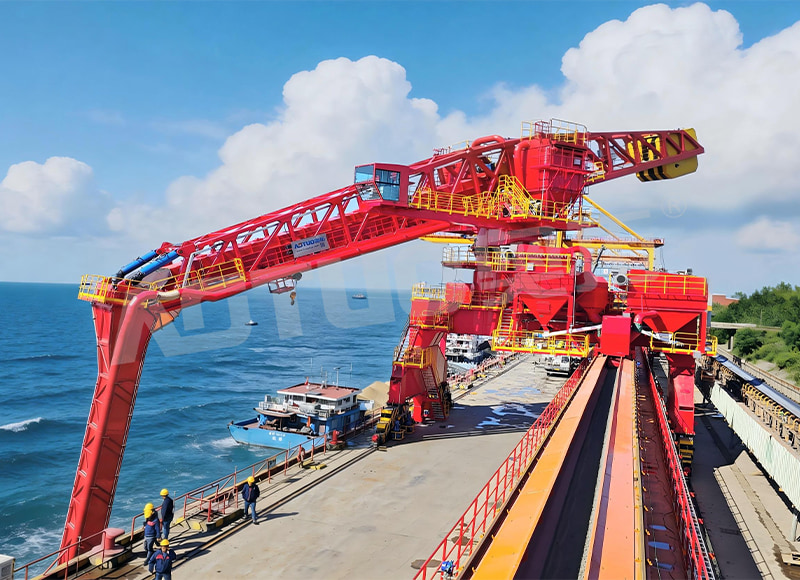
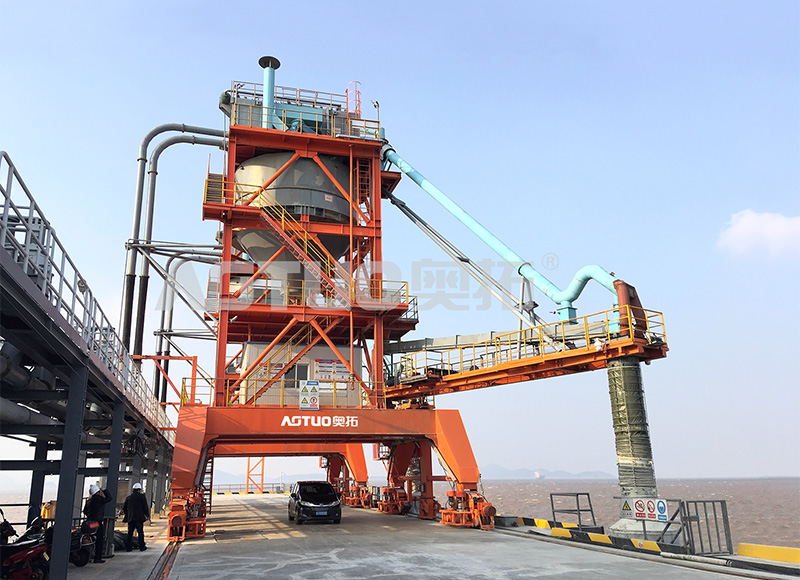 Adjustable Rail Mobile Ship Loader for Bulk MaterialsThis rail mobile ship loader handles 300-1500 t/h and fits 800-50000 DWT vessels. Its adjustable chute reduces free fall and dust, making it economical for varying material types.View Product →
Dust suppression must be engineered into the chute geometry because retrofitting after installation costs more and achieves less with abrasive materials. As material moves through the chute, it accelerates and entrains air. At the discharge point, that air expands rapidly and carries fine particles into the atmosphere. A chute that is designed only to move material will always produce dust.
Modern chute designs tackle this with three techniques. First, a baffle system slows the material before it reaches the discharge lip. Second, a flexible curtain seals the discharge zone to contain dust. Third, an adjustable discharge lip keeps the material compact and minimizes the free-fall distance. These techniques work together to keep airborne particles inside the chute and out of the air.
The result is a measurable reduction in dust emissions. For terminals near residential areas or under strict environmental permits, this can be the difference between operating and being forced to stop. Ports that have adopted these designs report lower environmental compliance costs and fewer complaints from surrounding communities.
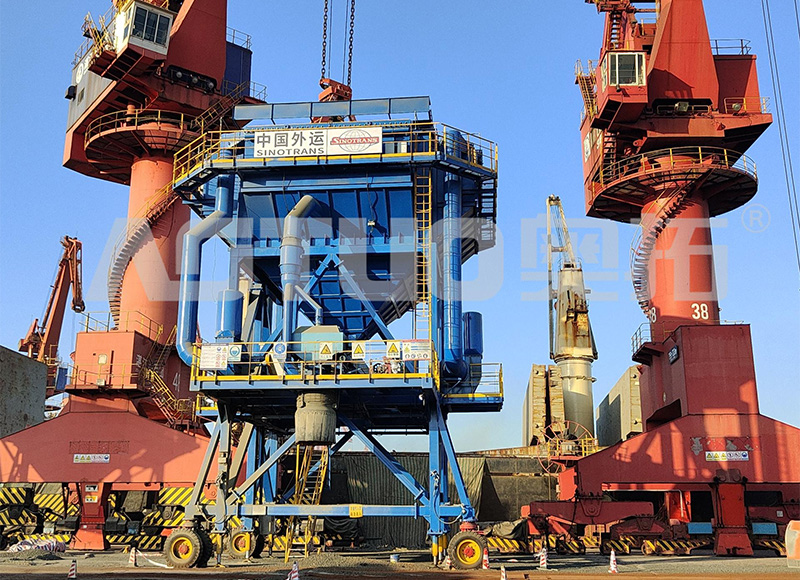 Tire Mobile Dust Suppression Hopper LoaderThis tire mobile hopper loader offers 200-800 t/h capacity with integrated dust suppression. It is designed for strict environmental areas and is validated through DEM simulation and testing.View Product →
Verification begins with DEM simulation, continues through factory testing, and ends with a coordinated commissioning run at the berth. Before fabrication, the designer models the full material stream in simulation software. This confirms the trajectory, checks for dead zones, and verifies that the chute can handle the full range of discharge rates.
After fabrication, the chute is installed and tested at the factory. Operators run material through the chute at operational rates and check the landing point, dust levels, and flow consistency. Any adjustment is made on the chute before it is shipped. At the site, the commissioning run confirms the chute performance in actual port conditions. A well-documented commissioning protocol with observable metrics should be part of the project contract. Terminals that skip this step often discover trajectory errors after the vessel is already at the berth.
Hangzhou Aotuo Mechanical and Electrical Co., Ltd. combines twenty years of dry bulk handling experience with a disciplined design-to-commissioning process. A real-world example is the project at Brisbane Port in Australia. The company's approach is documented on its about page.
The most important factor is matching the chute geometry to the cargo's material properties and the ship loader's discharge rate. The chute must direct material to the hold center-line, maintain a consistent flow, and suppress dust at the same time.
The angle of repose, particle size, and moisture content determine the chute's slope, lining material, and dust control strategy. Cement needs a steep slope and ceramic lining, clinker needs heavy manganese steel, and grain needs stainless steel to protect product quality.
Yes, but retrofit success depends on the existing head pulley position and belt speed. In most cases, a new chute can be designed and installed during a scheduled maintenance window.
An adjustable chute lets the operator control the discharge angle based on the material surface level. By keeping the discharge point close to the cargo, it reduces free fall, which directly reduces fragmentation, dust, and spillage.
It is focused on the overall solution of dry bulk material port transfer system,
research and development, manufacturing, and service
Copyright © Hangzhou Aotuo Mechanical and Electrical Co., Ltd. All Rights Reserved.
Custom Material Conveyor Transfer Systems Manufacturers