EN
 English
 中文简体
 Français

Industry News
Home / News / Industry News / Ship Loader Conveyor Capacity: Key Specs & Ratings for Bulk Material Handling

Article Directory
Ship loader conveyor capacity determines how quickly a bulk carrier can be turned around at the berth. A 75,000 DWT cement carrier loaded at 1,500 t/h occupies the berth for roughly 50 hours of effective conveying time, while a 600 t/h loader keeps the same vessel at the wharf for about 125 hours. Terminal engineers evaluating new equipment need the full specification picture, not just the headline tonne-per-hour figure, before committing to a loader design.
Rated capacity in tonnes per hour (t/h) describes the theoretical maximum mass flow a ship loader can sustain under defined material conditions, and it is always the starting point of a specification sheet.
Rated values assume free-flowing material at a reference bulk density. Cement at 1.25 t/m3 behaves differently from clinker at 1.35 t/m3 or wheat at 0.75 t/m3. The same volumetric flow rate produces different mass throughput figures for each material, which is why a loader rating built for cement does not directly transfer to a grain application.
Effective capacity equals rated capacity multiplied by equipment availability and utilisation factor. A 2,000 t/h loader operating 28 hours per week at 85 percent availability and 75 percent utilisation delivers roughly 35,700 tonnes of effective weekly throughput.
Achievable throughput also depends on hatch sequencing, boom slewing time, feed arrangement from the stockpile, and operator skill. These operational variables commonly reduce effective performance to between 65 and 85 percent of the rated figure.
Four parameters define ship loader conveyor capacity on every technical data sheet, and each one directly influences berth productivity and terminal economics.
| Parameter | Typical range | Operational impact |
| Rated throughput | 500-3,000 t/h | Controls berth occupancy and ship turnaround time |
| Belt speed | 1.5-4.0 m/s | Raises volumetric flow while increasing dust and wear |
| Belt width | 800-2,000 mm | Allows larger lumps and stabilises material flow |
| Vessel class | Up to 200,000 DWT | Determines boom reach, slewing range, and freeboard clearance |
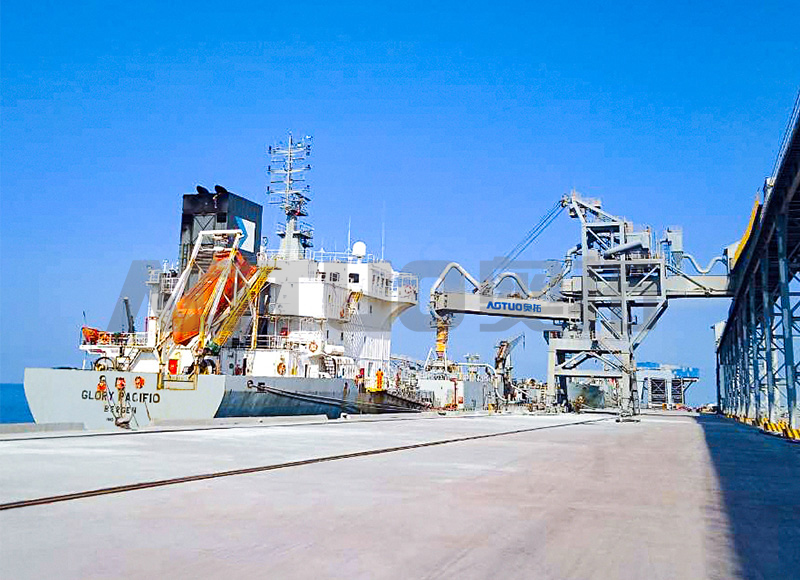
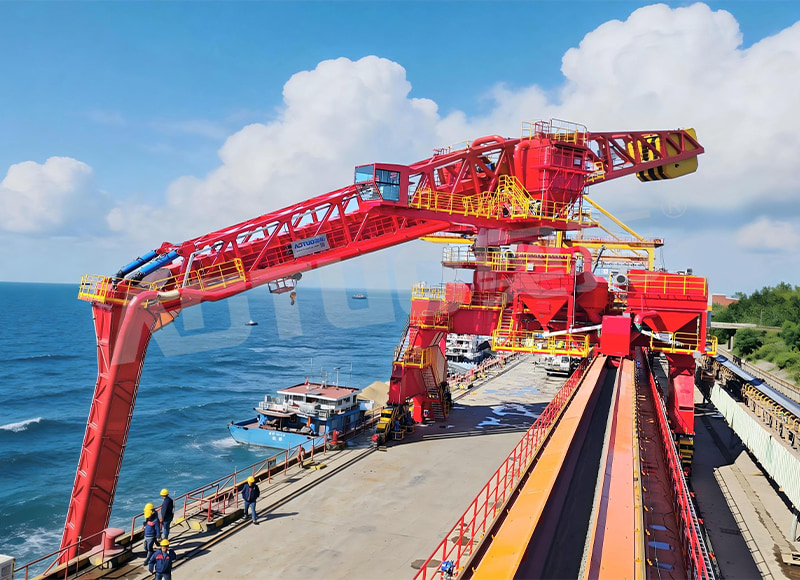
 Rail-Mobile Ship Loader for Bulk Materials, 300–1500 t/hThis rail-travelling ship loader combines the travelling mechanism, boom conveyor, and loading chute for rated capacities suited to 800–50,000 DWT bulk carriers, making it a direct fit for berth productivity planning.View Product →
On the Hangzhou Aotuo Mechanical and Electrical Co., Ltd. (AOTUO) product line, the rail-mobile ship loader integrates the travelling mechanism, boom conveyor, and loading chute into a single machine, giving terminal operators a rated capacity matched to modern bulk carrier fleets.
The real mass flow a ship loader conveyor can deliver is a direct product of belt speed, belt width, and the bulk density of the material being conveyed.
Here, Q is the rated capacity in t/h, A is the loaded cross-sectional area of material on the belt in square metres, v is the belt speed in m/s, and bulk density is the material density in t/m3. A loader rated for cement at 1.25 t/m3 will deliver roughly 20 percent lower mass throughput when handling grain at 1.0 t/m3, unless belt speed or the loaded cross-section is adjusted.
The angle of repose and lump size also affect the practical cross-section. Free-flowing cement forms a stable profile that fills the belt evenly, whereas clinker with coarse, irregular lumps requires a wider belt and a slower speed to prevent spillage at transfer points and chute transitions.
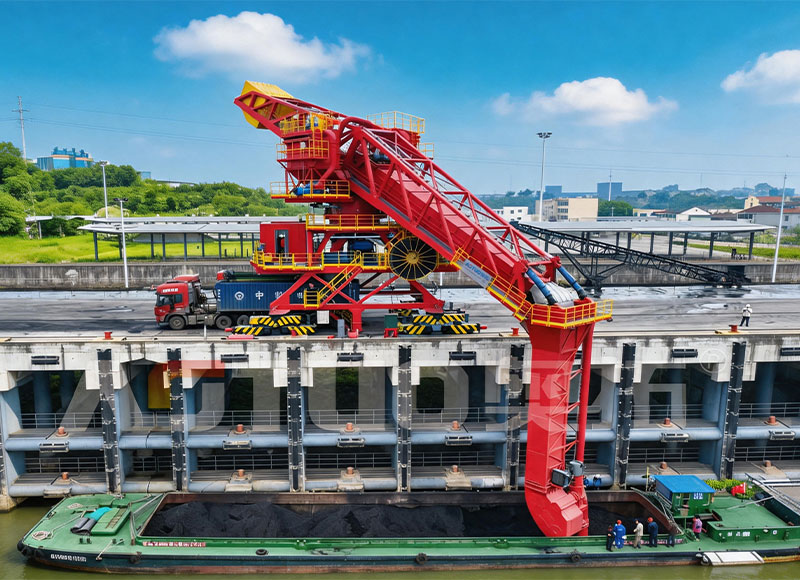
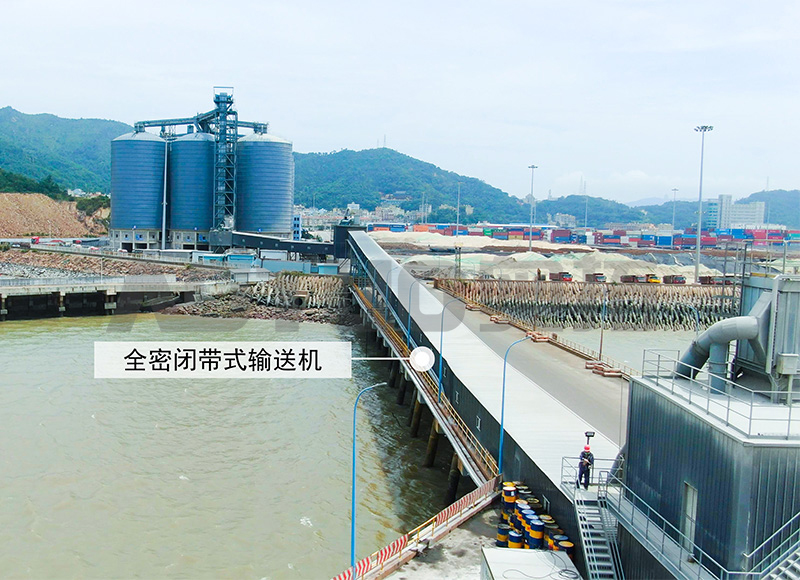 Belt Conveyor for Loose and Finished Bulk MaterialsWith capacities from 10 to 3000 t/h and belt widths from B400 to B2200, this conveyor addresses the belt speed and width trade-offs that matter when handling powders, granules, or lumpy clinker without spillage.View Product →
Terminal engineers can compare the full drive and belt configuration options in the bulk ship loader TPH efficiency optimization guide on this site, which covers the practical trade-offs between speed, width, and duty cycle.
The nominal capacity of a ship loader is only meaningful if the machine can physically reach the hatches of the target vessel and cover the full freeboard range across all loading conditions.
A loader sized for 200,000 DWT capesize vessels needs a substantially longer boom and a wider slewing arc than a unit designed for 30,000-50,000 DWT handy-size or supramax carriers. Hatch dimensions matter just as much: wide hatches permit continuous loading across the full opening, while narrow hatches force frequent boom repositioning and cut effective throughput by 10 to 20 percent.
Case references from AOTUO installations at the Port of Brisbane show that capacity specifications are validated in real harbour conditions, not only on the drawing board.
Typical maximum rated capacities vary by loader architecture, and the comparison below provides a quick reference for shortlisting equipment classes.
Selection rule: choose the loader class with the lowest fixed and operating cost that still satisfies the largest vessel in the fleet plan. Oversizing raises boom weight, drive power, and maintenance spend; undersizing creates demurrage exposure and caps future terminal growth.
High-capacity loading without effective dust control is not operationally viable under modern port emission limits, so capacity specifications must be evaluated together with the loading chute and transfer-point dust management system.
Enclosed loading spouts, telescopic chutes, and dust collection at transfer points allow a loader to sustain its rated throughput while keeping fugitive emissions within local regulatory thresholds. Terminal projects in jurisdictions with strict air quality rules increasingly make dust suppression a contract requirement rather than an optional extra.
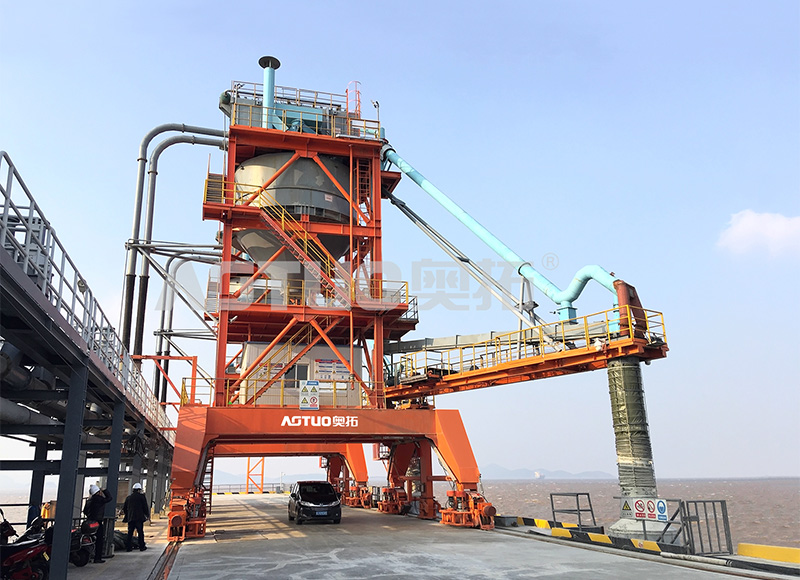
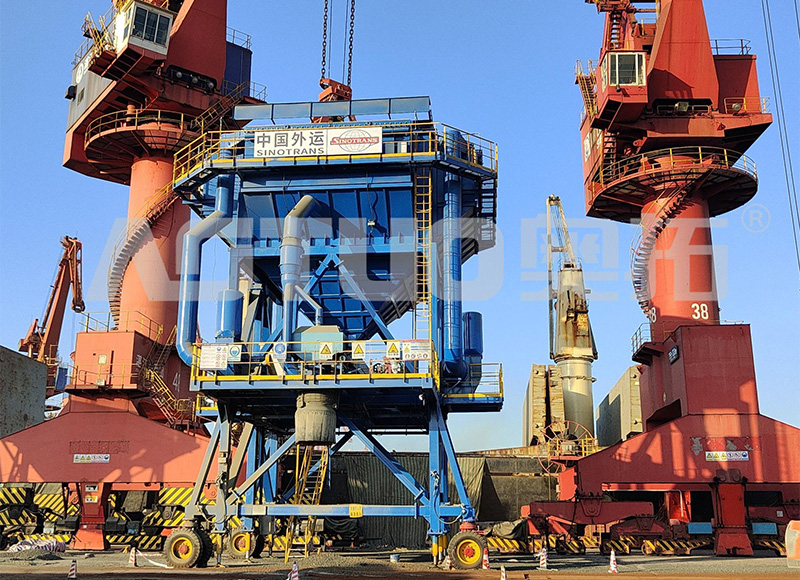 Tire-Mobile Dust Suppression Hopper Loader, 200–800 t/hEngineered for dusty dry bulk transfer, this mobile hopper loader includes high-volume funnel air and wind-resistant features, supporting strict dust control requirements while maintaining 200–800 t/h throughput at the terminal.View Product →
The AOTUO tire-mobile dust suppression hopper loader is one example of equipment engineered specifically to handle dusty bulk materials during transfer and loading operations with controlled dust output.
Environmental note: a loader that cannot maintain its rated capacity without violating dust limits has a lower effective capacity in practice, regardless of what the nameplate states. Specify the dust control envelope together with the tonnage rating.
A medium-sized import cement terminal handling 50,000-80,000 DWT vessels typically installs a loader rated at 1,000-1,600 t/h. Larger export terminals serving 100,000+ DWT carriers commonly specify 2,000-3,000 t/h to keep berth time and demurrage within budget.
Rated capacity is specified at a reference bulk density. When the same volumetric flow is used for a lighter material, the mass throughput falls proportionally. A 2,000 t/h loader rated for cement at 1.25 t/m3 will only move roughly 1,600 t/h of grain at 1.0 t/m3 unless belt speed or loading cross-section is increased.
Yes. Conveyor capacity is directly proportional to belt speed at a constant cross-sectional load. Raising belt speed from 2.5 m/s to 3.5 m/s increases volumetric flow by 40 percent, but it also increases drive power demand, belt wear, and dust generation, which is why speed selection always balances capacity against operating cost.
The boom reach, freeboard range, and slewing limits of the loader define the maximum vessel. A 200,000 DWT capability covers capesize vessels, while a 50,000 DWT design is sufficient for handysize and supramax fleets. Terminal owners should design for the largest vessel in the long-term fleet plan, not only the current call pattern.
Bottom line: specify ship loader capacity against the largest vessel, the densest material, and the strictest dust limit at the berth. Those three constraints define the machine you need.
It is focused on the overall solution of dry bulk material port transfer system,
research and development, manufacturing, and service
Copyright © Hangzhou Aotuo Mechanical and Electrical Co., Ltd. All Rights Reserved.
Custom Material Conveyor Transfer Systems Manufacturers