EN
EN English
 中文简体
中文简体 Français
Industry News
Home / News / Industry News / The Coal Ship Loader Boom: Key Structural Requirements for Vessel Loading

Article Directory
The boom of a coal ship loader determines whether a 100,000 DWT vessel loads in 36 hours or burns through a 60-hour berth window. When the boom cannot reach the far hatch, cannot survive the fatigue of a high-duty cycle, or leaks dust along the transfer path, the terminal absorbs the cost in delays and maintenance. Hangzhou Aotuo Mechanical and Electrical Co., Ltd. (AOTUO), a manufacturer of dry bulk port machinery with more than 20 years of R&D and production experience, evaluates every loader against five requirement groups: reach, stiffness, strength, articulation, and environmental sealing.
Benchmark: modern coal terminal booms operate at loading capacities up to 3,000 t/h and must cover the hatch plan of vessels up to 200,000 DWT.
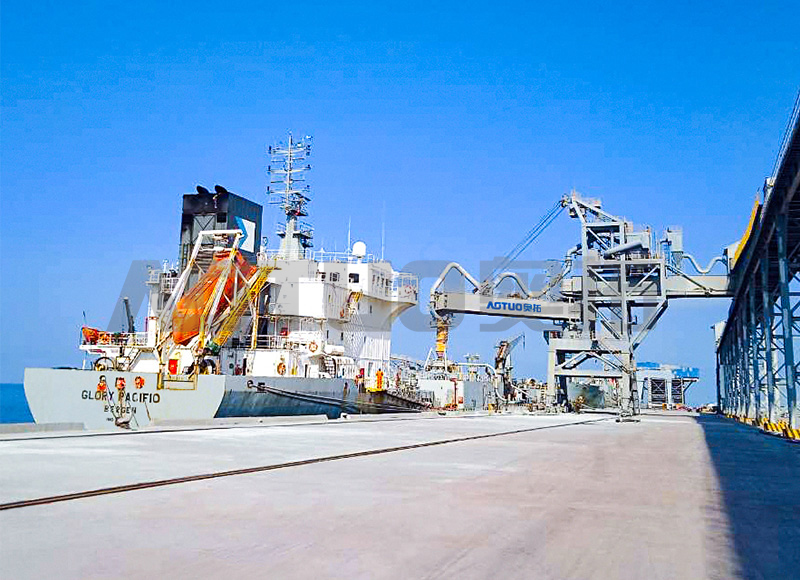
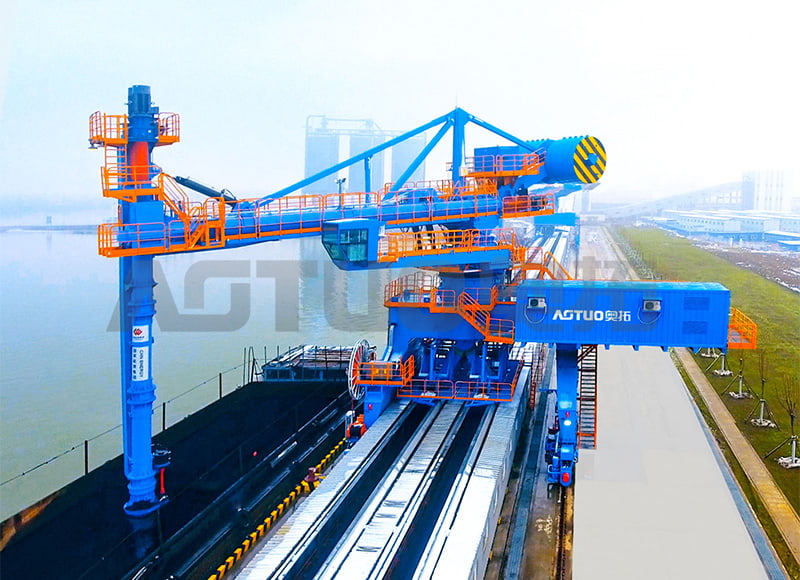
A coal ship loader boom is the cantilevered conveyor structure that projects over the vessel hatch and delivers coal from the quay conveyor into the hold.
The boom is a live conveyor with a trim chute at the tip, not an inert beam. The belt runs inside it, the chute hangs at its end, and the articulation system moves the assembly between hatches. Coal is abrasive and heavy at roughly 800 to 950 kg/m3 in loose condition, so the structure manages both dynamic loading and erosion.
Definition: the boom envelope is the three-dimensional working volume of the discharge point after combining slewing, luffing, and telescoping travel. The envelope must cover every trimming position required by the design vessel's hatch layout.
Boom reach is the first structural requirement to fix because it sets the loader's travel positions along the berth and the number of moves per hatch.
Reach must cover the far hatch of the largest design vessel, including ship beam, freeboard, and hatch coaming height. A short boom forces extra travel; an overlong boom adds deadweight and bending moment that the slewing ring and gantry carry for the machine's life.
Values are typical planning ranges; final reach is set by the vessel fleet and berth geometry.
Reach rule: fix boom length against the largest design vessel, then verify trim coverage at the near hatch. The near side is where chute angle, not boom length, becomes the limiting factor.
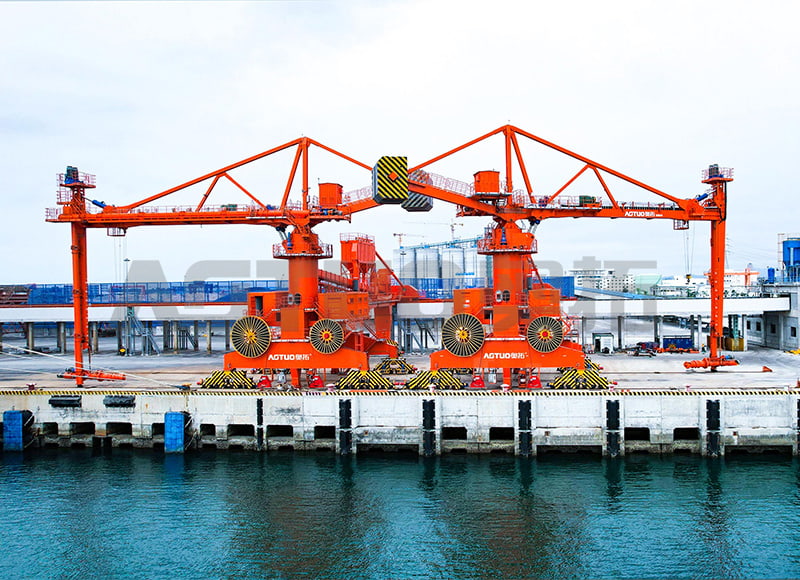
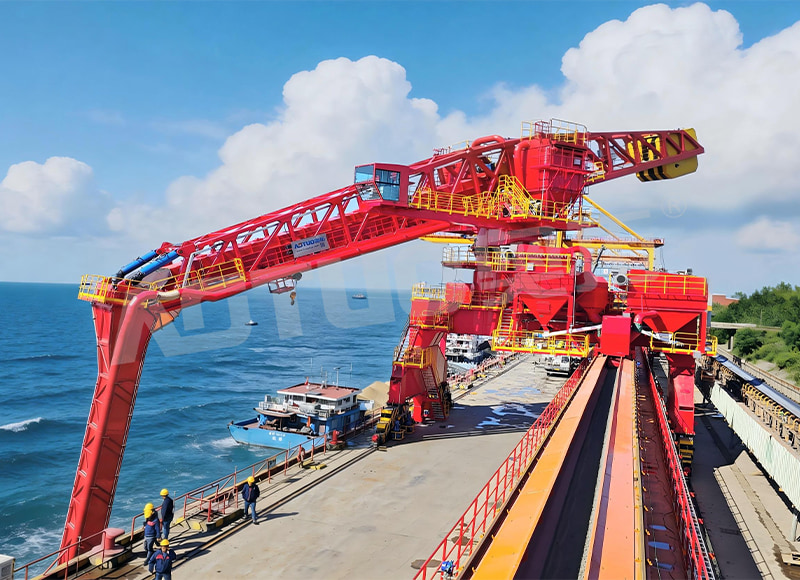
 Rail Mobile Ship Loader for Bulk Materials, 300-1500 t/hThis rail-mounted loader suits vessels from 800 to 50,000 DWT, with low energy use and dust control. Its boom design directly addresses the fatigue and reach concerns raised in the adjacent discussion.View Product →
Fatigue dominates the structural design of a coal ship loader boom; the static weight of a full belt is rarely the governing case.
Every belt start and stop, luffing cycle, and slew reversal sends a load pulse through the boom. Over a 20-year life this can total millions of cycles, so welded joints and plate thickness determine actual longevity. High-strength steel such as Q355B is common, but the critical details are the fatigue categories at the boom root and luffing cylinder brackets.
Coastal coal terminals add a second constraint: corrosion. A boom on a marine berth loses section thickness every year unless the paint system, drainage, and inspection access are specified for salt exposure. A 1 mm loss on a primary flange can reduce fatigue life by more than 20 percent.
Boom geometry follows the conveyor; structural engineers and the conveyor supplier must resolve deflection tolerances together.
The belt must keep its troughing profile along an inclined, articulated structure. Boom deflection changes belt tension and tracking, so stiffness limits are often set by conveyor alignment rather than stress. Typical coal ship loader belts run at 2.5 to 4.5 m/s with capacities from 1,000 to 3,000 t/h.
| Capacity range | Belt width | Belt speed | Trough angle | Chute arrangement |
| 1,000 to 1,500 t/h | 1,200 to 1,400 mm | 2.5 to 3.2 m/s | 35 to 45 degrees | Telescopic trim chute |
| 1,500 to 2,500 t/h | 1,400 to 1,600 mm | 3.2 to 4.0 m/s | 35 to 45 degrees | Trim chute with dust skirt |
| 2,500 to 3,000 t/h | 1,600 to 1,800 mm | 3.5 to 4.5 m/s | 45 to 55 degrees | Trim chute with skirt and spray ring |
Design rule: the boom must be stiff enough to keep belt tracking within tolerance when the luffing angle changes. Every degree of inclination shifts the load line over the idlers, so the structural deflection limit must match the conveyor manufacturer's alignment specification.
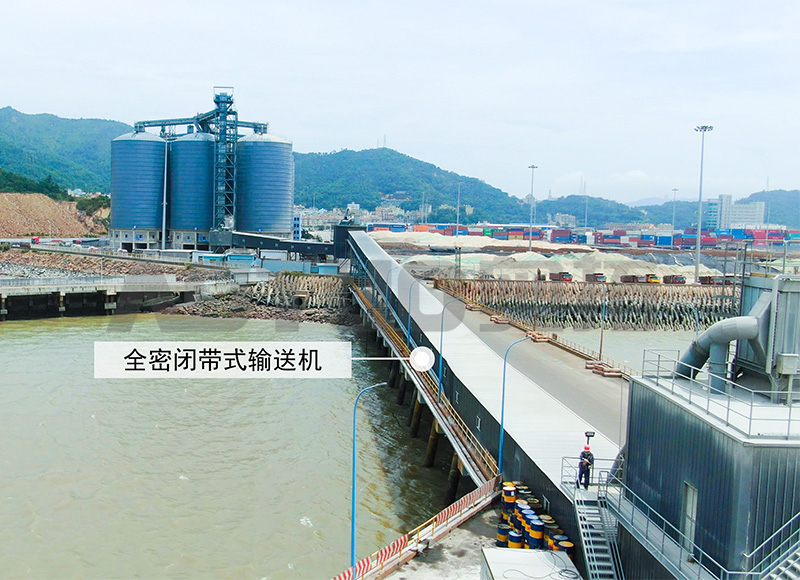 Belt Conveyor for Loose and Finished Bulk MaterialsWith capacities up to 3,000 t/h and bandwidths from B400 to B2200, this conveyor supports the articulated boom system. It aligns with the structural deflection and belt tracking requirements noted nearby.View Product →
The articulation system turns one fixed conveyor line into a boom that can place coal into every corner of every hold.
Rail-mounted ship loaders typically combine three motions above the gantry, and the boom structure must be detailed for each one without compromising the others.
Failure point to inspect first: the luffing cylinder brackets and slewing ring bolt circle carry the full boom moment. On any loader, these connections are more likely to develop cracks than the main boom members because they concentrate the highest stresses.
The boom is also an environmental enclosure; every opening that lets coal dust escape can put a terminal over its particulate emissions permit.
Dust control combines enclosure, extraction, and suppression. The belt is covered along the entire boom, the chute telescopes down close to the coal surface, and a dust collector or water spray ring captures fines at the transfer point. Wind loading complicates the structural case because a fully enclosed boom presents a large sail area; the design must separate the operating wind limit from the storm parking condition.
Practical operating datum: many coal terminals set the boom operating wind limit at 20 m/s, roughly force 8, and the storm parking limit at 45 to 55 m/s. The structure must survive the parking case with the boom stowed and the parking brake engaged.
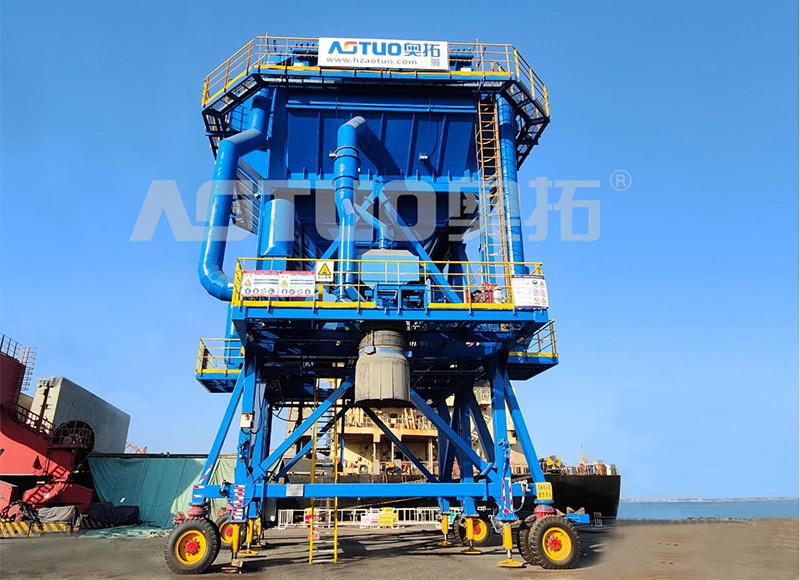
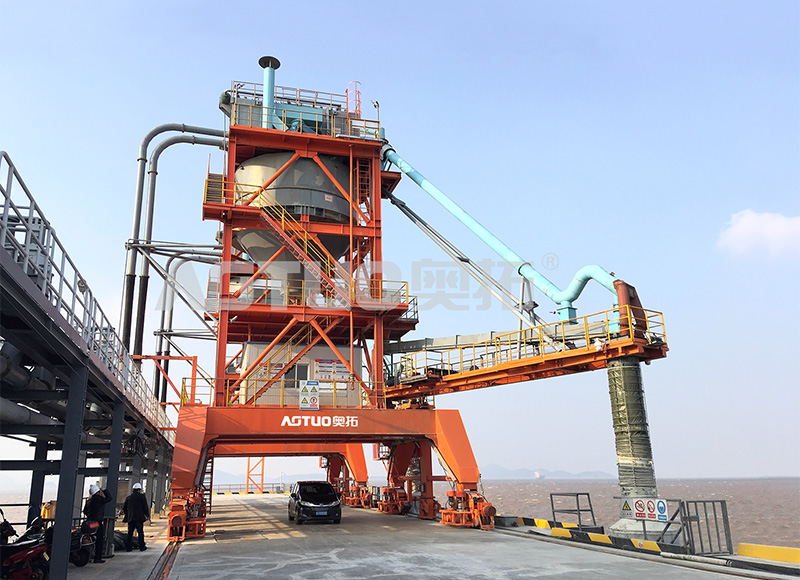
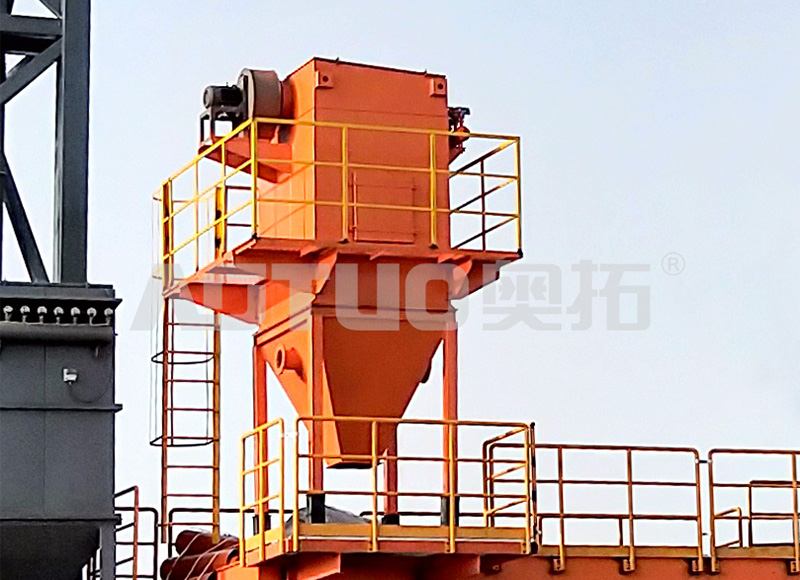 Pulse Jet Bag Dust Collector for Port Dust RemovalThis dust collector handles large air volumes and filters fine particles to low emission levels. It complements the loader and conveyor system, meeting the environmental limits implied by the operational wind and parking scenarios.View Product →
No boom specification is complete until it is checked against the actual vessel fleet, berth layout, and projected throughput.
Terminal owners should compare the candidate loader's boom envelope with the hatch plans of the vessels that will call regularly, including future fleet changes. A project such as the Huizhou Port bulk handling project shows how site conditions shape the final boom specification.
AOTUO reference data: 20 years in dry bulk handling equipment, more than 100 patents and software copyrights, unloading capacity up to 3,000 t/h, and equipment delivered to ports in Australia, Singapore, the Philippines, Vietnam, Indonesia, and Bangladesh.
For a broader comparison of specification choices, the coal ship loader capacity and dust control guide covers the same design decisions from an operational angle.
Three questions dominate every boom specification review: reach, fatigue life, and dust compliance.
For a 200,000 DWT bulk carrier, the discharge point typically needs to reach 38 to 42 m from the machine centerline. For 60,000 DWT vessels, 24 to 28 m is usually sufficient, depending on beam and hatch layout.
High-strength structural steel such as Q355B or equivalent is common. The controlling factor is the fatigue category of welded details at the boom root and cylinder brackets, not the base material grade alone.
The boom uses fully enclosed belt covers, a telescopic trim chute with a dust skirt, integrated dust collection ducting, and a water spray ring at the transfer point. Each element is designed to contain fines at the source.
Excessive deflection disturbs belt tracking and changes the idler troughing angle, causing spillage and belt damage. The structural deflection limit is therefore set by the conveyor alignment tolerance rather than by the stress limit alone.
It is focused on the overall solution of dry bulk material port transfer system,
research and development, manufacturing, and service
Copyright © Hangzhou Aotuo Mechanical and Electrical Co., Ltd. All Rights Reserved.
Custom Material Conveyor Transfer Systems Manufacturers