EN
EN English
 中文简体
中文简体 Français
Industry News
Home / News / Industry News / Grain Ship Loader Problems: Common Faults, Causes, and Practical Fixes

Article Directory
A 55,000 DWT bulk carrier alongside a grain terminal usually has a berth window of 36 hours or less to receive a full cargo of feed corn or wheat. If the grain ship loader's spout jams, the dust emission alarm trips, or the hold profile becomes uneven, that window starts to collapse. In two decades of building and servicing dry bulk port equipment, we have seen the same failure modes repeat across terminals—and nearly all of them are avoidable. This article explains the common problems with grain ship loaders, why they happen, and the engineering and maintenance solutions that keep a loading shift on schedule.
The failure modes below account for most unplanned downtime on grain ship loaders. The table summarizes the typical symptom and first-line solution for each.
| Problem | Typical symptom | Practical solution |
|---|---|---|
| Dust emissions | Dust alarms at the spout; visible dust plume over the hatch | Spout-head extraction; correctly sized dust collector; minimal drop height |
| Grain breakage | Rising fines and broken kernels in hold samples | Telescopic spout with pile-level sensing; internal flow retarders |
| Blockages | Spout or transfer chute stops; bridging at openings | Steep chute angles; smooth liners; access doors; line-clearing procedures |
| Corrosion | Surface rust and pitting on steelwork, fasteners and cabinets | Marine-grade coating system; stainless or galvanized fixings; annual inspection |
| Spout positioning errors | Spillage on deck; uneven hold profile; re-trimming delays | Automated positioning; ultrasonic pile-level control; coordinated boom motion |
| Component wear | Belt damage, overheated bearings, hydraulic leaks | Scheduled thermal checks; critical spare parts; routine lubrication |
| Electrical faults | Sensor failures, trips, cable faults | IP65-enclosed controls; industrial connectors; PLC diagnostics |
Each failure mode has a clear root cause, and the sections below explain what triggers each one and which solutions work best in practice.
Grain dust is generated at every transfer point and at the point where grain enters the hold. The free fall from an extended spout creates a steady stream of entrained dust, and inside a partially enclosed ship hold the concentration can rise quickly. Grain dust is a combustible dust: under test conditions such as ASTM E1226, wheat and corn dust typically produce a Kst of 100–200 bar·m/s, high enough to support an explosive event when an ignition source is present.
Emission limits around the world are tightening. Terminals face permit conditions on visible dust and particulate monitoring, and an explosive atmosphere in the hold puts both personnel and the vessel at risk. Every dust-related stoppage extends berth occupancy and raises the cost per ton loaded.
The solution is to capture dust where it is created. The loading spout should be fitted with an extraction hood, and the loader's internal transfer points should route dust to a collection system sized for the actual throughput of the machine. In our design work, we integrate a correctly sized dust collector into the whole system rather than treating it as an afterthought, because collection performance depends on duct routing, fan capacity and filter area. Differential pressure checks and regular filter maintenance keep the extraction rate stable across the season.
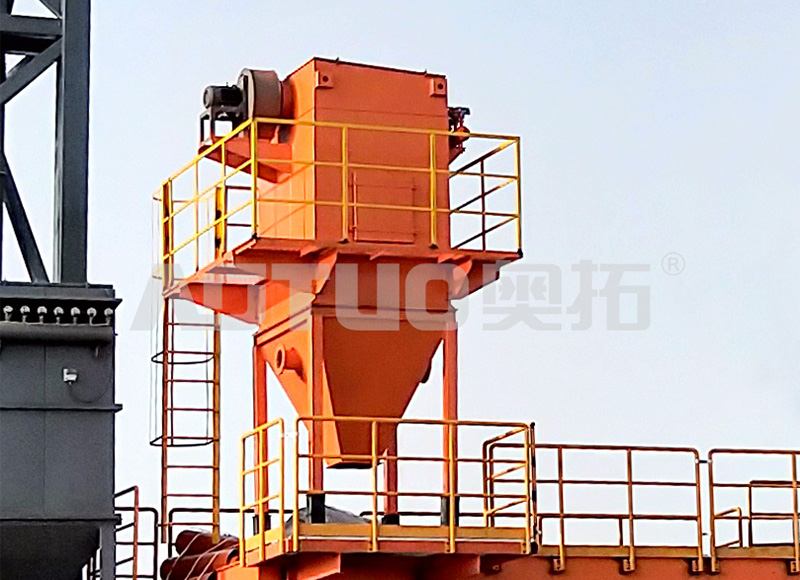 Custom Industrial Bag Dust Collector Manufacturers, SuppliersHangzhou Aotuo Mechanical and Electrical Co., Ltd. Is China Custom Industrial Bag Dust Collector Manufacturers, Suppliers, Offer Custom I...View Product →
When grain falls through a long spout and strikes the hold floor or an existing pile, kernels fracture. Breakage is most visible during the first stage of loading a hatch, when the drop distance is at its maximum. Every broken kernel adds to the dust load described above, so the two problems compound each other.
Buyers of malting barley, milling wheat and food-grade soybeans are strict about damaged kernels. A rise in fines of just 1–2% on a 60,000 t cargo means up to 1,200 t of product that may be discounted, rejected, or redirected to a lower-value market.
The answer is to control drop height and impact velocity. Telescopic spouts should keep the outlet within 1.5–2.0 m of the grain surface, with automatic level sensing so the height stays correct as the pile rises. Internal baffles or flow retarders slow the grain inside the spout, and the feed belt speed should be matched to the spout's maximum gentle-flow rate. This is one area where a modern automated loader pays for itself quickly, because manual operation cannot maintain that precision through a 24-hour shift.
The grain arriving at the loader is rarely clean and uniformly dry. New-crop corn and soybeans with moisture above 15%, grain loaded during rain or fog, and cargoes containing strings, plastic film or coarse vegetable matter can bridge or jam at the spout outlet, hopper transitions and belt transfer points.
A jammed spout is not a quick stop. Clearing it can interrupt a loading shift for 1–3 hours while a crew reaches the chute, removes the material, and restarts the machine. When a vessel costs tens of thousands of dollars per day, every hour of blockage is a direct demurrage charge.
Prevention starts with chute geometry. Transfer surfaces should be steep—at least 60° for clean grain—and lined with smooth, wear-resistant material that keeps its profile over time. Access doors at transition points allow crews to clear foreign material quickly. Loading procedures should include emptying the spout at the end of each hatch and when switching grain types. Understanding the capacity and operating principles of grain ship loaders helps terminal teams build these steps into their standard operating procedures.
A grain loader sits on the berth, exposed to salt-laden wind, spray, and humidity for its entire working life. Carbon steel structures show surface rust and pitting within 12–18 months when the coating specification was chosen for an inland site rather than a marine site. Fasteners, cable trays, hydraulic fittings, spout cylinders and electrical enclosures fail first.
Corrosion reduces the effective section thickness of structural members and accelerates fatigue. By the time a routine 10-year inspection reveals the loss, remedial strengthening or component replacement may be necessary—either way, it costs months of planning and significant capital.
The economical answer is a marine-grade coating system from the start: zinc-rich epoxy primer with a polyurethane topcoat is a proven combination for loaders. Use hot-dip galvanized or stainless steel for fasteners, ladders, handrails and cable trays. Schedule annual inspections that include dry film thickness measurement, coating adhesion checks, and spot measurement of member thickness in areas exposed to standing water.
The loader must position the spout accurately over each hatch, follow the ship's movement with the tide, and distribute grain evenly inside the hold. In practice, operators work with poor sightlines, wind deflects the spout, and the vessel drifts on its moorings. The result is spillage around the hatch, uneven heaps, and lost time spent re-trimming.
Uneven trim is a safety issue for the vessel and can delay sailing. Grain spilled on the deck creates slip hazards and attracts pests, a serious issue at terminals with strict quarantine rules. When the grain pile peaks too early, the operator must slow the loading rate or bring in additional trimming equipment to finish the hatch.
Automated positioning removes most of this uncertainty. Position sensors on the boom and slew/luff drives tell the controller exactly where the spout is relative to the hatch, and an ultrasonic sensor at the spout outlet holds a constant distance to the grain surface. On our rail mobile ship loader, the travel along the wharf, boom slewing and telescopic spout extension are coordinated so each hatch receives its planned tonnage with minimal operator input. The same control system records loading data for the end-of-shift report.
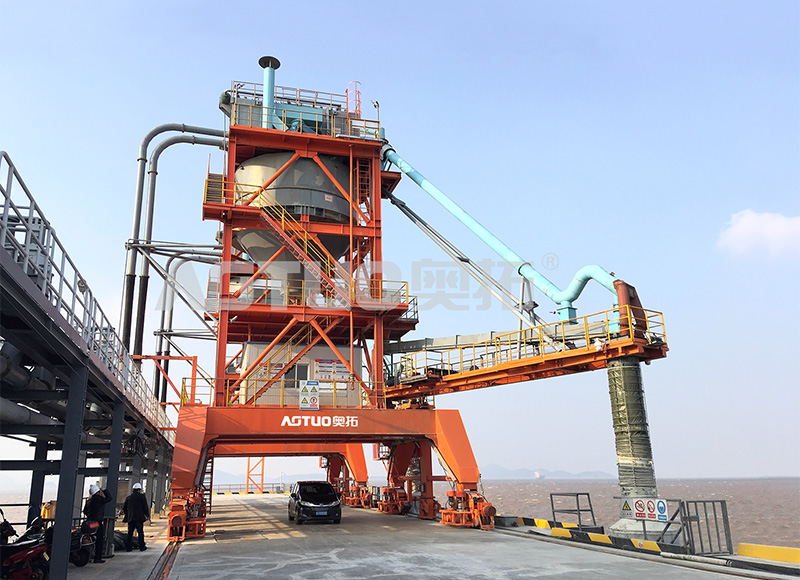 Custom 300-1500t/h 800-50000DWT Rail Mobile Ship Loader For Loading Bulk MateriaCustom 300-1500t/h 800-50000DWT Rail Mobile Ship Loader For Loading Bulk Materials, Hangzhou Aotuo Mechanical and Electrical Co., Ltd. is...View Product →
A loading operation runs for hours without stopping, which puts continuous stress on belts, idlers, bearings and hydraulic systems. Abrasive grain dust accelerates wear on belt edges and idler seals. A 1,000 t/h loader running without interruption moves 24,000 t per day; a minor belt misalignment that would take a month to show in an indoor conveyor appears in days at the berth. Wear-related failures are the biggest source of unplanned downtime, and the most practical countermeasure is a disciplined routine: weekly thermal checks of bearings and gearboxes, belt tracking checks, spout liner thickness measurement, and a stock of spare belts, idlers, hoses and seals.
Vibration, salt fog and cables that flex with every boom movement make electrical faults the second most common cause of loader stoppages. Limit switches and sensors degrade, and a fault hidden inside a cable reel can take hours to trace. Terminals that specify IP65-rated enclosures, industrial-grade connectors, and control systems with descriptive diagnostics typically restore service in minutes instead of hours. The ship loader maintenance strategies guide covers the inspection and repair routines that keep both mechanical and electrical downtime under control.
Many grain loader problems seen during operation were actually set at the procurement stage. When a loader is selected only on capacity and price, future operating costs tend to come as a surprise. We recommend checking the following points when comparing offers:
Terminals that address these points avoid most of the failure modes described above. If your terminal also imports grain, the same principles apply on the unloading side, where the grain ship unloader range we build shares the same approach to dust containment and low-impact handling.
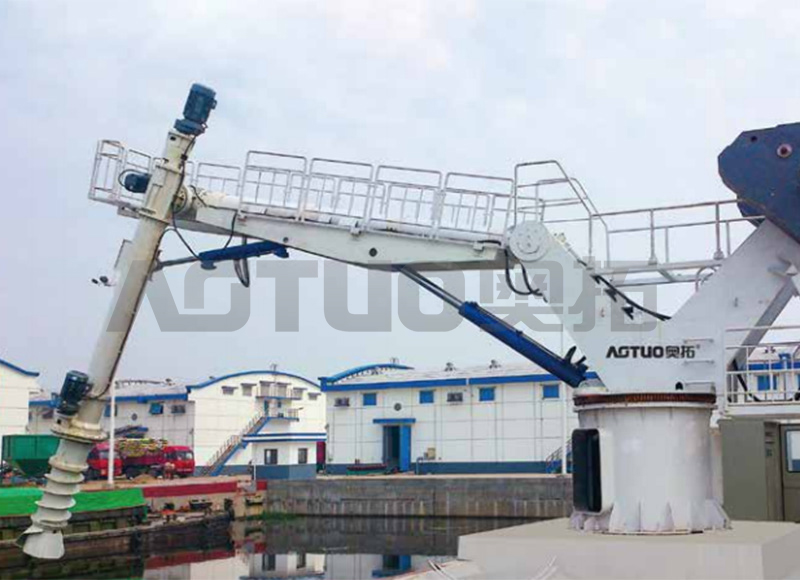 Custom Grain Ship Unloader Manufacturers, SuppliersCustom Grain Ship Unloader, Hangzhou Aotuo Mechanical and Electrical Co., Ltd. is China Grain Ship Unloader Manufacturers and Suppliers, ...View Product →
A grain ship loader is a long-term investment. The difference between a strong season and a disrupted one rarely comes down to the nameplate capacity of the machine; it comes down to whether the loader keeps running without jams, dust events and breakdowns. You can review our port project case studies to see how these machines perform in real terminals, and our engineers are available to review your terminal's loading requirements.
It is focused on the overall solution of dry bulk material port transfer system,
research and development, manufacturing, and service
Copyright © Hangzhou Aotuo Mechanical and Electrical Co., Ltd. All Rights Reserved.
Custom Material Conveyor Transfer Systems Manufacturers