EN
 English
 中文简体
 Français

Industry News
Home / News / Industry News / Coal Ship Loader Conveyor: Key Performance Requirements Every Port Must Verify

Article Directory
A coal ship loader conveyor that operates 10 percent below its rated capacity adds roughly one working shift to every Cape-size vessel stay. On a terminal moving 6 million tonnes of coal per year, that gap means about 1.2 million tonnes of unused load-out capacity annually, before demurrage is even calculated. Key performance requirements exist to close this gap between the nameplate figure and what the belt actually delivers on the berth.
Hangzhou AOTUO Mechanical and Electrical Co., Ltd. (AOTUO), a national high-tech enterprise with more than 20 years of dry bulk port machinery experience, treats a coal loader conveyor not as a single belt but as a system: stockyard feed, transfer points, belt line, shuttle boom, and dust control working together. The performance requirements below are the parameters a port must verify during specification, factory acceptance, and commissioning.
Performance requirements for a coal loader conveyor start with a single measurable outcome: loading a defined parcel of coal into a defined vessel within a defined time window, at a defined dust emission level, with acceptable belt and component life.
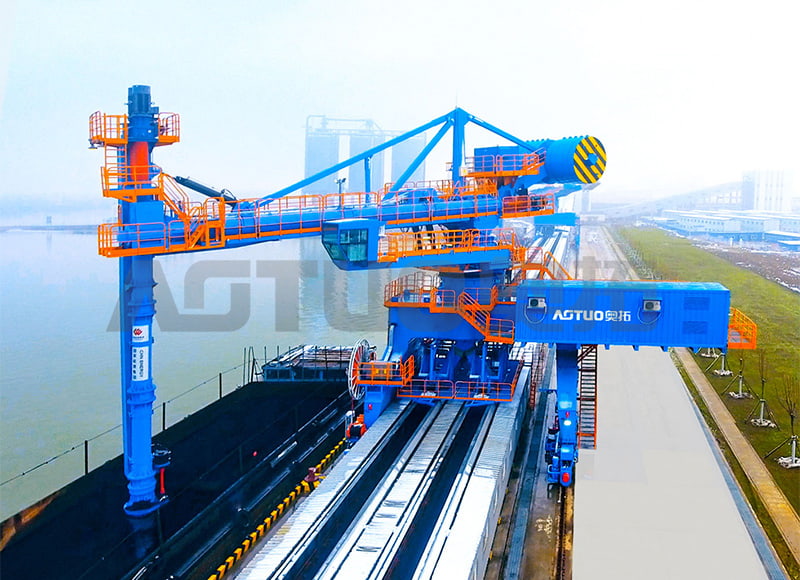
A coal ship loader conveyor is the continuous transport line that carries coal from the stockyard, reclaim tunnel, or receiving hopper to the ship loader boom, where a shuttle or telescopic chute distributes the material into the vessel hatches.
Six requirement categories must be fixed before equipment selection begins:
Each category interacts with the others. Raising belt speed to chase capacity increases dust generation and belt wear; widening the belt keeps speed moderate but changes chute and trestle geometry. The coal ship loader capacity and dust control guide published by AOTUO covers this trade-off in detail.
Continuous rated capacity is the master requirement, because it determines vessel turnaround time and therefore demurrage exposure.
A practical sizing method uses the largest regular vessel class in the terminal's forecast fleet, the target loading window, and an expected availability factor. Required capacity is parcel size divided by the product of window hours and availability. For a Panamax coal parcel of 65,000 tonnes loaded in 28 hours at 90 percent availability, the conveyor needs at least 2,400 t/h of continuous rating.
| Vessel class | Typical coal parcel (t) | Recommended rating (t/h) | Loading window (h) |
| Handysize 25,000 DWT | 15,000-22,000 | 800-1,200 | 14-20 |
| Handymax 45,000 DWT | 30,000-40,000 | 1,200-1,800 | 20-26 |
| Panamax 80,000 DWT | 55,000-70,000 | 1,800-2,500 | 26-30 |
| Capesize 180,000 DWT | 120,000-160,000 | 2,500-3,500 | 40-48 |
Surge is the killer. The conveyor drive must hold 110 percent of rated capacity for at least 30 minutes without tripping, spilling, or losing belt tracking.
Continuous rating by vessel class, upper end of the recommended range.
Surge capacity matters as much as the average rating because coal reclaims in bursts. When a portal scraper or bucket-wheel reclaimer feeds the belt, the conveyor must absorb sudden flow increases without plugging the chutes.
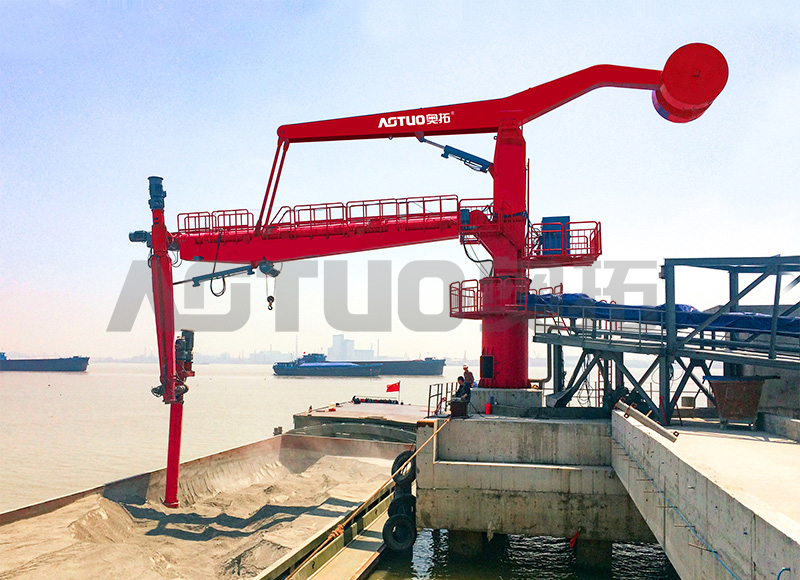
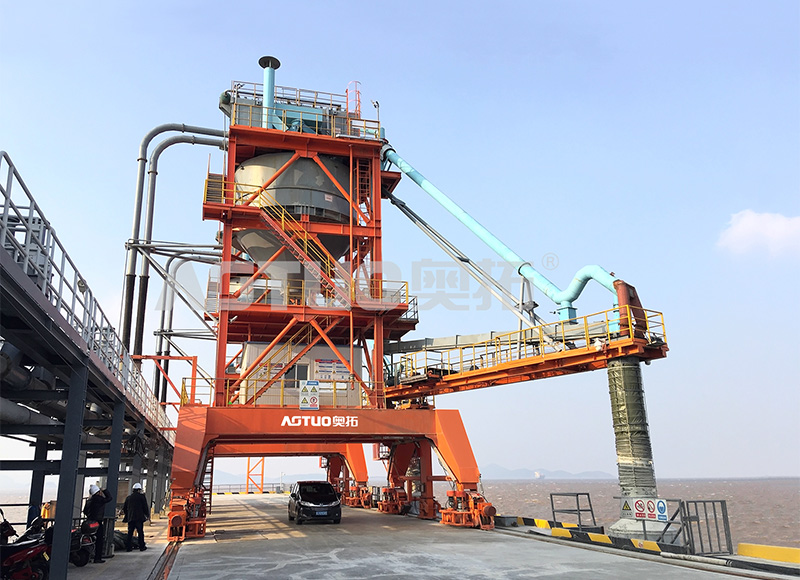 Rail Mobile Ship Loader for Bulk Materials, 300-1500 t/h, 800-50000 DWTThis rail-mounted loader is designed to handle surge flow peaks common in coal reclaim operations, with a capacity range of 300 to 1500 t/h and suitability for ships of 800 to 50000 DWT. Its performance is validated in projects like the Brisbane port bulk handling.View Product →
AOTUO designs its rail mobile ship loader around these surge profiles rather than steady-state laboratory ratings, an approach validated in projects such as the Brisbane port bulk handling project.
Belt speed is a trade-off, not a target. For coal loading conveyors, the practical range is 2.5 to 4.5 m/s, with the lower end reserved for high-moisture or high-fines coal and the upper end for screened, dry coal.
Wider belts allow lower speed for the same capacity, which reduces dust entrainment, idler wear, and spillage at transfer points. A 1,600 mm belt running at 3.5 m/s can carry roughly 2,500 t/h of coal at 1.1 t/m3 density. A 1,200 mm belt needs about 4.5 m/s for the same flow. The choice changes chute angles, skirt geometry, and the entire trestle structural load.
Lower steelwork cost and smaller deck width, but higher dust generation, belt wear, and spillage risk. Best for short conveyors and pre-screened dry coal.
Higher first cost and wider transfer towers, but calmer material flow, lower dust loads, and longer belt life. Recommended for dusty thermal coal and high-moisture grades.
Loading envelope rule: keep belt speed below 4 m/s whenever fines content exceeds 15 percent.
Flow control depends equally on upstream equipment. Apron feeders and variable-speed reclaim drives must be interlocked with the belt scale so feed rate stays inside the conveyor's control band. Without this loop, a surge of 30 percent above rating causes chute plugging and tracking problems.
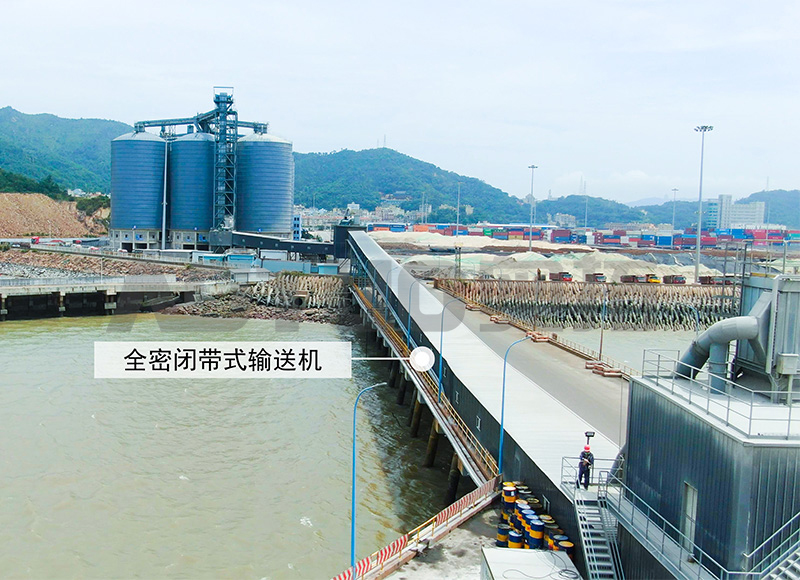 Belt Conveyor for Loose and Finished Materials, 10-3000 t/h, B400-B2200The belt conveyor complements upstream reclaim equipment by providing a wide conveying range (10-3000 t/h) and bandwidth options, supporting the interlocked feed control needed to keep surge rates within the conveyor's operational band and prevent plugging.View Product →
Dust control is now a legal requirement in almost every coal port jurisdiction, not an optional environmental extra.
Uncontrolled transfer points can contribute 50 to 70 percent of all visible fugitive dust on a coal handling line. The second major source is the ship loader boom, where coal falls into the hatch and fine particles are caught by the wind.
For a 2,500 t/h coal loader, every transfer point must be fully enclosed with wear-resistant liners, loaded belt skirts on both sides, and a dust collector extracting at least 3,000 m3/h of air per transfer point.
The performance requirements must be measurable:
Moisture is the cheapest dust suppressant, but too much water reduces handling efficiency and may trigger penalties from the receiver. Trim to 6 to 8 percent surface moisture for thermal coal, and rely on engineered enclosures plus extraction for the rest.
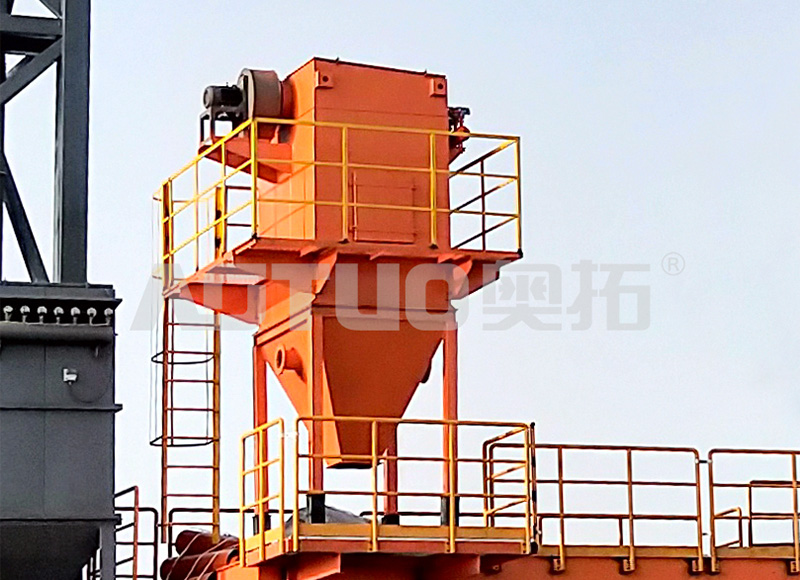 Pulse Jet Bag Dust Collector for Dust Removal, Air Volume 700-314000 m3/hThis pulse air-box bag dust collector achieves an export concentration of ≤10 mg/Nm3, making it suitable for the engineered enclosures and extraction systems recommended for managing dust from coal handling, especially when moisture control alone is insufficient.View Product →
Automation converts a good mechanical conveyor into a profitable one by holding load-out accuracy and protecting the belt from avoidable events.
Belt scales must hold +/- 0.5 percent accuracy through the full load range, checked against static weights at commissioning and recalibrated quarterly. The ship loader control system then trims each hatch according to the loading plan, so the vessel finishes on an even keel without manual survey corrections.
Reliability requirements should be written as availability, not as vague quality language. A realistic specification is 95 percent mechanical availability over a 12-month period, with mean time to restore below 4 hours for drive and control modules.
Availability above 95 percent is not a stretch target; it is the minimum accept level for a modern coal load-out conveyor.
| Requirement | Target value | Verification method |
| Continuous rated capacity | 2,500 t/h at design coal density | Weighed loaded trial, 8 hours |
| Surge capacity | 110 percent for 30 minutes | Controlled overfeed test |
| Belt speed range | 2.5-4.5 m/s | Drive pulley tachometer |
| Load-out accuracy | Within 0.5 percent | Belt scale calibration run |
| Fugitive dust at transfer points | Below 50 mg/m3 | Ambient dust monitoring |
| Mechanical availability | 95 percent over 12 months | Maintenance records audit |
Factory acceptance tests and site trials must reproduce the specified requirements under controlled conditions; nothing should be signed off on nameplate data alone.
Four hours continuous running to check belt tracking, idler alignment, and drive temperature rise.
Two consecutive hours at 110 percent of rated feed, documenting spillage, power draw, and chute performance.
Weighed test loads in at least three flow ranges; deviation must stay within 0.5 percent.
Continuous particle monitoring at transfer and loading points at a maximum wind velocity of 10 m/s.
The acceptance rule is simple: if the conveyor cannot hold 110 percent of rated capacity, stay within 0.5 percent weighing tolerance, and keep transfer dust below 50 mg/m3 for a full shift, it does not meet the key performance requirements.
Typical ratings follow vessel class: 800 to 1,200 t/h for Handysize, 1,200 to 1,800 t/h for Handymax, 1,800 to 2,500 t/h for Panamax, and 2,500 to 3,500 t/h for Capesize terminals.
The recommended range is 2.5 to 4.5 m/s. Use the lower half for high-moisture or high-fines coal and the upper half only for screened dry coal on short conveyors.
Dust control combines fully enclosed transfer points with dust collectors, telescopic chutes with suppression collars, moisture conditioning to 6 to 8 percent, and enclosed galleries with sufficient air changes per hour.
The most valuable features are belt scale closed-loop feed control, automatic tracking monitors, vibration and temperature sensors on drive shafts, and condition-based alarms integrated into the port control room.
Specify performance as a tested number, not a brochure claim. The only reliable performance requirement is the one that survives a 110 percent load test.
It is focused on the overall solution of dry bulk material port transfer system,
research and development, manufacturing, and service
Copyright © Hangzhou Aotuo Mechanical and Electrical Co., Ltd. All Rights Reserved.
Custom Material Conveyor Transfer Systems Manufacturers