EN
 English
 中文简体
 Français

Industry News
Home / News / Industry News / Screw Ship Unloader vs Grab Ship Unloader: Key Differences in Bulk Material Handling

Article Directory
Two quotations arrive for the same berth, and both data sheets say 1,000 t/h. One machine is a screw ship unloader with a vertical screw buried in the cargo; the other is a grab ship unloader swinging a clamshell bucket over a hopper. The nominal figure is identical, but the tonnage that actually crosses the quay by the end of the shift is not, because one machine works continuously and the other works in cycles.
For a terminal fixing its equipment list against a known cargo mix, a fixed dust permit and a vessel schedule, the decision usually comes down to four measurable items: effective tonnes per hour, dust at the site boundary, wear cost per tonne and the vessel size range the machine can serve. The sections below work through each one with the numbers a review panel will ask for.
A screw ship unloader lifts bulk cargo continuously through an enclosed rotating screw, while a grab ship unloader excavates the same cargo in discrete bucket loads suspended from a crane. That single mechanical difference drives almost every other contrast in this comparison: dust, power profile, wear parts, achievable tonnage and the type of berth each machine fits.
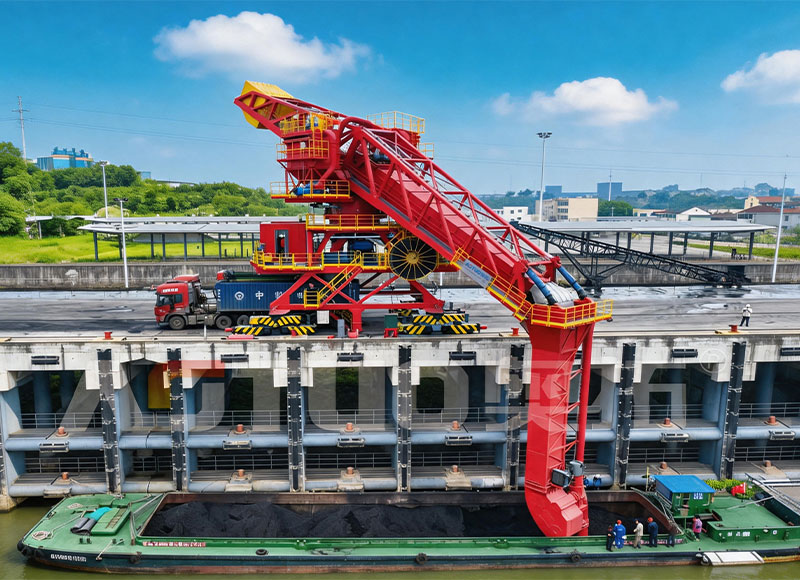
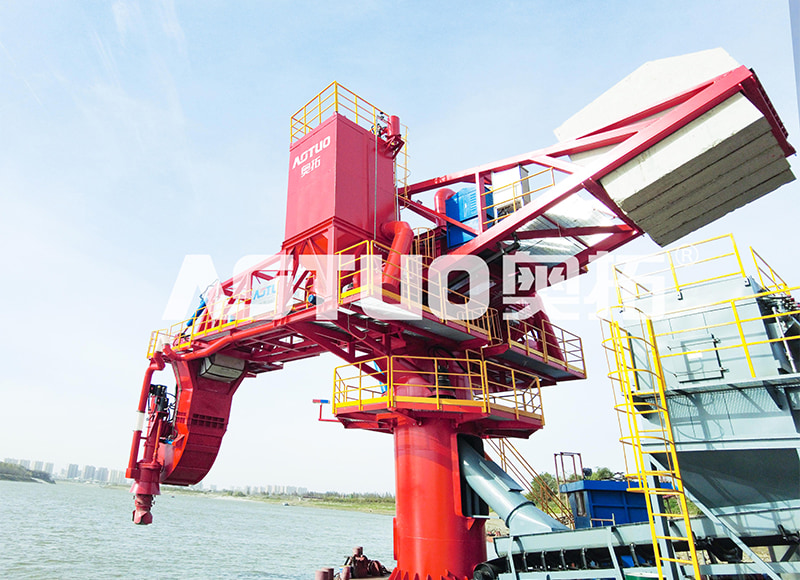
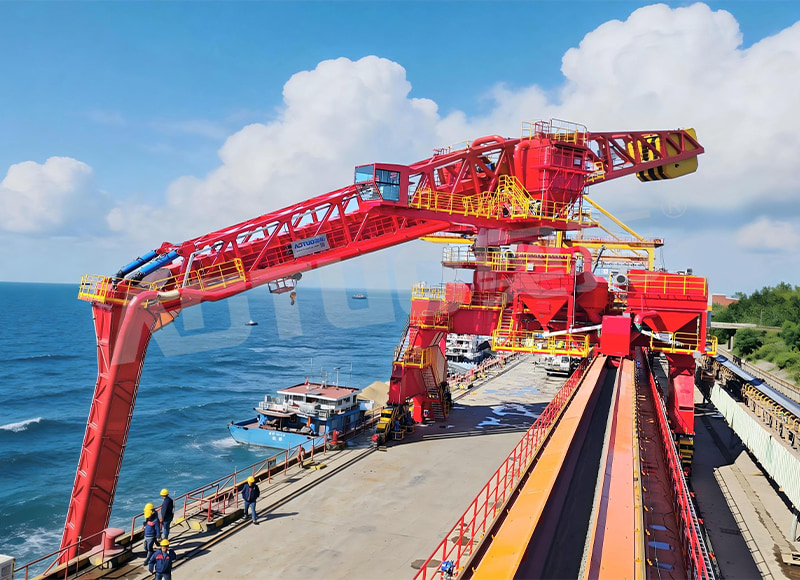
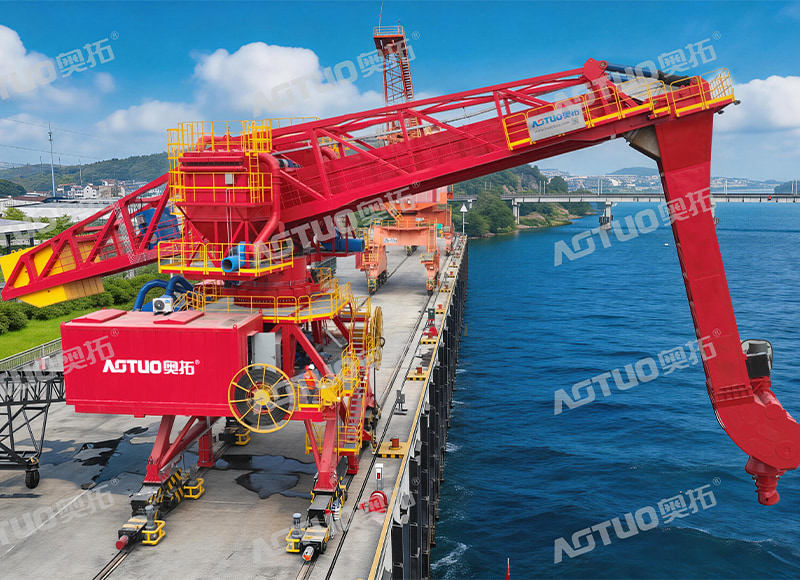
A vertical screw ship unloader draws cargo from the hold through a feed section, lifts it inside a fixed casing with a rotating screw, and discharges it onto a belt conveyor or air slide for delivery to the quay. A grab ship unloader uses a clamshell or rope-operated grab on a crane jib to scoop cargo from the hold and release it into a receiving hopper.
Both machines remove cargo from the same hatch. What differs is everything that happens between the hold floor and the quay edge.
The working sequence is short and repeatable, which is exactly why the machine holds a steady rate:
The equipment range built by Hangzhou Aotuo Mechanical and Electrical Co., Ltd. (AOTUO) reaches unloading capacities of 3,000 t/h and vessel sizes of 200,000 DWT, according to the company's published product data. Capacity at that level only pays off if the downstream conveyor, silo intake and truck loading can absorb it, which is why screw unloader projects are designed as a system rather than as a single machine.
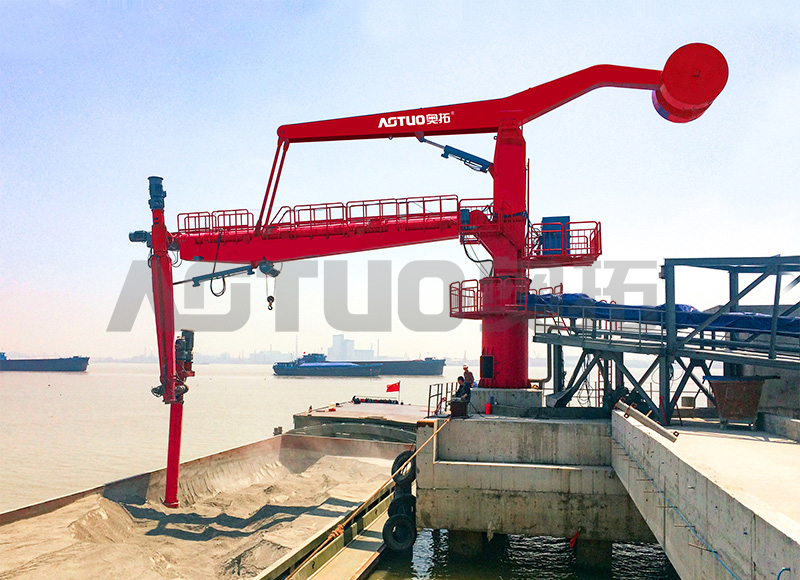
 Cement Screw Ship Unloader Configurations for Port TerminalsFully enclosed screw unloader in five configurations, with capacities to 1,500 t/h, suited to terminals planning continuous unloading as a system.View Product →
A grab cycle contains five motions: lowering, closing or digging, hoisting, slewing and releasing, followed by the return swing. Cargo moves only during digging and hoisting. The rest of the cycle is steel in motion, and every one of those seconds is berth time that cannot be recovered.
The same cycle explains the dust. The grab opens at the hold face, closes on the cargo, then releases the load in free fall into a hopper. Two open transfers per cycle means two dust sources per cycle, and the receiving hopper needs a filter unit, a skirt or a suppression system to stay inside permit limits.
For a wider view of how grab, pneumatic and screw machines divide the market, this overview of ship unloader types is a useful starting point before the detailed comparison below.
Effective throughput decides vessel turnaround, not the nameplate figure, and the gap between the two is wider for a grab unloader because part of every cycle carries no cargo at all.
Suppliers do not quote capacity on the same basis. A screw unloader's rating is normally stated as continuous capacity at a defined bulk density and fill level. A grab unloader's rating is often a peak figure taken from the best cycle the crane can run with a full bucket and a free hopper. Comparing those two figures directly is the most common mistake in equipment evaluation.
| Parameter | Grab ship unloader | Screw ship unloader |
| Basis of rating | Peak cycle with a full bucket | Continuous flow at a stated bulk density |
| Cargo moved per cycle | One bucket load | Continuous flow |
| Open transfers per cycle | 2 | 0 inside the machine |
| Planning factor applied to rating | 0.70 to 0.85 (estimate) | 0.85 to 0.95 (estimate) |
| Dust control equipment | Hopper filter, skirt, water spray | Enclosed casing plus filters at transfer points |
| Hold clean-up after the main pass | Loader or bulldozer plus manual sweeping | Residual at hold corners, manual sweeping |
| Operators per machine | 1 crane driver | 1 operator |
Assume the same 600 t/h berth handling cement at 1.3 t/m3. Grab option: bucket 8 m3, fill factor 0.9, cycle time 55 s. Each cycle carries 8 x 1.3 x 0.9 = 9.4 t, which equals 9.4 x 3,600 / 55 = 613 t/h in theory. Apply a 0.80 factor for hatch moves, trimming and truck exchange, and the working figure is about 490 t/h.
Screw option: rated 800 t/h continuous, with a 0.85 utilisation factor for hatch moves, trimming and short belt stoppages, giving 680 t/h.
Difference: 190 t/h, or roughly 39 percent more cargo per shift. These figures are assumptions chosen to make the arithmetic visible, not measured results. Rerun the same calculation with the real cycle time, bucket volume and bulk density before any decision is taken.
A screw unloader contains cargo from hold to quay, so visible dust comes from the hold surface and the transfer points, whereas a grab unloader releases material twice per cycle in open air.
Permit limits usually combine a concentration limit at a defined monitoring point with a visible-emission clause that an inspector can apply without instruments. The second is harder to argue with. A grab releasing cement into an open hopper at the top of its arc is visible from the site boundary, and no volume of record keeping changes that.
Rule for the specification: price the dust control as part of the machine, not as an optional extra added after permit review. On a grab installation the hopper filter, skirt and water system carry a real capital and maintenance cost that belongs in the comparison.
Cement, clinker, coal and grain can all be handled by both machines, and the deciding factors are bulk density, particle size, moisture content and how much dust the cargo releases when disturbed.
| Cargo | Screw unloader | Grab unloader | Practical note |
| Cement, 1.0 to 1.5 t/m3 | Preferred | Workable | Enclosed lift suits a powder that fluidises and holds airborne dust |
| Clinker, 1.2 to 1.4 t/m3 | Strong with abrasion-resistant flights | Common | Grab tolerates oversized lumps and foreign objects more easily |
| Coal, 0.8 to 0.9 t/m3 | Good with enclosed transfers | Common | Dust and self-heating risk both push towards enclosed handling |
| Grain, 0.75 to 0.80 t/m3 | Good, moderate mechanical damage | Workable | Free-fall release from a grab adds impact breakage |
| Iron ore and heavy lump | Limited | Preferred | High density and large lump size favour a bucket |
| Sticky or wet cargo | Design review needed | More tolerant | Bridging risk rises in the vertical screw feed section |
For cement and clinker, a rule of thumb used in screw unloader selection puts the practical moisture ceiling near 12 to 15 percent by weight. Above that level the feed section can bridge, and the machine loses capacity until the hold is cleared. The correct response is a design review with the manufacturer, not a larger motor.
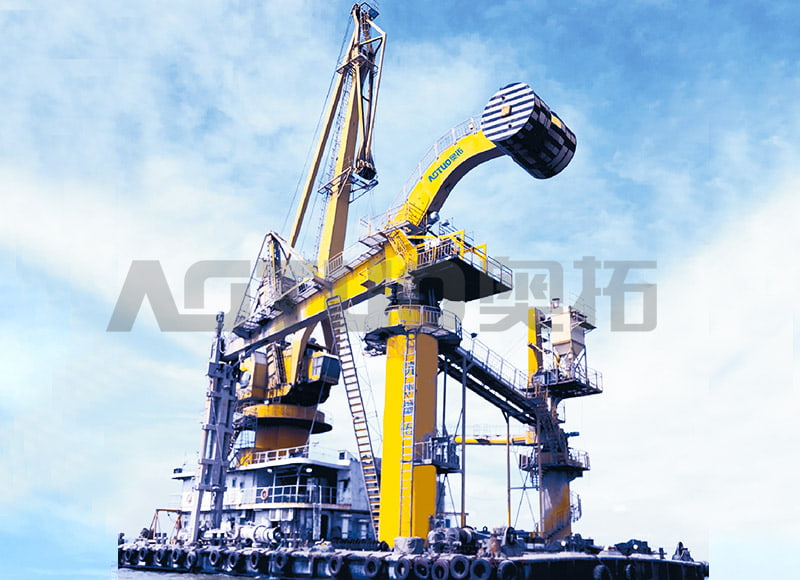
 Tire-Mounted Multi-Material Ship Unloader for Dry Bulk TerminalsSelf-propelled screw unloader handles clinker, coal, aggregates and grain at 400–1,000 t/h, with enclosed dust-controlled conveying and no rail infrastructure.View Product →
Multi-material applications are the hardest to specify honestly, because screw geometry, wear protection and dust control are each set by a different cargo. Clinker sets the abrasion requirement, cement sets the sealing requirement and coal sets the fire and dust requirement.
A screw unloader draws steady power from intake to discharge, while a grab unloader draws short peaks during hoisting and idles between cycles; the wear parts follow the same pattern.
Power cost per tonne favours the continuous machine when the cargo is consistent and the berth runs long campaigns. The advantage narrows when the machine works short campaigns with frequent material changes, because cleaning and changeover inside an enclosed system cost time that a grab does not incur in the same way.
A ten-year comparison should include spares, rope or liner replacement, dust control consumables, clean-up labour and the cost of berth time lost during unplanned stops. Installed power alone is a weak predictor of total cost.
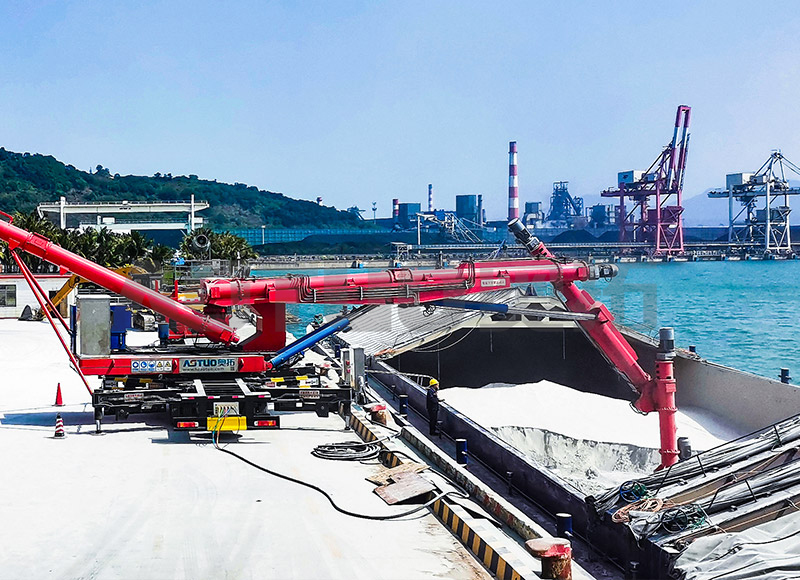
Screw unloaders are built in fixed, rail-mobile, tyre-mobile, shipborne and vehicle-mounted forms, so one unloading technology can serve a dedicated cement berth, a shared multi-purpose quay or a temporary project site, while grab unloaders stay tied to a portal or gantry structure on rails.
A fixed screw unloader has the lowest capital cost and the smallest footprint, but it serves one berth position. A rail-mobile unit covers the full length of a quay. A tyre-mobile unit can be moved between berths or yards without track work, which matters for terminals that handle several cargoes and cannot dedicate a berth all year.
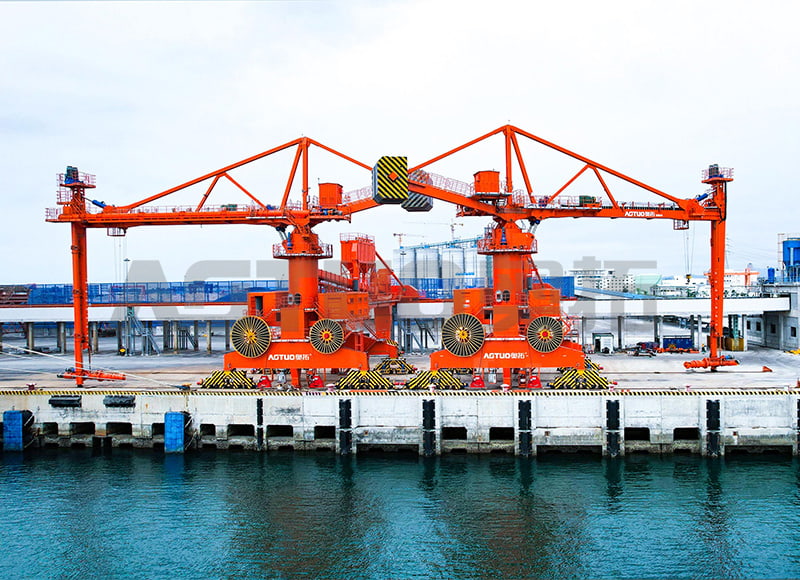
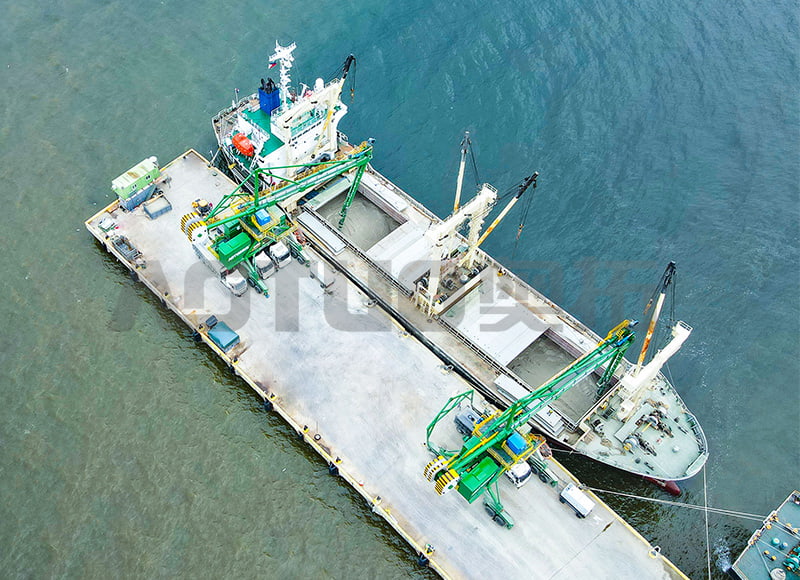 Tire Mobile Screw Ship Unloader for Rail-Free BerthsSelf-propelled unloader serves 1,000–70,000 DWT vessels at 200–1,500 t/h and relocates between berths in 15–20 minutes without track work.View Product →
Vessel size sets the reach and the lift height. AOTUO's published envelope of 200,000 DWT means the boom, screw length and ship-to-shore interface are designed for the largest bulk carriers as well as Handysize and Panamax units. Older grab installations are frequently limited by crane rail capacity and by hopper position rather than by the grab itself.
Published project records include equipment supplied to Port of Brisbane in Australia and the Port of Mariveles in the Philippines, which shows the same screw technology working in export terminals outside China. A Port of Brisbane project reference is a useful check when a review panel asks for comparable installations.
Run the evaluation in this order, because each step narrows the equipment list before the next one is applied.
Specify effective tonnes per hour at a stated bulk density and a stated utilisation factor, not the peak cycle. For a grab unloader, quote the bucket volume, fill factor and cycle time so the arithmetic can be checked. For a screw unloader, quote continuous capacity together with the discharge conveyor capacity that supports it, because the machine is only as fast as the belt behind it.
A multi-material screw unloader can be specified for several dry bulk cargoes, but the screw geometry, wear protection and dust control are set by the hardest cargo in the mix. Declare the full cargo list at enquiry stage rather than after award, since clinker, cement and coal each impose a different design constraint on the same machine.
AOTUO's published equipment envelope covers vessels up to 200,000 DWT with unloading capacities up to 3,000 t/h. At a specific berth, the real limit is set by water depth, boom reach and the discharge conveyor system behind the machine, so the vessel range should always be confirmed against the berth survey rather than the equipment brochure alone.
A grab unloader is the more practical option for iron ore and heavy lump cargo, for berths that must handle many cargo types in short campaigns, and for terminals whose capital budget cannot support a dedicated continuous machine. In those cases the dust control cost shifts to the hopper and the yard, and the throughput calculation should use a utilisation factor below 0.85.
It is focused on the overall solution of dry bulk material port transfer system,
research and development, manufacturing, and service
Copyright © Hangzhou Aotuo Mechanical and Electrical Co., Ltd. All Rights Reserved.
Custom Material Conveyor Transfer Systems Manufacturers