EN
 English
 中文简体
 Français

Industry News
Home / News / Industry News / How to Match Screw Ship Unloader Capacity with Vessel Size and Port Throughput

Article Directory
A 55,000 DWT supramax bulk carrier loaded with 48,000 tonnes of ordinary Portland cement has roughly 60 hours of laytime at the berth. A screw ship unloader rated at 1,000 t/h nameplate will not clear that parcel inside the window. At a realistic 65% duty cycle the machine delivers 650 t/h and the discharge alone runs to 74 hours. The 14-hour gap is not an operating problem, it is a specification problem, and it is settled months earlier on the equipment datasheet.
This guide sets out how to match screw ship unloader capacity to vessel size and port throughput using four measurable inputs, and how to test a supplier's capacity claim before the contract is signed.
Matching a screw ship unloader to a vessel and a berth comes down to four numbers: parcel size in tonnes, available laytime in hours, effective duty cycle, and the berth's annual throughput target.
The first three divide into a nameplate rating. Required capacity equals parcel size divided by laytime divided by duty cycle. The fourth number confirms that the resulting machine is also large enough for the terminal's yearly tonnage, not only for one ship.
Parcel size is cargo weight, not vessel deadweight. A 55,000 DWT supramax leaving Southeast Asia for a cement terminal rarely carries more than 48,000 tonnes. Laytime for that trade is commonly 60 hours. Those two figures set the floor on capacity before any efficiency factor is applied.
Duty cycle is where most sizing errors happen. A 1,000 t/h machine looks as though it clears 48,000 tonnes in 48 hours; at 65% duty cycle it takes 74 hours.
For screw ship unloaders working cement and clinker, measured duty cycles typically fall between 55% and 75%.
Vessel deadweight sets the parcel size, the hold count and the hold depth, and those three variables define the capacity band a terminal should be buying in.
Hold count is the strongest of the three. A 55,000 DWT supramax carries five cargo holds, a 75,000 DWT panamax carries seven, and a 180,000 DWT capesize carries nine. Every additional hold adds one hatch-to-hatch move per discharge and erodes duty cycle further.
Hold depth sets the tail of the discharge curve. In a deep hold the vertical screw loses conveying efficiency once the remaining cargo falls below the reach of the horizontal feed section, and the final 15% to 20% of the hold is recovered at close to half the peak rate.
| Vessel class | Deadweight | Cargo holds | Typical parcel | Nameplate rating |
| Handysize | 10,000 to 35,000 DWT | 4 to 5 | 12,000 to 25,000 t | 400 to 600 t/h |
| Handymax | 35,000 to 50,000 DWT | 5 | 25,000 to 40,000 t | 600 to 900 t/h |
| Supramax | 50,000 to 60,000 DWT | 5 | 40,000 to 55,000 t | 900 to 1,300 t/h |
| Panamax | 65,000 to 80,000 DWT | 7 | 55,000 to 75,000 t | 1,300 to 1,800 t/h |
| Capesize | 100,000 to 200,000 DWT | 9 | 90,000 to 190,000 t | 2,000 to 3,000 t/h |
| Cement carrier | 10,000 to 40,000 DWT | 4 to 6 | 10,000 to 35,000 t | 400 to 800 t/h |
The top of that range matches the 3,000 t/h ceiling of the AOTUO screw ship unloader line, which is specified for vessels up to 200,000 DWT. Beyond a capesize parcel the choice is a larger machine or a longer window; operating skill does not change the arithmetic.
Annual throughput targets convert into a nameplate rating in three steps: divide annual tonnage by annual operating hours, divide again by the duty cycle, then check the peak arrival window rather than the annual average.
Take a 1.5 million tonne per year cement terminal working 330 days a year at 20 operating hours a day, which is 6,600 operating hours. Average demand is 1,500,000 divided by 6,600, or 227 t/h. At a 65% duty cycle the nameplate requirement is 227 divided by 0.65, or 350 t/h.
That average hides the real constraint. If 60% of the tonnage arrives in a five-month import season, then 900,000 tonnes must move inside 2,750 operating hours, which is 327 t/h average, or 503 t/h at a 65% duty cycle. The correct order is a 500 to 600 t/h machine, not a 350 t/h machine.
Installation type decides how many berths one machine can serve, and that decides whether a port buys one large unloader or two smaller ones.
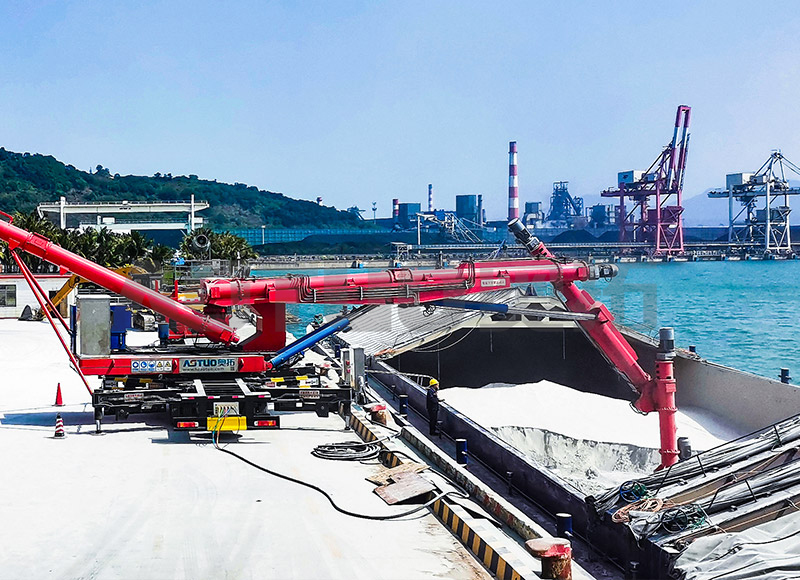
A fixed unloader is the cheapest route to a given capacity because nothing is spent on travel gear or quay rails. It serves one berth and usually one material. A rail-mounted unloader travels the quay in 5 to 20 minutes per berth move, which lets a single machine cover two or three berths and absorb peak arrivals without a second capital purchase.
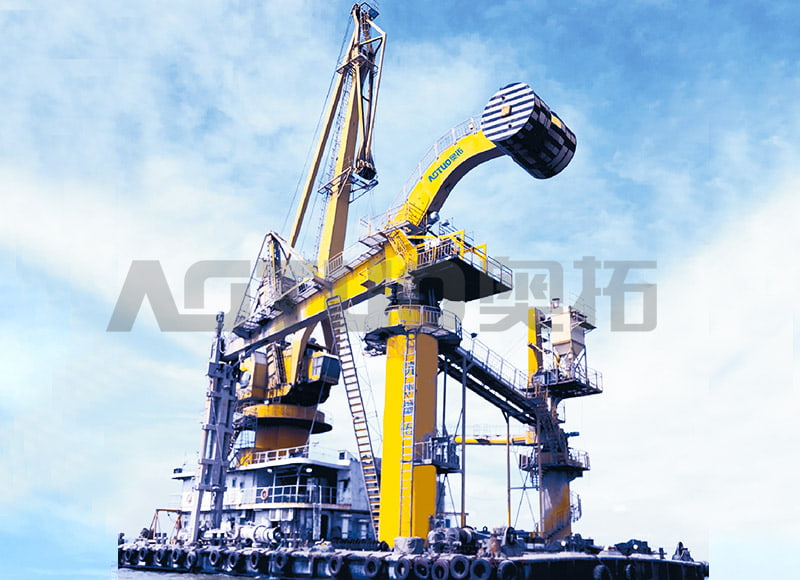
AOTUO, formally Hangzhou Aotuo Mechanical and Electrical Co., Ltd., builds five mounting variants of the cement screw unloader: fixed, rail mobile, shipborne, tire mobile and vehicle mounted. Rail-mounted units have been delivered for terminal projects that include the Port of Mariveles in the Philippines.
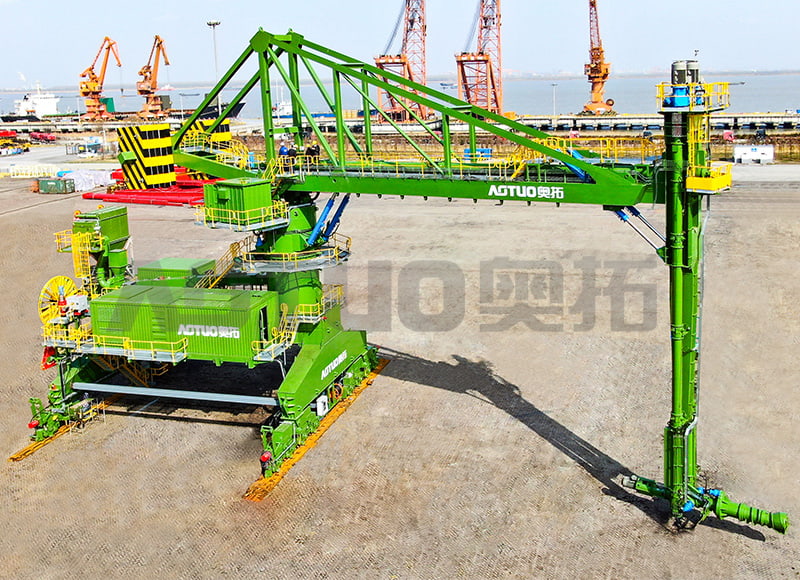 ATXL-B Rail Mobile Screw Ship UnloaderRail-mounted continuous bulk unloader for vessel-to-shore discharge, offering 200–1500 t/h on cement with flow modulation and dust control.View Product →
A screw unloader is a volumetric machine, so the tonnage it delivers depends on bulk density: the same unit can be a 1,000 t/h machine on cement and a 600 t/h unit on coal.
Moving a fixed 700 cubic metres per hour, a machine delivers 980 t/h of cement at 1.4 tonnes per cubic metre and 595 t/h of coal at 0.85. A buyer who specifies 1,000 t/h without naming the material has ordered a 600 t/h coal unloader and will discover it during the first acceptance test.
Volumetric throughput is fixed by screw diameter, pitch and rotational speed, which is why two terminals ordering the same nominal tonnage can receive machines with different screw geometry.
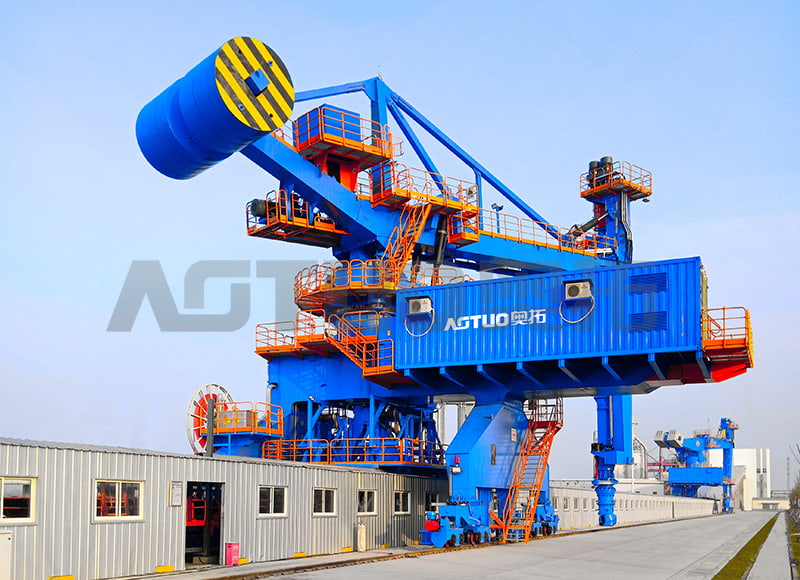 Rail Mobile Screw Coal Ship UnloaderContinuous enclosed rail-mounted coal unloader for 500–200,000 DWT vessels, with 200–3000 t/h capacity and multi-berth transfer; capacity depends on coal density and test conditions.View Product →
A capacity guarantee is only as good as the test conditions attached to it, so the contract should state the duty cycle, the material specification and the acceptance test behind every tonnage figure.
In China the reference document is JC/T 2575, the building materials industry standard for bulk cement screw ship unloaders. It was drafted by Hangzhou Aotuo Mechanical and Electrical Co., Ltd., a company established in 2003 that holds more than 100 patents and software copyrights and supplies dry bulk port handling systems to Australia, Singapore, the Philippines, Vietnam, Indonesia and Bangladesh.
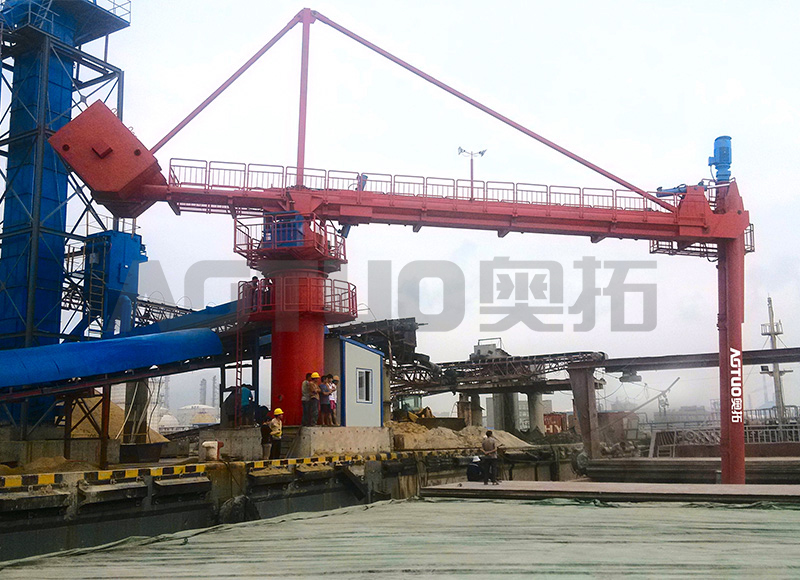 ATXL-A Fixed Screw Ship UnloaderFixed continuous screw unloader for dedicated berths, with 100–500 t/h cement capacity, enclosed conveying and filtration; suited to smaller terminals and inland ports.View Product →
1,231 t/h. The calculation is 48,000 divided by 60 hours divided by a 0.65 duty cycle. A 1,300 t/h machine leaves a small margin; a 1,000 t/h machine needs 74 hours and will attract demurrage on most cement charters.
No. Above roughly 1,200 t/h on a supramax parcel, extra nameplate capacity is absorbed by hatch-to-hatch moves, trimming and quay conveyor changeover, which together account for 25% to 35% of berth time. Beyond that point the bottleneck shifts to the ship and the quay line.
Yes, with a rail-mounted machine. Travel between adjacent berths takes 5 to 20 minutes, so one rail-mounted unit can cover two or three berths on a 300 metre quay. The trade-off is capital cost against the cost of a second fixed machine.
Divide total cargo lifted by nameplate rate and by total berth time, including hatch changes, trimming and hold cleaning. On cement and clinker, measured values for screw unloaders typically fall between 55% and 75%. A guarantee written without a stated duty cycle is not a guarantee.
Sizing a screw ship unloader is arithmetic before it is engineering: parcel divided by laytime divided by duty cycle, checked against vessel class and material density. Terminals that run those four numbers before issuing an enquiry avoid the two most expensive mistakes in bulk port equipment, buying a machine one size too small and buying a second machine that was never needed.
It is focused on the overall solution of dry bulk material port transfer system,
research and development, manufacturing, and service
Copyright © Hangzhou Aotuo Mechanical and Electrical Co., Ltd. All Rights Reserved.
Custom Material Conveyor Transfer Systems Manufacturers