EN
 English
 中文简体
 Français

Industry News
Home / News / Industry News / Grain Ship Unloader Selection: Capacity, Dust Control and Procurement Guide

Article Directory
Four numbers decide which grain ship unloader a terminal should buy: the largest parcel the berth will receive, in tonnes; the laytime the charter party allows, in hours; the broken-kernel limit in the buyer's contract, in percent; and the dust limit in the port's operating permit. Every other item in the specification, from the unloading principle to the rated throughput and the clean-out method, follows from those four numbers.
A grain ship unloader is not a catalogue item. It is a continuous bulk handling system that has to fit one berth, one vessel mix and one cargo grade, and it is judged at the end of the charter by demurrage statements and cargo survey reports rather than by a datasheet. Terminals that buy on peak rate alone usually find the gap during the first Panamax discharge, when the average rate across the whole window decides the demurrage bill.
Grain imposes three requirements that cement, clinker and coal unloaders are not designed around: a contractual limit on kernel damage, a hold condition that must pass survey before the next cargo, and a volumetric duty that shifts with the stowage factor.
Definition: a grain ship unloader is a continuous mechanical ship unloader that lifts bulk grain such as wheat, maize, soybean, barley or rice from a vessel hold to a quay-side receiving point using a vertical screw, a bucket chain or pneumatic suction, and it is rated in tonnes per hour at a stated bulk density and conveying height.
The stowage factor is the number most often missing from a tender document. Bulk wheat, maize and soybeans typically stow at 1.30 to 1.45 cubic metres per tonne, and that figure moves with moisture content and grade. An unloader rated at 800 t/h at 0.75 t/m3 is not an 800 t/h machine when the intake is volumetrically limited and the cargo arrives lighter, so the rating condition has to be written down and agreed before the order.
The number to specify is the average rate the berth window demands, calculated as parcel tonnage divided by usable hours after deducting hatch changes, trimming, hold cleaning and weather.
The calculation is short. Take the parcel tonnage from the cargo declaration, take the laytime from the charter party, deduct non-productive time, and divide. On a grain discharge, non-productive time rarely falls below 15 to 20 percent of the window: hatch changes, trimming stops and final clean-out all consume hours that the charterer still counts.
| Vessel class | Representative parcel (t) | Laytime window (h) | Usable hours at 80% | Required average rate (t/h) |
| Handysize | 30,000 | 48 | 38.4 | 781 |
| Supramax | 50,000 | 72 | 57.6 | 868 |
| Panamax | 70,000 | 96 | 76.8 | 911 |
| Capesize | 90,000 | 120 | 96.0 | 938 |
The average rate assumes the machine performs at its rated figure for every productive hour, which no machine does across a full discharge. Specify rated capacity 10 to 15 percent above the calculated average.
Require the supplier to state the bulk density, conveying height and duty cycle behind that rating. Without those three conditions, the number cannot be tested at acceptance.
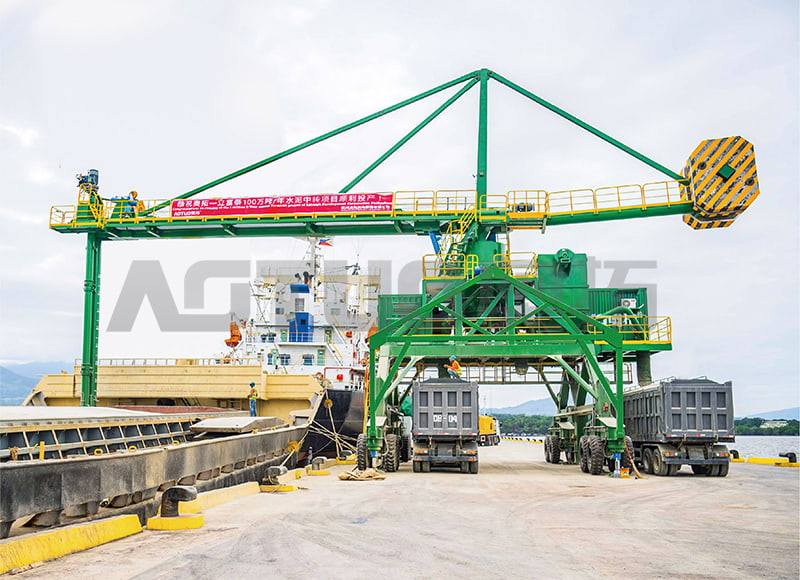
For berths receiving vessels of 30,000 DWT and above, with a required rate above roughly 300 t/h, a continuous mechanical unloader is the only principle that reaches the rate without multiple cranes and a wide open quay.
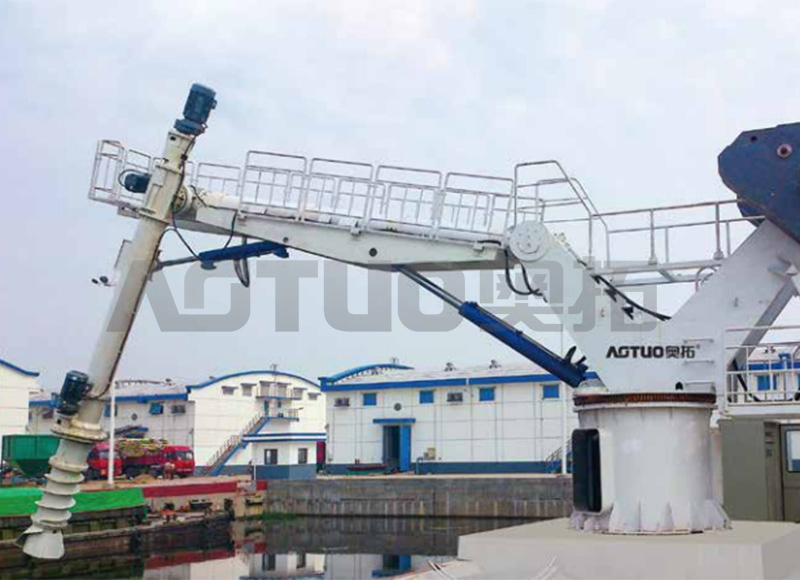 BULKFLOW G-7000 Rail-Mounted Continuous Screw Grain Ship UnloaderFor berths needing continuous mechanical unloading above roughly 300 t/h, this rail-mounted screw unloader targets grain with gentle conveying and configurable capacity.View Product →
Bucket-chain continuous unloaders are the third mechanical option and are widely used in grain. They combine high rates with low breakage, but the digging line carries more wearing parts and the machine needs a heavier quay structure than a screw unit of the same capacity.
The unloading method feeds straight into the survey figures that decide whether the buyer accepts the parcel: broken kernels, foreign matter and the residue left in the hold.
Grain trade contracts for wheat and maize routinely set broken-kernel tolerances in the 2 to 3 percent band and foreign-matter limits near 1 percent. A discharge that adds fines at the intake, the hopper or a transfer chute can push a parcel outside that band even when the tonnage is exactly right, and the claim lands on the terminal rather than on the ship.
Clean-out is the other half of the commercial test. A hold that fails survey before the next cargo costs a cleaning shift, and on a tight berth schedule that shift is the difference between a two-day and a three-day port stay.
Grain dust is a combustible dust, so the unloader's intake, hopper and transfer points sit inside the terminal's dust hazard classification, and the quay emission limit is fixed by the operating permit rather than by the equipment supplier.
A dust explosion needs fuel, dispersion, confinement and an ignition source, and grain handling produces all four unless the design removes one of them. Practical measures on an unloader are an enclosed transfer path, negative pressure at the receiving hopper, correctly sized dust collection with explosion venting, bonding and grounding of conductive parts, and a housekeeping regime that keeps layer build-up under control.
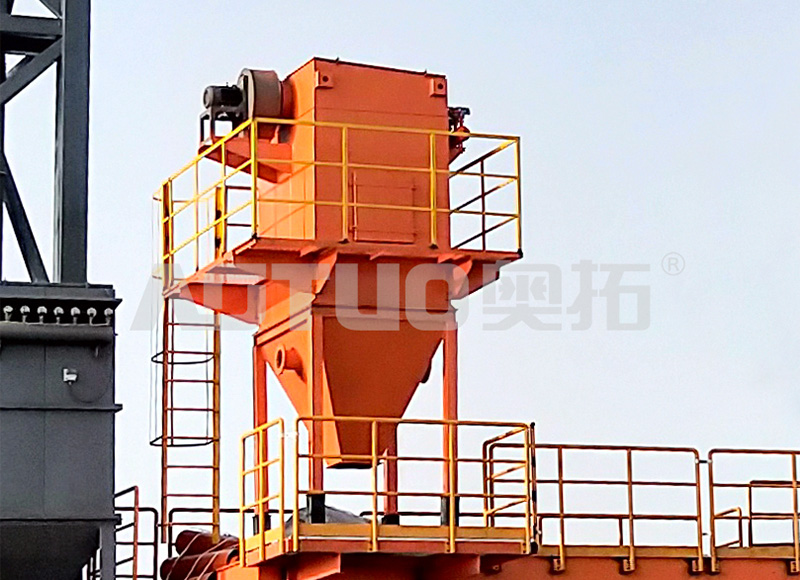 Pulse Single Machine and Air Box Bag Dust CollectorsSized for transfer-point dust control, these modular collectors offer pulse-jet cleaning, explosion venting and filter media options for grain and bulk terminals.View Product →
Dust collection should be sized from the number and location of transfer points, not from the unloader's tonnage alone. One collector serving the receiving hopper, the belt transfer and the loading chute is a different specification from three local units, and the permit test is carried out at the boundary, not at the machine.
Installed power scales with rated capacity, conveying height and conveying length, so a single kilowatt figure is not comparable between suppliers. Ask for the connected load, the duty cycle and the motor sizing basis.
Automation is where two machines of identical capacity separate in daily operation. Ask which functions run automatically and which are operator-assisted, how the control system handles hold changes and trimming, what interlocks stop the machine before damage occurs, and whether the PLC exposes data that the terminal's own system can read.
Screw conveying engineering is the discipline behind this equipment, and it is worth checking how deep a supplier sits inside it. Hangzhou Aotuo Mechanical and Electrical Co., Ltd., the Hangzhou-based manufacturer known as AOTUO, is the drafting organisation for the Chinese industry standard JC/T 2575 for bulk cement screw unloaders, and applies the same vertical screw principle across cement, clinker, coal and grain.
Five items decide whether the delivered machine matches the specified one: the design basis, the definition of rated capacity, the performance guarantees, the terminal interfaces, and the service structure.
Delivery record matters when the berth cannot absorb a learning curve. AOTUO equipment is in service at ports including Brisbane in Australia, Sydney Harbour and Mariveles in the Philippines, which is a practical check on cross-border delivery and site support.
An unloader reaches its rated rate only when the receiving conveyor, the hopper, the dust collector and the loading side of the terminal are sized to the same number.
The unloader is one machine in a chain that starts at the hold and ends at the silo or the truck loading bay. A 1,000 t/h unloader feeding an 800 t/h belt conveyor is an 800 t/h terminal. The same logic applies on the outbound side: export and transhipment terminals need a loading system matched to the unloading rate, and a mismatch there simply moves the bottleneck from the ship to the stockpile.
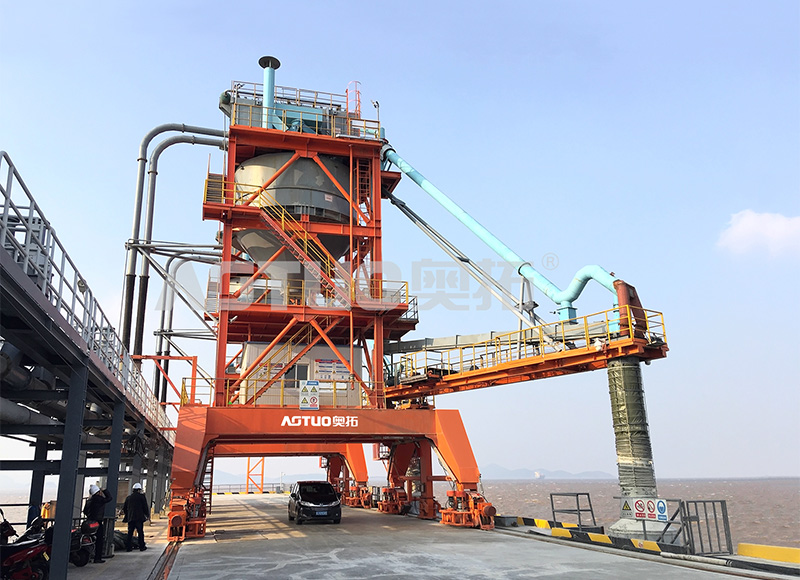 300–1500 t/h Rail-Mobile Bulk Ship LoaderFor terminals matching unloading rates, this rail-mounted loader serves multiple berths and handles bulk materials with telescopic spout and dust filtration.View Product →
AOTUO's auxiliary range covers air slides, belt conveyors, elevators, bulk loaders, continuous receiving devices and dust collectors, which is the equipment that turns a single unloader into a working terminal rather than a machine standing next to an undersized conveyor.
A 70,000 t parcel in a 96-hour laytime window, at 80 percent usable time, needs an average of about 911 t/h. Specify 1,000 t/h or more of rated capacity and require the rating to be stated at the cargo's bulk density and at the actual conveying height.
Continuous mechanical unloaders, screw or bucket chain, are specified where the required rate exceeds roughly 300 t/h and vessels are above 30,000 DWT. Pneumatic suction is reserved for smaller vessels, barges and multi-purpose berths, where parcel size is small and flexibility matters more than peak rate.
By a performance test on a defined cargo at a defined bulk density, conveying height and duty cycle, with the measurement point and test duration written into the contract. A rating quoted without those three conditions cannot be checked at acceptance.
Screw flighting wear liners or bucket-line wear parts, the bottom bearing and seal assembly, hydraulic hoses and drive couplings, and dust filter cartridges. Ask the supplier to state the replacement interval for each wear item and to quote a 12-month consumable set with the machine.
It is focused on the overall solution of dry bulk material port transfer system,
research and development, manufacturing, and service
Copyright © Hangzhou Aotuo Mechanical and Electrical Co., Ltd. All Rights Reserved.
Custom Material Conveyor Transfer Systems Manufacturers