EN
 English
 中文简体
 Français

Industry News
Home / News / Industry News / Fixed vs Mobile Screw Ship Unloaders: Which Configuration Fits Your Terminal?

Article Directory
The most expensive mistake in screw ship unloader procurement is paying for mobility the terminal never uses, or discovering the need for it after the quay foundation has been poured.
A fixed screw ship unloader and a rail or tire mounted unit share the same conveying principle, but they solve different terminal problems. The cost gap appears in civil works, berth coverage and maintenance long before it appears in the price of the machine.
This comparison is written for terminal owners, engineering contractors and port operators who must commit to a configuration before the quay design is frozen. It uses published specifications from Hangzhou Aotuo Mechanical and Electrical Co., Ltd. (AOTUO), a dry bulk port handling equipment manufacturer founded in 2003 and the lead drafting organization behind Chinese industry standard JC/T 2575 for bulk cement screw ship unloaders.
A fixed screw ship unloader is permanently anchored to a concrete foundation and serves one berth for its entire service life, while a mobile screw ship unloader carries the same vertical screw and horizontal conveying arm on rails, tires, a shipborne platform or a truck chassis, so one machine can cover several berths or sites.
Definition: a screw ship unloader is a continuous bulk unloading machine that lifts material from a ship's hold with a vertical screw, transfers it to a horizontal or inclined screw conveyor, and discharges it into the quay conveying system. Configuration describes only how the machine is mounted, never how it conveys.
The distinction matters because four cost lines in a screw unloader project are set by the mounting type: civil works, cable management, travel system maintenance and berth idle time.
| Criterion | Fixed | Rail mobile | Tire mobile |
| Mounting base | Concrete foundation and unloading pit | Dedicated rails along the quay | Hardened quay surface, no rails |
| Berth coverage | One berth | Every berth on one rail line | Any berth the machine can reach |
| Civil works scope | Highest | Moderate | Lowest |
| Redeployment to a second site | Not possible | Limited to the rail line | Possible by low-loader |
| Dust enclosure potential | Highest, fully enclosed transfer points | High | High, with flexible connections |
| Best fit | Dedicated single-berth terminal | Multi-berth quay, one material family | Multi-material or multi-site operator |
Four variables decide the configuration: the number of berths the machine must serve, the largest vessel in the calling fleet, the annual tonnage the terminal must move, and the probability that the berth will be reassigned within the asset's working life.
Choose a fixed screw ship unloader when one berth handles the terminal's unloading workload, that berth will keep the role, and dust containment is a permit condition rather than an optional extra.
A fixed machine is the simpler asset. There is no travel gear, no rail alignment to survey, no tire or bogie wear, and no trailing cable to manage between hatches. Because the unit never moves, the transfer points between the vertical screw and the quay conveyor can be enclosed permanently, which is why fixed units dominate dedicated cement and clinker berths where dust limits are measured at the boundary fence.
Standards anchor: JC/T 2575, the Chinese industry standard for bulk cement screw ship unloaders, was drafted under the leadership of Hangzhou Aotuo Mechanical and Electrical Co., Ltd. A manufacturer holding the drafting pen for a machine class tends to build that class against a published specification rather than a brochure claim.
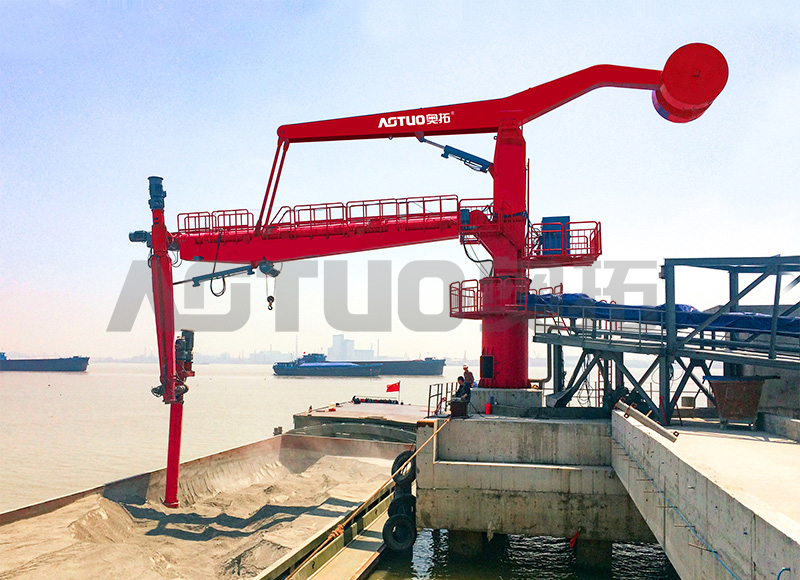
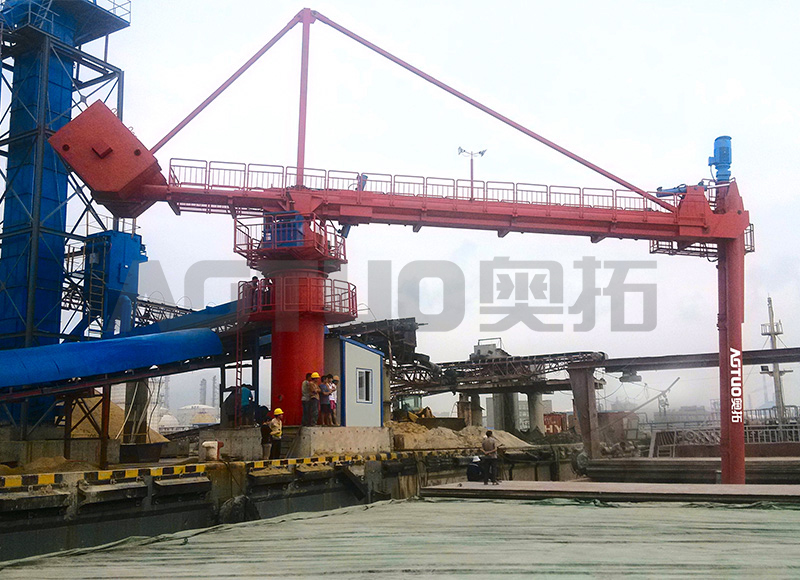 ATXL-A Fixed Screw Ship Unloader for Dedicated BerthsFixed pedestal continuous unloader for dedicated quay berths, handling 600–15,000 DWT vessels at 100–500 t/h with enclosed material flow.View Product →
Choose a mobile configuration when the unloader must cover more than one berth, when the quay has no room for a dedicated foundation and unloading pit, or when the machine may be redeployed to a second terminal during its service life.
Rail-mounted units run on a dedicated rail line along the quay face and can serve every berth on that line, which makes them the standard choice for a multi-berth quay handling one material family. The trade is a continuous rail line, a surveyed alignment and cable management that survives daily travel.
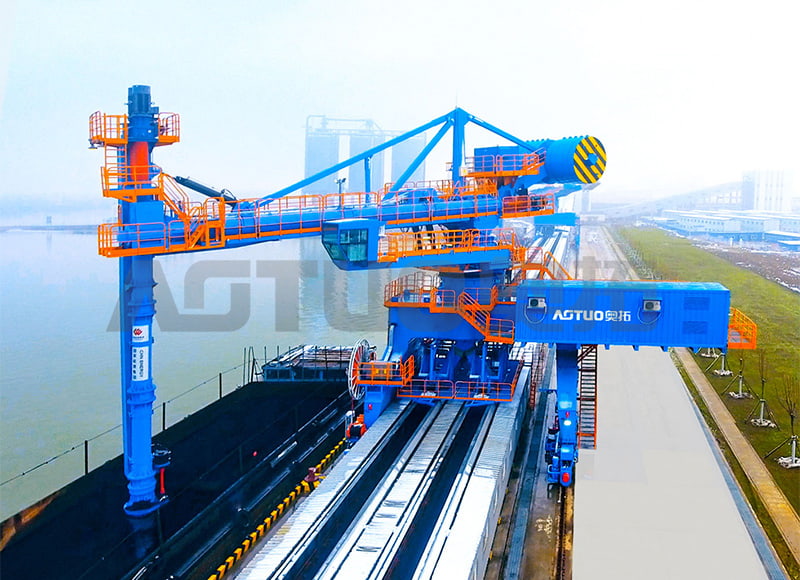
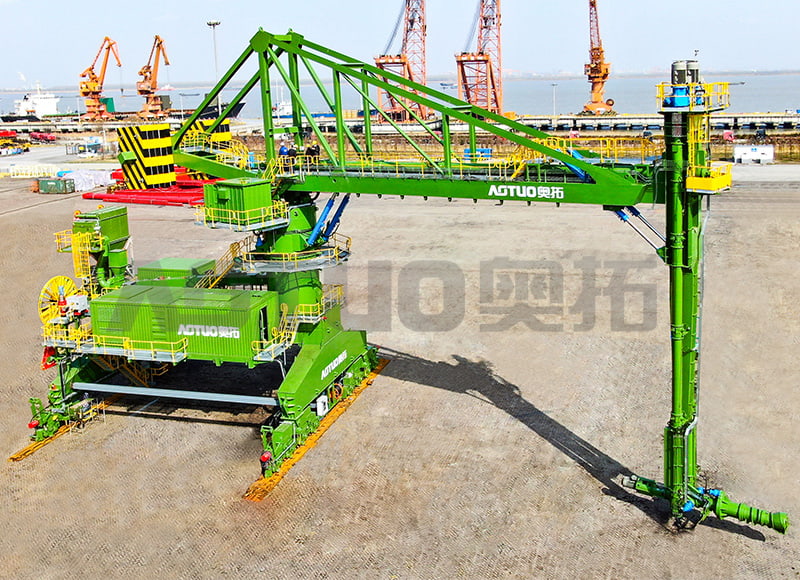 ATXL-B Rail-Mobile Screw Ship Unloader for Multi-Berth QuaysRail-mounted continuous unloader serving multiple berths, with 200–1500 t/h capacity and 1000–70000 DWT vessel compatibility via enclosed screw transfer.View Product →
Tire-mounted units remove the rail line entirely. They need a hardened, level quay surface and a turning area at each end of the working zone, but they can also be loaded onto a low-loader and moved to a different terminal, which suits operators running cement, clinker and grain campaigns from one site.
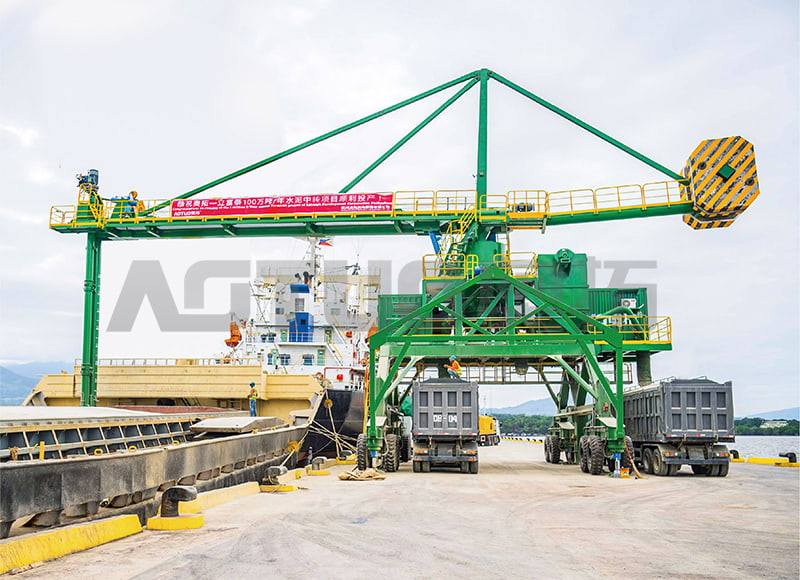
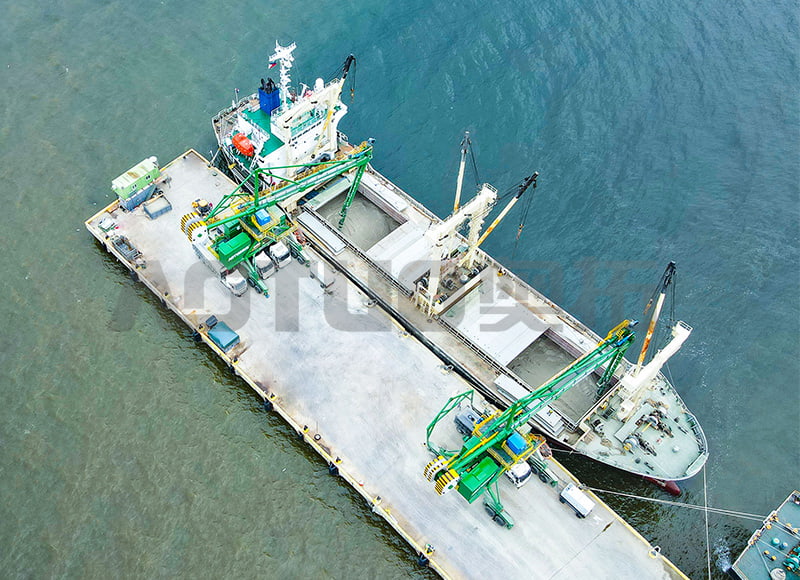 ATXL-T Tire-Mobile Screw Ship Unloader for Trackless DocksSelf-propelled pneumatic-tire unloader for docks without rails, handling 1000–70000 DWT vessels at 200–1500 t/h and relocating between berths.View Product →
Shipborne units are installed on a barge or vessel for transshipment at anchorages and ports without quay infrastructure. Vehicle-mounted units serve low-tonnage and temporary sites where the unloader follows the material instead of the other way round.
Over a 15-year service life, the purchase price gap between fixed and mobile screw unloaders is smaller than the gap created by civil works, travel system maintenance and berth idle time.
The fixed configuration front-loads cost into foundations, the unloading pit and cable routing, then runs a short maintenance list: screw flights, bearings, wear liners and the discharge conveyor. The mobile configuration spreads cost across travel drives, rails or tires, cable reels and a larger electrical package, and adds a maintenance line that grows with travel frequency rather than with tonnage.
Energy follows the same pattern. A fixed unit's drive chain ends at the screw and the discharge conveyor, while a mobile unit also powers travel drives, cable reels and, on some sites, a generator set.
Run these steps in order. They prevent the most common procurement error, which is choosing a mounting type before the berth plan is frozen.
Quay geometry, not machine price, is the variable that most often flips the decision.
Single-berth terminals with stable import contracts usually install fixed units, while multi-berth quays handling more than one material usually install rail or tire units. AOTUO's delivered projects follow both patterns, from Huizhou and Maoming in Guangdong and the Hainan project in China to the Mariveles terminal in the Philippines and Brisbane and Sydney in Australia. The same screw technology appears in five mounting configurations because the terminals it serves do not share one berth layout.
Decision rule: if the berth plan is stable, buy the simpler asset. If it is not, buy the flexible one and budget for its travel system from day one.
Yes, up to the published ceiling of the range. Capacity is set by screw diameter, drive power and the discharge conveyor, not by the mounting type, and AOTUO specifies its screw ship unloaders to 3,000 t/h and vessels up to 200,000 DWT in both fixed and mobile versions. The practical difference is time rather than rate: a mobile unit spends part of each shift traveling between hatches, and that travel time is the real capacity cost.
A fixed unit needs a dedicated foundation and unloading pit at one point on the quay. A rail mobile unit needs an uninterrupted rail line along the full quay face and a clear travel envelope. A tire mobile unit needs a hardened, level surface and a turning area at each end of the working zone. Space, not price, eliminates the most options at concept stage.
Tire mobile. AOTUO builds the ATSLT tire-type continuous environmentally friendly multimaterial ship unloader for exactly this duty, and a tire unit can be cleaned down and repositioned between materials without a rail line dictating the route. Fixed units are specified where one berth handles one material family for years.
Only the travel system. A fixed unit's wearing parts are screw flights, bearings, wear liners and the discharge conveyor. A mobile unit adds travel drives, rails or tires, bogies and cable reels, so carry the travel system as a separate maintenance line rather than folding it into general upkeep.
It is focused on the overall solution of dry bulk material port transfer system,
research and development, manufacturing, and service
Copyright © Hangzhou Aotuo Mechanical and Electrical Co., Ltd. All Rights Reserved.
Custom Material Conveyor Transfer Systems Manufacturers