EN
 English
 中文简体
 Français

Industry News
Home / News / Industry News / What Buyers Should Consider When Sourcing a Screw Ship Unloader Manufacturer

Article Directory
Two terminals can issue near-identical tenders for a 600 t/h screw ship unloader and end up with machines that behave nothing alike. The screw itself is rarely the difference. Casing geometry, vertical screw pitch, the dust enclosure, the counterweight, the control philosophy and the commissioning support are what separate a machine that reaches its rated rate in the first week from one that never quite does.
This guide is for the people who sign the purchase order: terminal operators, EPC contractors and procurement teams comparing screw ship unloader manufacturers. A manufacturer's quotation is a scope document, not a price list, and every figure in it is conditional on something the buyer confirms or supplies.
A screw ship unloader is a continuous mechanical unloading system that lifts bulk material out of a ship's hold with a vertical screw enclosed in a casing, transfers it through a horizontal screw or belt conveyor, and discharges it to the quay at a rated capacity expressed in tonnes per hour.
Screw ship unloader: a continuous, enclosed mechanical system in which a vertical screw feeder collects material from the hold, a casing controls the flow, and a transfer stage moves material to shore-side receiving equipment. Rated capacity is always quoted at a defined material, moisture condition and discharge point.
Because the machine works continuously rather than in grabs, its commercial value sits in three places: feed rate into the vertical screw, dust sealing around the hold, and reliability of the transfer stage.
A complete supply scope normally covers:
The scope boundary is where sourcing problems begin. An offer naming a tonnes-per-hour figure without naming material, bulk density, moisture condition, hatch opening and receiving point cannot be compared with one that does. Put both offers on the same page before comparing price.
Rated capacity is a design point, not a shift average. AOTUO publishes a maximum unloading capacity of 3,000 t/h and vessel compatibility up to 200,000 DWT across its screw unloader range. Those are design ceilings, and the guaranteed figure in your contract must be tied to a named material, a moisture range and a defined duty point.
Three conditions move the delivered number away from the quoted one:
| Material | Product line | Mounting configurations | Primary sourcing question |
| Cement | Cement screw ship unloader | Fixed, rail mobile, shipborne, tire mobile, vehicle mounted | Does the quoted machine fit the berth's structural load limits? |
| Cement clinker | Environmentally friendly clinker unloader (ATSLA, ATSLB, ATSLT) | Fixed, rail mobile, tire mobile | How is dust contained at the transfer and discharge points? |
| Coal | Rail mobile screw coal ship unloader | Rail mobile | What dust control and material containment are included? |
| Grain | Grain ship unloader | Dedicated product line | How is kernel breakage limited through the screw and transfer stages? |
| Bulk loading | Rail mobile ship loader | Rail mobile | Is the loading spout sealed against the hatch during filling? |
Mounting configuration is usually the largest single cost variable in a screw ship unloader purchase, and it is the decision buyers fix too early. AOTUO builds its core unloading principle in five configurations: fixed, rail mobile, shipborne, tire mobile and vehicle mounted.
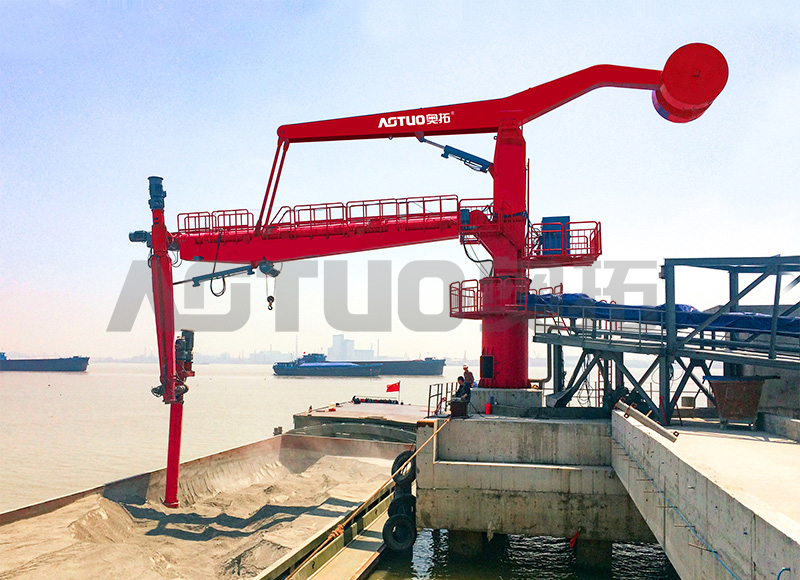
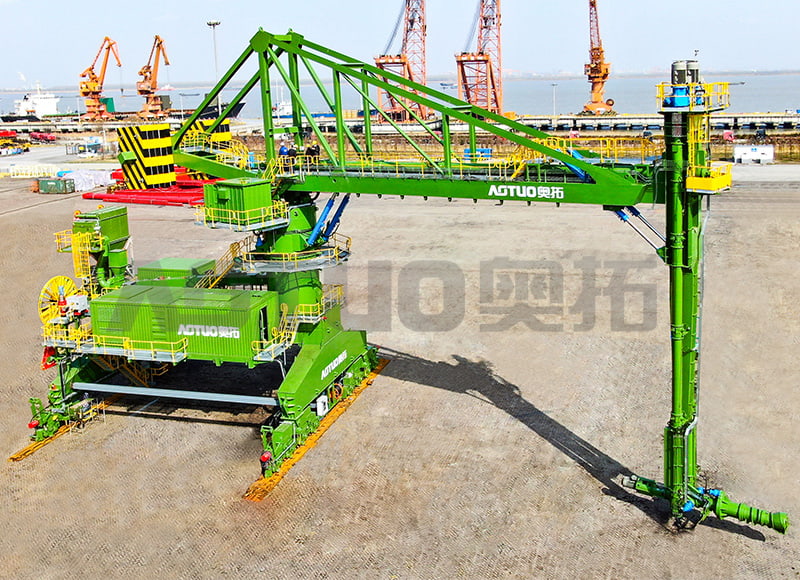 Rail-Mobile Screw Ship Unloader ATXL-B / RMS-200-1500Rail-mounted continuous unloader for dry bulk, offering berth-to-berth mobility and 200–1500 t/h capacity; review for multi-berth terminals needing flexible positioning.View Product →
Lowest structural complexity. No travel gear, no cable reeling, no rail foundation. Suits a berth, receiving point and material that will stay the same for the life of the asset.
Trade-off: the machine serves one position, and a second berth needs a second machine.
Rail mobile, tire mobile and vehicle mounted units travel to the work, which suits terminals running several berths, seasonal cargo or temporary operations.
Trade-off: rail alignment or hardstand quality, travel gear maintenance and cable management become buyer-side responsibilities.
Shipborne units invert the logic: the unloader travels with the vessel rather than the berth, which changes commissioning location, spares strategy and support distance. Ask the manufacturer which configurations it has delivered, in which country and with which material.
A machine designed for cement will not handle grain well, and the reason is mechanical. Cement is fine, aeratable and dust-generating. Clinker is coarse and abrasive. Coal adds containment requirements. Grain is fragile and must move without cracking kernels.
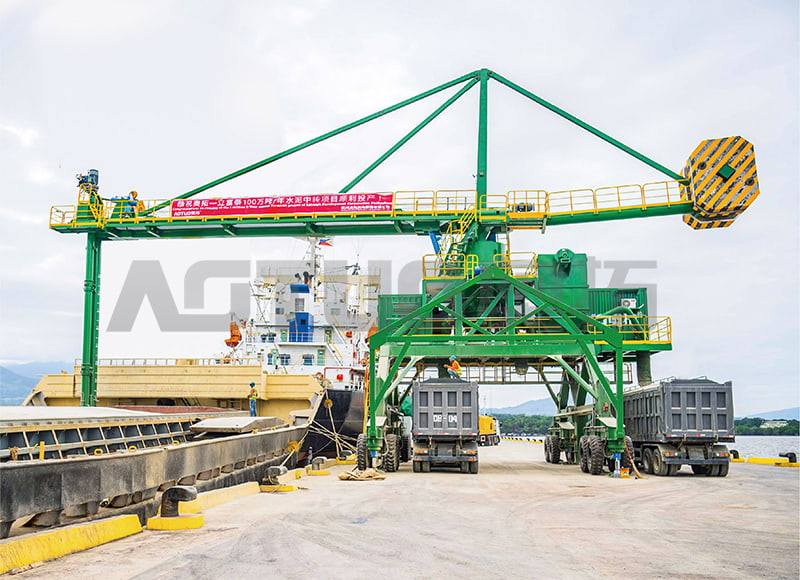
 BULKFLOW G-7000 Grain Ship UnloaderRail-mounted continuous unloader for wheat, corn, and soybeans, with gentle screw conveying and grain-focused dust and explosion safety for port terminals.View Product →
The differences show up in four places:
A manufacturer running separate lines for cement, clinker, coal and grain is a different proposition from one selling a single generic unloader. The first has already paid the engineering cost of those differences.
Participation in standards drafting is one of the few publicly checkable signals of design ownership. Hangzhou Aotuo Mechanical and Electrical Co., Ltd. (AOTUO) is the responsible drafting unit for JC/T 2575, the building materials industry standard for the bulk cement screw ship unloader, and states that it holds more than 100 invention, utility model and design patents together with software copyrights.
For a buyer, the value is not the certificate. A manufacturer working inside a standard has agreed terminology, agreed test methods and agreed acceptance criteria for the equipment category, which makes performance claims testable instead of rhetorical.
Ask which standard number the machine is designed and tested against, and which test method the performance guarantee references. If the answer is vague, the guarantee is vague.
Rule for evaluating performance guaranteesRead a supplier's company profile as a document rather than a brochure: what it claims, what it can evidence, and what it leaves unsaid.
Before a contract, buyers have two verification routes: what the factory can show and what previous projects can prove. AOTUO reports equipment operating in Australia, Singapore, the Philippines, Vietnam, Indonesia and Bangladesh, and publishes port project records covering Huizhou Port and Maoming Port in Guangdong, Brisbane and Sydney Harbour in Australia, and the Port of Mariveles in the Philippines.
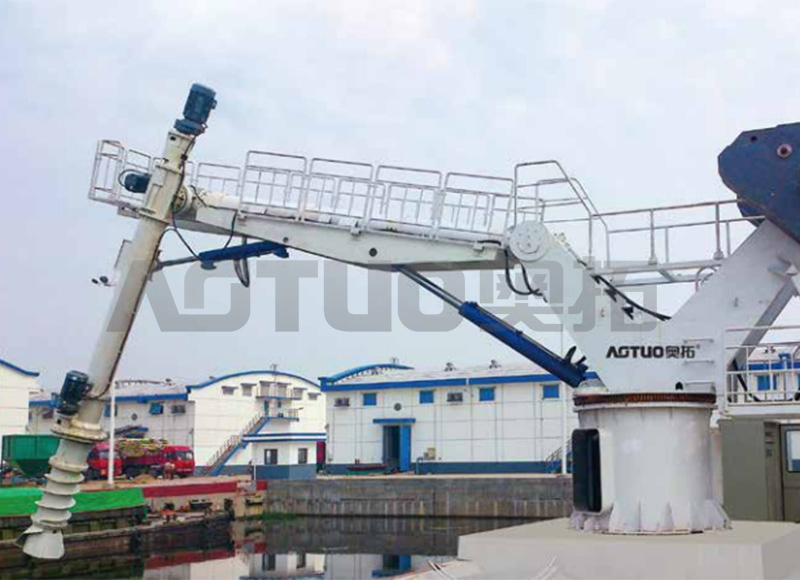
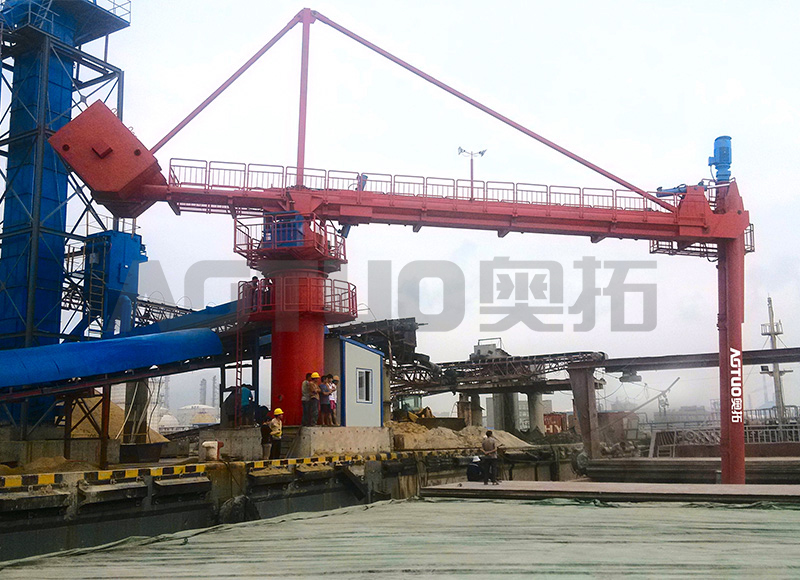 ATXL-A Fixed Screw Ship UnloaderFixed-pedestal continuous unloader for dedicated berths, handling 100–500 t/h with lower capital cost when vessel arrivals and berth assignment are predictable.View Product →
Use references carefully. A reference is useful only when it matches your material, vessel class and berth constraints. Ask for the closest match rather than the largest, then ask that reference what capacity the machine actually averages and what has failed.
A pre-award checklist that has repeatedly exposed gaps:
Most of the cost difference between two screw ship unloader manufacturers appears after delivery, in the terms left loose. Lock these down in writing:
The purchase price is one line in that list. A machine quoted lower but carrying a longer commissioning window, an earlier liner change and internationally shipped spares is rarely the cheaper asset.
Specify capacity at the material and duty point you actually operate, then compare it with the manufacturer's published ceiling. AOTUO publishes a maximum of 3,000 t/h and vessel compatibility up to 200,000 DWT across its screw unloader line. Those describe the top of the range, so the guaranteed number in your contract must be tied to a named material, a moisture condition and a defined hatch geometry.
Rail mobile and tire mobile configurations exist for that case. A rail mobile unit follows the quay; a tire mobile unit needs a hardstand but no rail foundation. Choose between them on berth layout, travel distance per shift and whether the quay can carry the additional wheel or rail loads.
Use three checks in order. Confirm whether the manufacturer helped draft the relevant industry standard; AOTUO is the responsible drafting unit for JC/T 2575. Audit the factory and look at fabrication and assembly rather than the showroom. Then call a reference running the same material and vessel class and ask what has broken.
Because the engineering inputs differ. Abrasiveness sets liner material, dust behaviour sets the sealing arrangement, and particle fragility sets conveying and discharge geometry. A manufacturer maintaining separate lines has already resolved those trade-offs; a single generic machine pushes that risk onto the buyer.
It is focused on the overall solution of dry bulk material port transfer system,
research and development, manufacturing, and service
Copyright © Hangzhou Aotuo Mechanical and Electrical Co., Ltd. All Rights Reserved.
Custom Material Conveyor Transfer Systems Manufacturers