Article Directory
Port terminals and bulk handling facilities that cannot justify the capital expenditure of fixed, rail-mounted shiploaders increasingly rely on a single piece of equipment to close the gap between stockpile and ship hold: the mobile ship loader. Self-propelled on rubber tyres or crawler tracks, repositionable between berths without civil infrastructure, and capable of loading rates from 500 to 10,000 tonnes per hour depending on configuration, mobile shiploaders have redefined the economics of bulk export terminals for grain, coal, fertiliser, cement, and mineral concentrates. This guide covers the four specification decisions that determine whether a mobile shiploader delivers its rated throughput across a 20-year operational life.
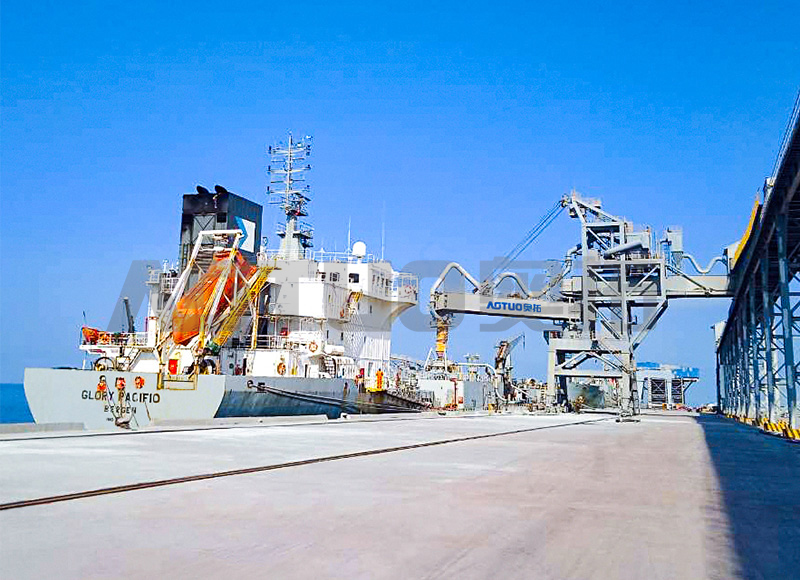
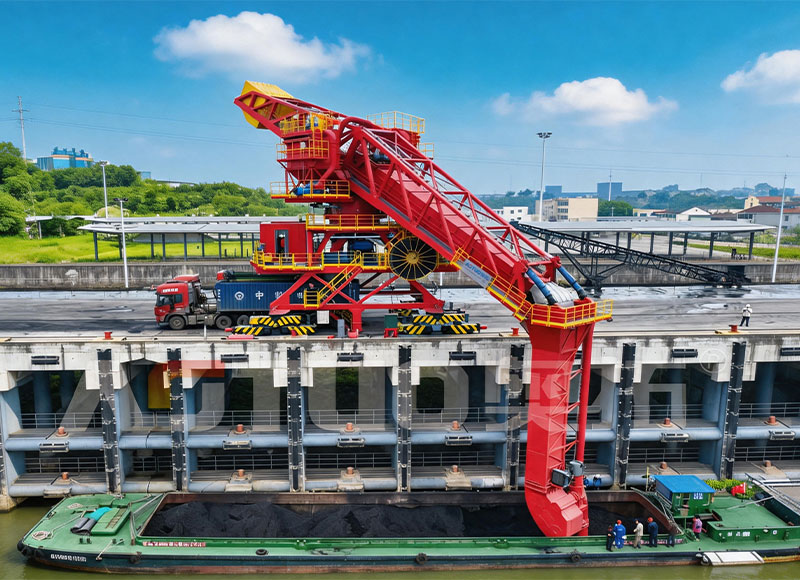
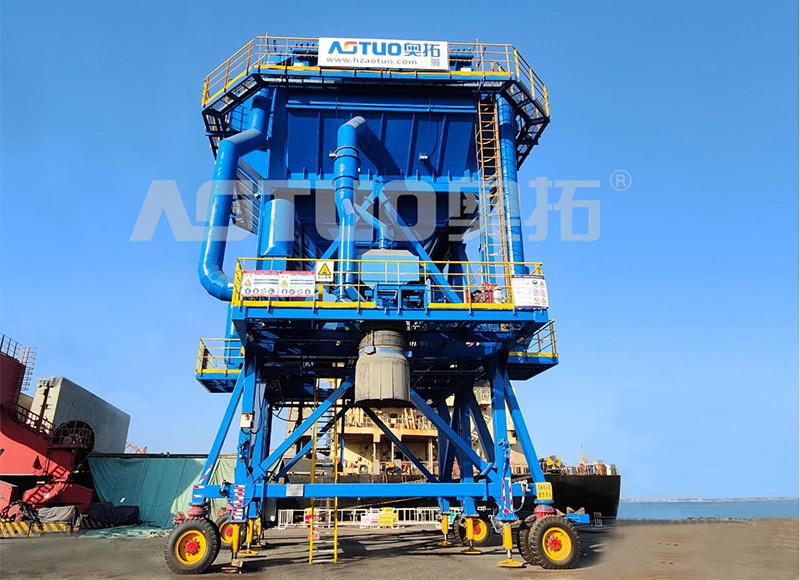
A mobile shiploader is a self-contained bulk material handling system that receives cargo from a land-side conveyor or hopper, transfers it along an articulated boom, and discharges it into a ship hold through a telescoping chute. Every functional system within the machine exists to manage material flow, dust, spillage, and structural load simultaneously.
Material arrives at the loader's intake conveyor from a land-side belt conveyor, hopper, or front-end loader feed point. The receiving conveyor is fitted with a weigh-belt or impact weigher that provides real-time tonnage data for loading rate control and draft survey reconciliation. Belt width at the intake is sized to match the peak feed rate from the upstream conveying system — a mismatch here creates the bottleneck that limits terminal throughput regardless of boom capacity.
The main boom carries a belt conveyor from the machine body to the discharge point above the ship hold. The boom luffs — raises and lowers — via hydraulic cylinders to match the varying hold depth as the ship loads and settles deeper in the water. Luffing angles typically range from +15° (elevated, travelling position) to -15° (depressed, loading into deep holds). Some configurations add slewing — 360° or sector rotation — allowing a single machine to reach multiple hold positions without repositioning the entire machine along the quay.
At the boom tip, a telescoping chute extends downward into the ship hold, placing the material discharge point within 1–2 metres of the cargo surface. This short drop distance is the primary mechanism for dust suppression — eliminating the long free-fall that generates fugitive dust in open-chute designs. The chute retracts automatically as the hold fills, maintaining the target drop height throughout the loading sequence. Chute extension ranges from 3 to 12 metres depending on hold depth and vessel class.
Rubber-tyred mobile shiploaders travel on the quay surface under self-propelled diesel-hydraulic or electric drive, repositioning between holds or berths without crane assistance. Crawler-track configurations are used where quay surface bearing capacity is limited or where gradient travel is required. Outrigger stabilisers deploy from the machine base during loading operations, distributing the structural reaction loads across a footprint that matches the quay's allowable bearing pressure — typically 50–120 kN/m² for container and bulk quay designs.
Mobile shiploaders are designed for free-flowing bulk solids — materials that discharge by gravity from a conveyor belt and can be transported on a belt without adhesion, bridging, or excessive degradation. Cargo characteristics determine belt speed, chute geometry, dust suppression requirement, and material contact surface specification.
| Cargo Type | Bulk Density (t/m³) | Key Design Requirement | Dust Class | Special Consideration |
| Grain (wheat, corn, soy) | 0.72 – 0.85 | Food-grade belt, enclosed chute | Moderate | Phytosanitary cleaning between cargoes |
| Thermal Coal | 0.80 – 0.90 | Fire suppression, belt earthing | High | Water spray mandatory on all transfer points |
| Cement / Clinker | 1.20 – 1.50 | Hardened belt covers, sealed chute | Very High | Filter unit required; cement sets if wet |
| Fertiliser (granular) | 0.90 – 1.10 | Stainless contact surfaces | Moderate | Hygroscopic — enclosed conveyor preferred |
| Iron Ore / Concentrates | 2.00 – 2.60 | Heavy-duty belt (EP500+), reinforced chute | Low–Moderate | High bulk density drives belt and structure sizing |
| Wood Pellets / Biomass | 0.55 – 0.70 | ATEX-rated electrical components | Very High | Explosion risk — inert gas chute flushing required |
Required loading capacity is not determined by the shiploader alone — it is calculated backwards from the vessel turnaround time target, the demurrage cost per hour, and the upstream stockpile feed rate. Undersizing loading capacity costs more in vessel demurrage than the capital cost difference between machine classes over a five-year operating period.
Handysize vessels (10,000–35,000 DWT). Boom length 20–28 m. Suited to regional grain export terminals, small coal ports, and mineral concentrate facilities with annual throughput below 2 million tonnes.
Supramax to Panamax vessels (35,000–80,000 DWT). Boom length 28–36 m. The most common class for new greenfield bulk terminals. Covers 80% of global dry bulk vessel calls by volume.
Post-Panamax to Capesize vessels (80,000–180,000 DWT). Boom length 36–42 m. Standard for major coal export terminals, iron ore facilities, and large grain export ports with annual volumes above 10 million tonnes.
Capesize and VLOC vessels (180,000+ DWT). Boom length 42–50 m. Dual-belt or twin-boom configurations. Required for dedicated iron ore and coal export facilities with sub-24-hour turnaround requirements on 200,000 DWT vessels.
The industry standard for capacity sizing is: Required TPH = (Vessel DWT × Load Factor) / (Allowed Laytime in hours × Operational Efficiency). For a 75,000 DWT vessel at 95% load factor, 36-hour laytime, and 75% mechanical availability, the required nominal loading rate is 2,778 TPH — placing it squarely in Class II territory. Sizing to Class I on this vessel profile generates approximately USD 45,000 per vessel call in demurrage exposure at standard Panamax demurrage rates.
Selecting a mobile ship loader for a new or upgraded terminal involves six specification parameters that must be resolved before approaching any equipment supplier for a formal quotation.
Rubber-tyred machines require a paved, load-rated quay surface with minimum bearing capacity of 80 kN/m² under outrigger pads. Crawler-track machines can operate on unpaved or lower-capacity surfaces but travel at 0.3–1.0 km/h versus 5–15 km/h for tyred machines. Confirm the quay's structural loading certificate before specifying travel system type — retrofitting outrigger pads to an under-capacity quay is a civil engineering project, not a machine accessory.
Define the design vessel — the largest vessel that will regularly call at the berth — and size the boom reach accordingly. Boom length must place the discharge chute over the outermost hold coaming at maximum vessel beam with a minimum 2 m clearance margin. Check the air draught requirement: the boom in travel position must clear the vessel's navigation bridge when transiting between holds along the berth.
The mobile shiploader's intake must interface cleanly with the terminal's land-side conveyor system. Specify the feed conveyor belt width, speed, and peak tonnage, then confirm the shiploader intake can accept this rate without spillage or belt overloading. Travelling cable reels or catenary cable systems must be sized for the full travel distance along the berth — inadequate cable management is among the most common causes of unplanned downtime on mobile shiploaders in the first year of operation.
Specify the dust emission standard required by the port authority and environmental permit. Water spray systems (at intake, boom transfer, and chute tip) suit most coal, ore, and fertiliser applications. Enclosed conveyor and filter unit configurations are mandatory for cement, clinker, and wood pellet loading. ATEX Zone 2 electrical specification is required for biomass and some fertiliser cargoes — confirm the cargo's dust explosion class (Kst value) before finalising the electrical design.
Shore power (electric cable reel) is the standard for permanent terminal installations — lower operating cost and zero exhaust emissions at the berth. Diesel-hydraulic or diesel-electric self-contained power is specified for multi-terminal operations, remote facilities without shore power infrastructure, or applications requiring full machine independence during berth relocation. Hybrid configurations — diesel for travel, shore power for loading — optimise fuel consumption and emission compliance simultaneously.
Specify the machine's preventive maintenance cycle — 250-hour, 500-hour, and annual service intervals — and confirm that the supplier maintains a regional spare parts depot within 48-hour delivery distance of the terminal. Key wear items (belt scrapers, chute liners, belt idlers, hydraulic seals) must be available locally, not on 8–12 week sea freight lead times from the manufacturer's country of origin. Request the spare parts list and local distributor network confirmation before contract award.
It is focused on the overall solution of dry bulk material port transfer system,
research and development, manufacturing, and service
Copyright © Hangzhou Aotuo Mechanical and Electrical Co., Ltd. All Rights Reserved. Custom Material Conveyor Transfer Systems Manufacturers