EN
EN English
 中文简体
中文简体 Français

A screw ship unloader is a continuous mechanical bulk material handling system that uses one or more helical screw conveyors to extract dry bulk cargo — such as grain, cement, fertilizer, coal, and minerals — from the holds of ships and transfer it to shore-side storage or transport systems. Compared to grab unloaders, screw ship unloaders deliver higher efficiency, lower cargo losses, and significantly less dust generation, making them the preferred choice for grain terminals, cement import facilities, and environmentally sensitive port operations worldwide.
How a Screw Ship Unloader Works
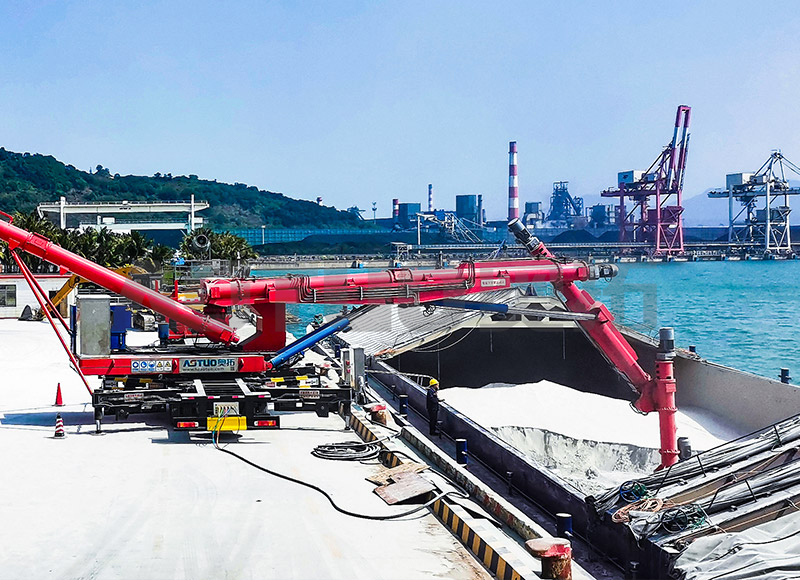
The operating principle of a screw ship unloader is straightforward: a rotating helical auger (screw) is lowered into the ship's cargo hold, where its flights bite into the bulk material and push it upward along the screw's axis into a vertical conveying tube. From there, the material is transferred to a horizontal or inclined discharge conveyor on the boom, then onto a shore-side belt conveyor or into trucks and storage bins.
The complete mechanical chain typically follows this path:
- Intake screw (in-hold): One or more horizontal or inclined intake screws at the bottom of the machine sweep material from the hold floor toward the base of the vertical screw. These are critical for achieving low hold residue.
- Vertical screw conveyor (riser): The core component — a large-diameter helical screw housed inside a sealed tube that lifts material from hold to boom level. Typical vertical screw diameters range from 400 mm to 800 mm.
- Boom conveyor: A belt or enclosed screw conveyor on the boom transfers material horizontally to the discharge point above the quay.
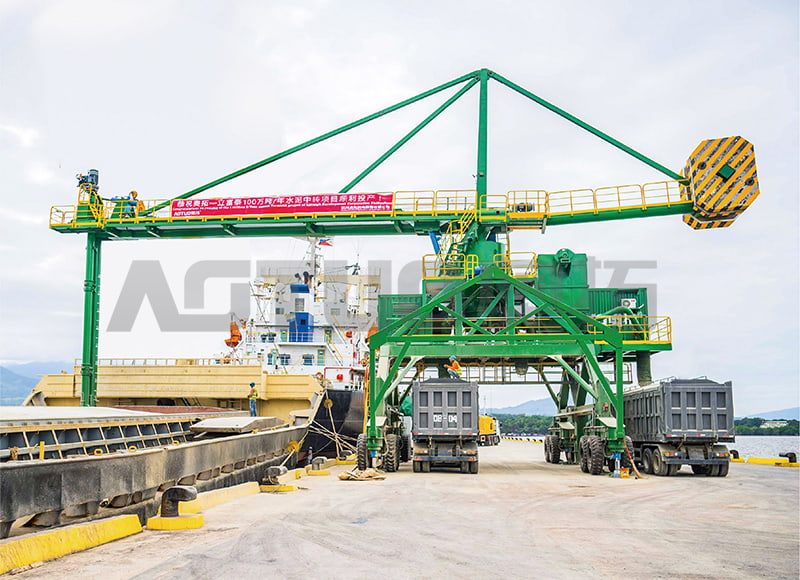
- Discharge to shore: Material drops onto a quay conveyor belt, into hoppers, or directly into trucks depending on terminal layout.
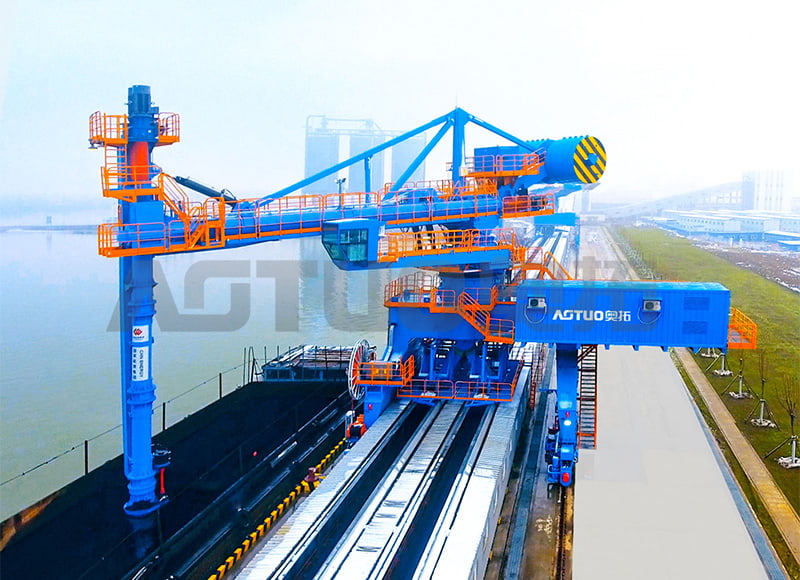
The entire vertical screw assembly is mounted on a luffing boom that can be raised, lowered, and slewed (rotated horizontally) to reach different positions within a ship's hold. Most modern units also telescope — the screw tube extends downward to keep pace with the dropping cargo surface as unloading progresses.
Drive Systems and Power
Screw ship unloaders are powered electrically in virtually all modern installations. The vertical screw is driven by a high-torque electric motor at the top of the riser tube, typically through a gearbox. Intake screws use separate drive motors, allowing speed control independent of the vertical screw. Total installed power for a mid-size unit with a 500 t/h capacity typically ranges from 250 kW to 450 kW, while large high-capacity units (1,000 t/h and above) may require 600–900 kW of installed power.
Types of Screw Ship Unloaders
Several distinct configurations have emerged to suit different port layouts, cargo types, and ship sizes. Selecting the right type depends on quay geometry, vessel beam, cargo characteristics, and required capacity.
| Type | Structure | Typical Capacity | Best Application |
|---|---|---|---|
| Portal / Rail-Mounted | Travels on quay rails; portal frame straddles the quay conveyor | 200 – 1,500 t/h | Dedicated grain, fertilizer, or cement terminals with fixed quay conveyors |
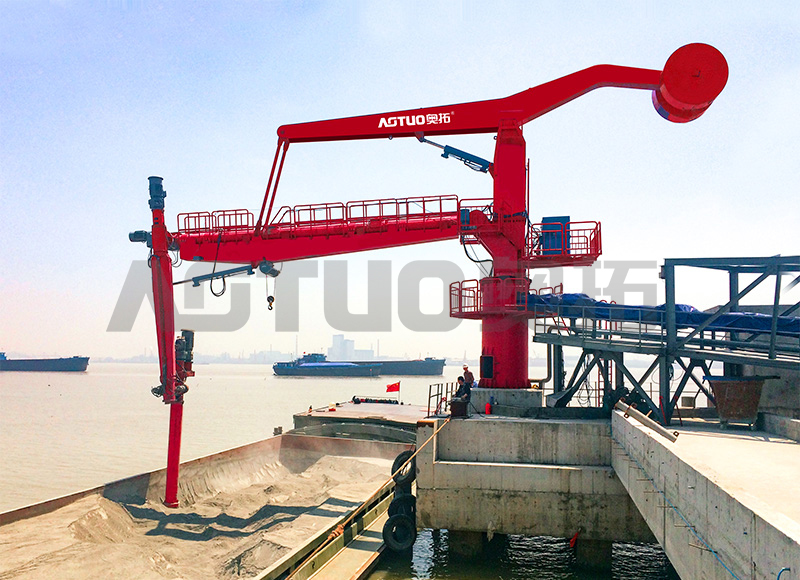
| Pedestal / Fixed-Base | Fixed to quay structure; boom slews and luffs only | 100 – 600 t/h | Smaller terminals with limited berth length; cement import |
| Shipboard / Vessel-Mounted | Installed on the ship itself (self-unloading vessels) | 500 – 2,000 t/h | Self-unloading bulk carriers; reduces port equipment investment |
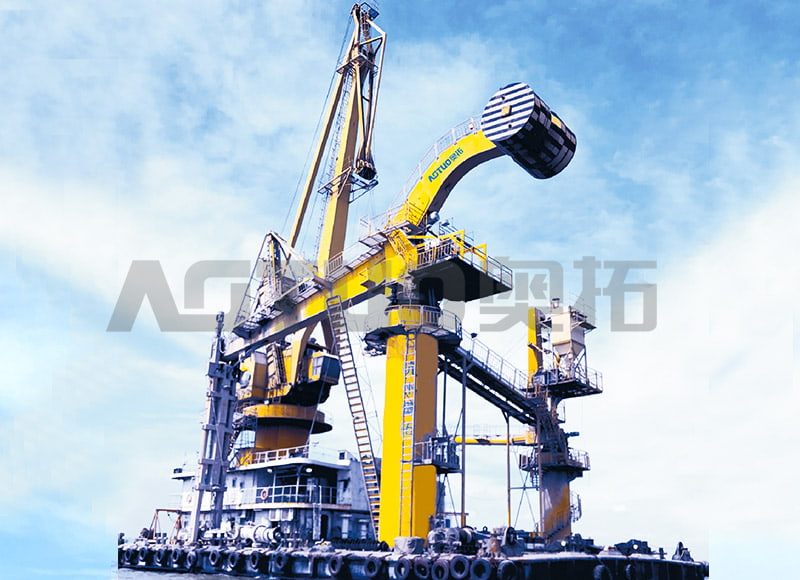
| Floating / Barge-Mounted | Mounted on a pontoon or barge; not quay-dependent | 200 – 800 t/h | Anchorage or roadstead operations; ports without fixed quay infrastructure |
| Telescopic Boom Type | Boom length adjusts to reach vessel beam; screw tube extends vertically | 300 – 1,200 t/h | Ports handling a wide range of vessel sizes (Handysize to Panamax) |
Rail-Mounted Portal Type: The Most Common Configuration
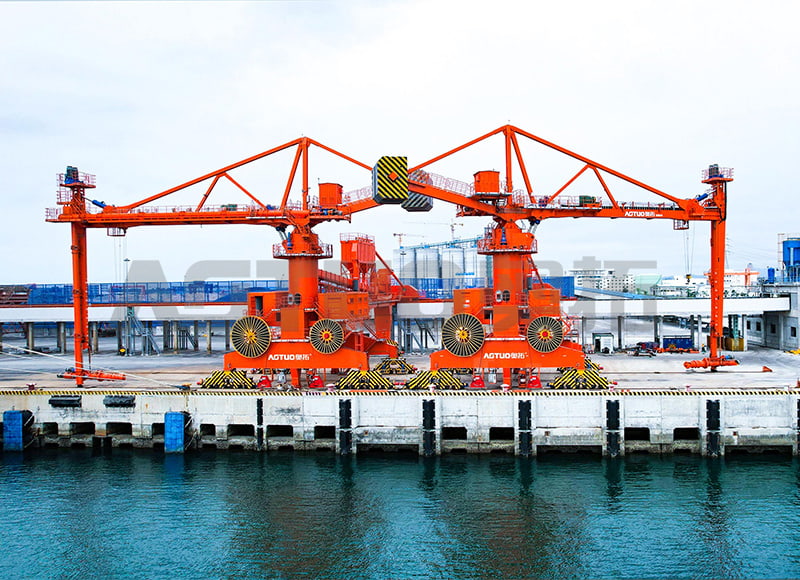
The rail-mounted portal screw ship unloader is the workhorse of major bulk terminals. It travels along rails on the quay, allowing a single machine to service multiple ship hatches sequentially without the vessel needing to shift berth. The portal frame design leaves the quay conveyor belt accessible below the machine, enabling continuous shore-side transport while unloading proceeds. Machines of this type from manufacturers such as NEUERO, Bühler, and Cargotec (Siwertell) regularly achieve rated capacities of 600–1,000 t/h in grain and fertilizer service.
Siwertell (Enclosed Screw) Type: The Dust-Free Standard
The Siwertell design, developed by Cargotec, uses a fully enclosed screw conveyor chain from hold intake to shore discharge point. No material is exposed to the atmosphere at any stage, making it the dominant choice where dust emissions must be near zero — cement terminals, malt and grain import in urban ports, and facilities near residential areas. Siwertell units are in operation at over 600 installations globally, with some handling capacities exceeding 1,500 t/h for coal and grain.
Key Performance Specifications to Evaluate
When specifying or comparing screw ship unloaders, the following parameters define real-world performance and total cost of ownership more accurately than headline capacity figures alone.
| Parameter | Typical Range | Why It Matters |
|---|---|---|
| Rated capacity (t/h) | 100 – 2,000 t/h | Determines ship turnaround time; must match terminal throughput targets |
| Vertical screw diameter | 400 – 800 mm | Larger diameter increases capacity and reduces blockage risk for coarse materials |
| Max ship size (DWT) | 5,000 – 100,000 DWT | Boom reach and telescoping range must cover full vessel beam and hold depth |
| Hold residue (% of cargo) | 0.1% – 0.5% | Lower residue reduces cargo loss and cleaning time between voyages |
| Screw rotation speed | 50 – 200 RPM | Higher RPM increases throughput but raises wear rates on screw flights and liners |
| Dust emission level | <1 mg/m³ (enclosed) to <10 mg/m³ (semi-enclosed) | Critical for environmental permits; enclosed designs are mandatory in many jurisdictions |
| Specific energy consumption | 0.3 – 0.8 kWh/t | Directly impacts operating cost; lower values indicate higher mechanical efficiency |
| Slewing range | ±90° to ±270° | Wider slew allows the machine to cover more hatch positions without traveling |
| Availability / uptime | 85% – 97% | High availability depends on screw flight wear monitoring and scheduled maintenance intervals |
Hold Residue: The Most Overlooked Metric
While rated capacity attracts the most attention in procurement, hold residue — the percentage of cargo left in the hold that must be removed by hand or auxiliary equipment — has an outsized impact on total unloading cost. A machine handling 50,000-tonne Panamax shipments at 0.5% residue leaves 250 tonnes per ship to be swept manually, adding several hours of labor and delay per voyage. The best modern screw unloaders with extended reach intake screws achieve residues below 0.15%, saving significant labor and turnaround costs over thousands of annual vessel calls.
Materials Handled by Screw Ship Unloaders
Screw conveyors are effective across a wide range of dry bulk commodities, but material properties — particularly bulk density, abrasiveness, moisture content, and flowability — significantly influence screw design, lining material, and maintenance intervals.
| Commodity | Bulk Density (t/m³) | Key Challenge | Design Consideration |
|---|---|---|---|
| Wheat / Corn / Soybeans | 0.72 – 0.82 | Grain breakage from excessive screw speed | Controlled RPM; gentle intake geometry; food-grade liners |
| Cement (clinker) | 1.2 – 1.5 | High abrasiveness; dust generation; moisture sensitivity | Hardened screw flights; fully enclosed system; dehumidified air purge |
| Fertilizer (urea, DAP, AN) | 0.75 – 1.0 | Hygroscopic caking; corrosive to steel | Stainless steel or coated flights; drying air injection; rapid cleanout design |
| Coal | 0.8 – 0.95 | Abrasive; dust explosion risk | Wear-resistant liners; inert gas purge option; ATEX-rated drives |
| Potash / Mineral Salts | 1.0 – 1.3 | Highly abrasive; corrosive | Tungsten carbide–tipped screw flights; 316L stainless contact surfaces |
| Malt / Barley | 0.55 – 0.65 | Low density; fragile kernels; food safety | Reduced RPM; smooth interior surfaces; NSF-compliant materials |
| Soybean Meal / Fishmeal | 0.55 – 0.70 | Sticky; odor containment; pest risk | Easy-clean surfaces; enclosed system; sealed inspection hatches |
Why Abrasiveness Drives Maintenance Cost More Than Anything Else
Cement clinker, potash, and coal are the most demanding commodities for screw flight wear. Unprotected mild steel flights handling cement clinker may require replacement after as few as 8,000–12,000 operating hours. By contrast, screw flights with Ni-Hard or tungsten carbide overlay can extend service life to 30,000–50,000 hours on the same materials, dramatically reducing both maintenance downtime and lifetime cost. Specifying the correct wear protection at the time of purchase — rather than retrofitting later — is consistently more cost-effective.
Screw Ship Unloader vs. Other Bulk Unloading Methods
| Technology | Capacity Range | Dust Control | Cargo Loss | Best For | Limitations |
|---|---|---|---|---|---|
| Screw Ship Unloader | 100 – 2,000 t/h | Excellent (enclosed) | Very low (<0.2%) | Grain, cement, fertilizer, coal | Less effective for very coarse or lumpy materials |
| Grab / Crane Unloader | 200 – 2,000 t/h | Poor – moderate | High (0.5% – 2%+) | Coal, iron ore, scrap metal | High dust; spillage; slow cleanup; high residue |
| Pneumatic Unloader | 50 – 400 t/h | Good (enclosed) | Very low | Grain, flour, pellets | High energy consumption (2–3× screw); slow for large vessels |
| Bucket Elevator Unloader | 300 – 1,500 t/h | Moderate – good | Low – moderate | Grain, coal, minerals | Complex mechanical system; high maintenance on buckets/chains |
| Self-Unloading Belt | 1,000 – 5,000 t/h | Moderate | Low | Coal, aggregate, iron ore (large volumes) | Requires specially built self-unloading vessel; high capital cost |
The screw ship unloader's decisive advantages over grab cranes are dust control and cargo recovery. At a grain terminal handling 300 vessel calls per year with an average cargo of 30,000 tonnes, reducing spillage and residue from 1.0% (grab) to 0.2% (screw unloader) recovers approximately 2,400 additional tonnes of saleable cargo annually — a direct revenue benefit that typically pays back the premium cost of an enclosed screw system within 3–5 years.
Against pneumatic unloaders, screw systems win on energy efficiency. A pneumatic system handling grain at 200 t/h may consume 1.5–2.5 kWh/t, while an equivalent screw system consumes 0.3–0.5 kWh/t — a 4x to 6x energy saving that translates directly into lower operating cost per tonne handled.
Installation, Commissioning, and Maintenance Considerations
Quay and Foundation Requirements
Rail-mounted screw ship unloaders impose significant structural loads on the quay. A fully equipped 600 t/h machine with a telescoping boom typically has a self-weight of 150–280 tonnes. Quay design must account for wheel loads, wind loads (typically designed to Beaufort 12 storm conditions in parked position), and seismic loading where applicable. Rail gauge for large portal units commonly ranges from 10 m to 16 m. Any terminal expansion or new construction project must engage structural engineers to verify quay load capacity before specifying the machine configuration.
Screw Flight Wear Monitoring
Modern screw ship unloaders increasingly incorporate wear monitoring systems — ultrasonic thickness measurement sensors embedded in screw flight tips or along the conveyor tube lining — that report real-time wear data to the control system. This allows maintenance teams to plan flight replacements based on actual condition rather than fixed time intervals, reducing unexpected breakdowns by up to 40% in documented case studies from cement terminals in Northern Europe.
Routine Maintenance Intervals
- Daily: Visual inspection of screw flight condition, lubrication checks on upper and lower screw bearings, inspection of sealing systems on intake screws
- Weekly: Gearbox oil level check, travel rail and wheel flange inspection, boom hoist wire rope condition assessment
- Monthly: Full lubrication of all slewing ring bearings, inspection of screw tube liner wear, electrical panel inspection
- Annual: Full screw flight dimensional inspection, gearbox oil change, structural crack inspection per manufacturer's fatigue analysis, non-destructive testing (NDT) of critical structural welds
Typical Service Life
A well-maintained screw ship unloader at a grain or fertilizer terminal can achieve a service life of 25–35 years for the primary structural components (portal frame, boom structure, travel bogies). Screw flights and wear liners are consumable items replaced on a 3–7 year cycle depending on material abrasiveness. Drive motors and gearboxes typically require overhaul or replacement at 15–20 year intervals. This long service life makes the initial capital cost — typically USD 3–12 million for a medium to large rail-mounted unit — justifiable on a per-tonne-handled basis over the machine's lifetime.
Leading Manufacturers and Notable Installations
| Manufacturer | Brand / Product Line | Notable Installation | Capacity |
|---|---|---|---|
| Cargotec (Finland) | Siwertell | COFCO Grain Terminal, Tianjin, China | 2 × 1,000 t/h (wheat) |
| NEUERO (Germany) | NEUERO Portquip | Port of Hamburg grain terminal | 600 t/h (grain) |
| Bühler Group (Switzerland) | PORTALINK / SICON | Multiple grain terminals in Brazil and Europe | 300 – 800 t/h |
| Van Aalst (Netherlands) | Screw Unloader Series | Rotterdam cement terminal | 400 t/h (cement) |
| BEUMER Group (Germany) | Ship Unloader | Fertilizer terminal, Jorf Lasfar, Morocco | 500 t/h (DAP/urea) |
| Metso Outotec (Finland) | Bulk handling systems | Mining mineral terminals, Southeast Asia | Up to 1,200 t/h |
The Siwertell enclosed screw system has the largest global installed base for environmentally sensitive applications, with over 600 units in operation across grain, cement, and coal terminals on every continent. NEUERO machines are especially prevalent at European grain terminals, where their modular design simplifies spare parts logistics across multiple terminal operators. For the highest-capacity requirements — bulk coal and mineral unloading above 1,500 t/h — some operators combine screw unloaders for hold floor sweeping with bucket elevator systems for the main vertical lift, achieving the dust control of a screw intake with the high throughput of a bucket system.
Selecting the Right Screw Ship Unloader: Decision Checklist
- Define your cargo mix: A machine optimized for grain at 0.75 t/m³ bulk density will be undersized in terms of motor torque if you later add cement clinker at 1.4 t/m³. Specify the full range of commodities upfront.
- Confirm vessel size range: Maximum beam, hold depth, and hatch opening dimensions for the largest vessel expected at the berth must be verified against boom reach and telescoping stroke specifications.
- Set dust emission requirements: Check local environmental regulations before specifying open vs. enclosed design. Many ports in the EU, North America, and urban Asia now mandate <5 mg/m³ dust emissions, which requires fully enclosed screw systems.
- Evaluate quay load capacity: Engage a structural engineer to confirm that the existing quay can support the machine's self-weight and dynamic loads before finalizing the machine weight and rail gauge.
- Calculate total cost of ownership, not just capital cost: A lower-cost machine with standard wear liners may cost more per tonne over 20 years than a premium machine with hardened flights and a high-availability design.
- Assess spare parts supply chain: For terminals in remote locations, verify that the manufacturer has a regional spare parts depot or can supply critical wear components (screw flights, liner segments, gearbox internals) within 48–72 hours.
- Plan for automation: Modern screw ship unloaders can be equipped with anti-collision radar, hold contour scanning (LIDAR), and automated depth control. If the terminal plans to move toward semi-autonomous or fully automated operation within the machine's service life, specify the control system infrastructure now.