EN
 English
 中文简体
 Français

Industry News
Home / News / Industry News / Screw Ship Unloaders for Cement and Fly Ash Handling Efficiency at Ports

Article Directory
Two figures decide whether a cement or fly ash berth pays for itself: the rated capacity of the unloader and the deadweight of the ships it must serve. Hangzhou Aotuo Mechanical and Electrical Co., Ltd. (AOTUO) builds screw ship unloaders rated to 3,000 t/h for vessels up to 200,000 DWT, and the company drafted JC/T 2575, the Chinese industry standard for bulk cement screw unloaders. Everything between those numbers is a question of flowability, dust and berth time.
Berth productivity is lost to three things long before it is lost to rated capacity: powder that will not flow steadily, dust that has to be contained, and minutes spent repositioning between hatch squares.
Cement and fly ash are powders rather than granules. Ordinary Portland cement is typically shipped at a bulk density of about 1.4 t/m3, while dry fly ash sits near 0.85 t/m3 and begins to behave like a liquid the moment a grab or an air stream aerates it. Powder that fluidises surges into any opening offered to it. Powder that compacts bridges over the same opening. Both reactions cost berth hours, and both are predictable from a cargo analysis instead of being discovered on the day of discharge.
Dust is the third constraint, and its cost is measurable rather than theoretical. A grab working an open hold is an open material system: the bucket releases cargo from height, air moves through the falling stream, and the finest fraction of the parcel leaves the quay as airborne dust. That fraction was mined, ground and shipped, and it never reaches the silo.
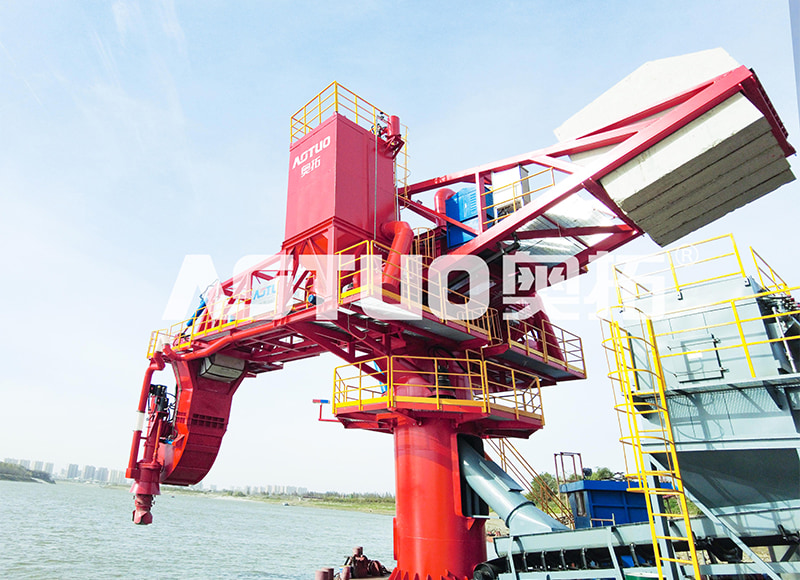
A screw ship unloader is a continuous mechanical unloader that feeds bulk material from the ship's hold into a vertical screw conveyor inside an enclosed casing, then transfers it to the quay through a horizontal screw, air slide or belt conveyor.
There is no pneumatic air circuit and no grab anywhere in the material path. The vertical screw is a positive-displacement conveyor: cement or ash enters at the open intake at the bottom of the casing, is lifted by the rotating screw, and cannot escape sideways because the casing encloses it along its full length. AOTUO has designed and manufactured these machines for more than 20 years, holds more than 100 patents, design registrations and software copyrights, and was among the first Chinese manufacturers to localise the bulk cement screw unloader.
The energy case follows from the same architecture. Published engineering work on mechanical ship unloaders records that screw-principle machines hold substantial energy advantages over other cement handling systems, because the drive motors move the material directly rather than using compressed air as an intermediate transport medium.
The gain from screw unloading appears in three places: a continuous discharge curve instead of a cyclic one, a lower specific energy per tonne than pneumatic conveying, and no clean-up shift after the last hold.
| Criterion | Screw ship unloader | Pneumatic transfer | Grab crane |
| Dust containment | Fully enclosed casing, sealed transfer points | Closed pipeline, leaks possible at joints and filters | Open bucket, dust released at every transfer |
| Discharge pattern | Continuous; up to 3,000 t/h in the AOTUO range | Continuous, limited by air velocity and pipe bore | Cyclic, one bucket at a time |
| Energy per tonne | Motors act directly on the material | Blowers or vacuum pumps run in addition to transport | Low at the bucket, high in total handling |
| Fly ash behaviour | Feed rate controlled at the intake | Heavy aeration of a light powder, blockages with damp ash | Dusting and product loss at every transfer |
| Typical fit | Cement, clinker and fly ash on fixed or rail-mounted berths | Short runs, small parcels, constrained layouts | Mixed cargo, low volume, non-dusty materials |
The last row is where terminal budgets usually go wrong. Grab systems look inexpensive at the equipment line and expensive at the operating line, because cargo handled twice and every cubic metre of extracted dust carry a cost that repeats at every call.
Cargo lost as dust is revenue lost, and the arithmetic is simple: on a 30,000 t parcel, a one percent release is 300 t of product that was shipped, unloaded and never received.
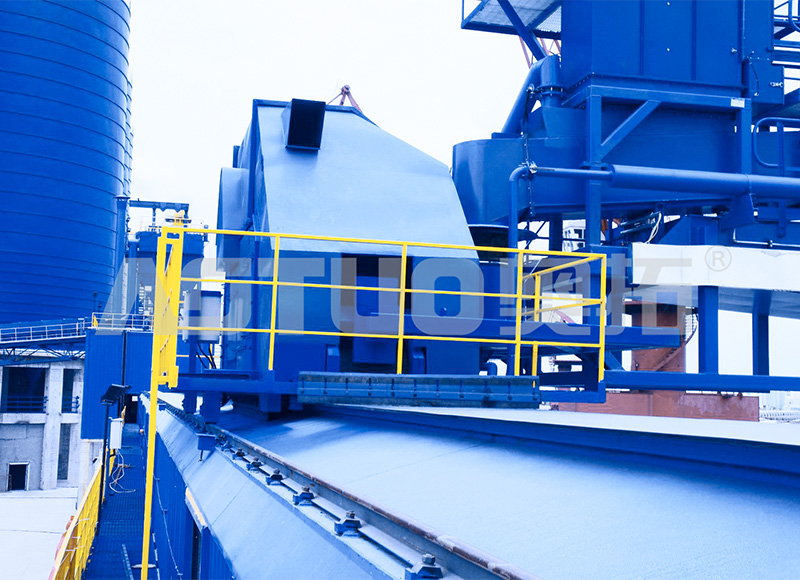
Enclosed screw conveying and negative-pressure collection solve the problem from both ends. Enclosure prevents dust from forming, because the material is never in free fall in open air. Collection at the belt transfer, the receiving hopper and the silo inlet captures what does form. AOTUO supplies dust collectors, air slides and belt conveyors as elements of the same system as the unloader, sized against the unloader's rated output rather than added afterwards.
The screw geometry is largely shared across the range. The mounting and travel system decides which berths a machine can serve and how much of each hold it can reach.
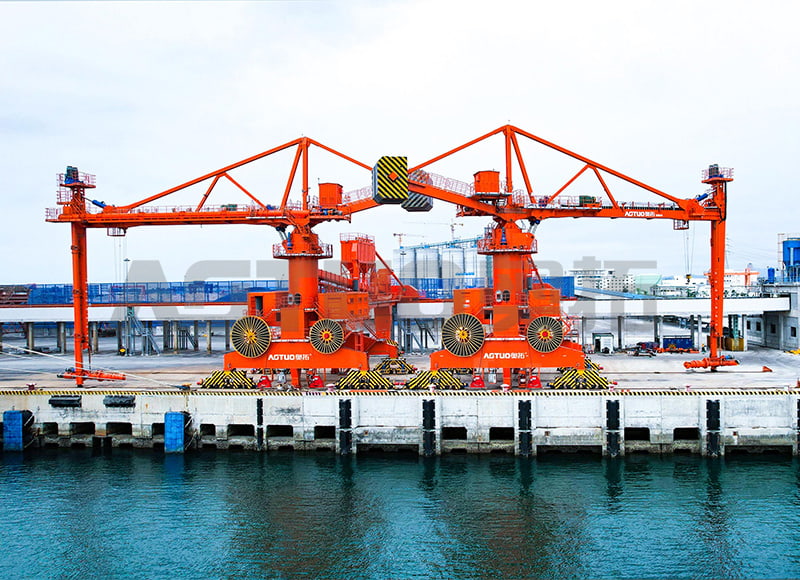
The rail mobile cement screw unloader is the configuration most often specified for a dedicated cement quay, because it keeps the discharge point fixed over the receiving hopper while covering the full berth length.
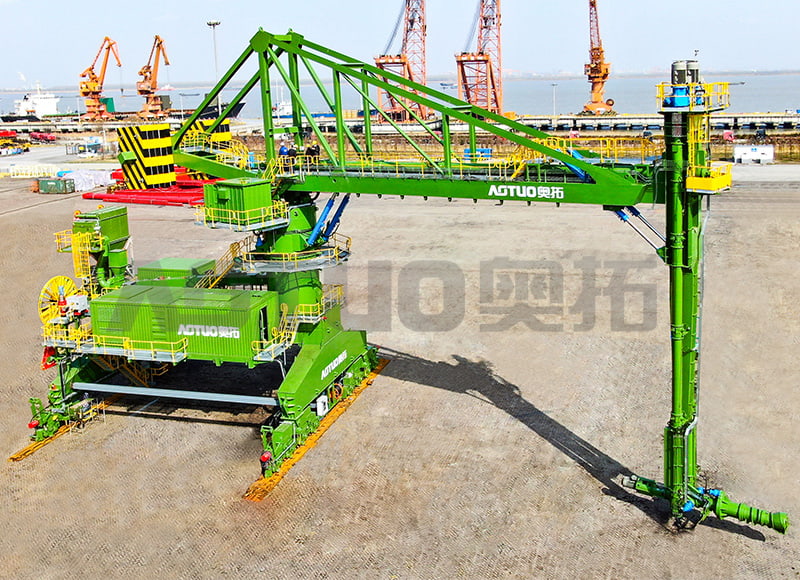 ATXL-B / RMS-200-1500 Rail Mobile Screw Ship UnloaderRail-mounted screw ship unloader for dedicated cement quays, offering 200–1500 t/h capacity and enclosed conveying to shore systems.View Product →
Reference installations include the Port of Maoming and the Port of Huizhou in Guangdong Province, projects in Brisbane and Sydney in Australia, and the Port of Mariveles in the Philippines.
Dry fly ash is roughly 40 percent lighter per cubic metre than ordinary Portland cement, and that single difference changes intake geometry, screw pitch, motor sizing and the handling rate the machine can hold.
A screw unloader handles fly ash well when the feed rate is controlled and the intake is designed for a light, aeratable powder. The failure mode to design against is over-aeration: if the ash is fluidised too aggressively at the intake, it fills the casing faster than the screw can clear it and the machine stalls. Moisture creates the opposite problem, because damp ash compacts and bridges over the intake.
Pneumatic transfer on fly ash
Screw conveying on fly ash
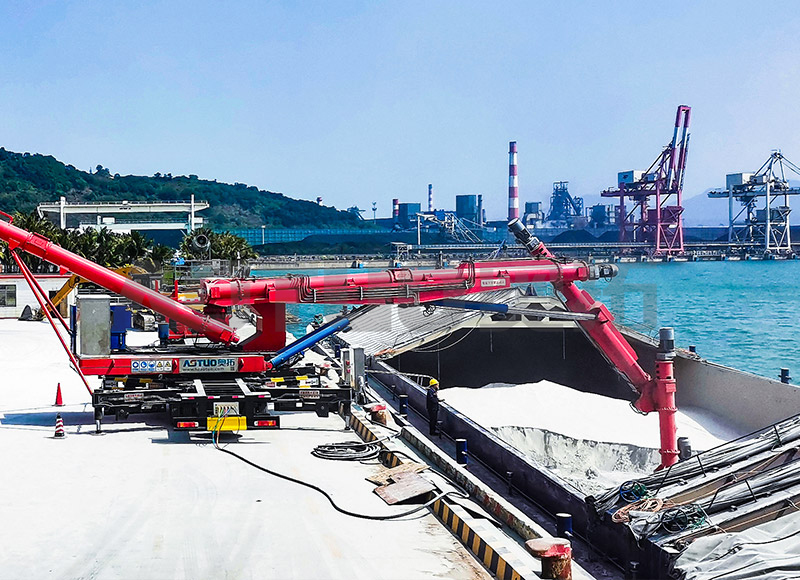
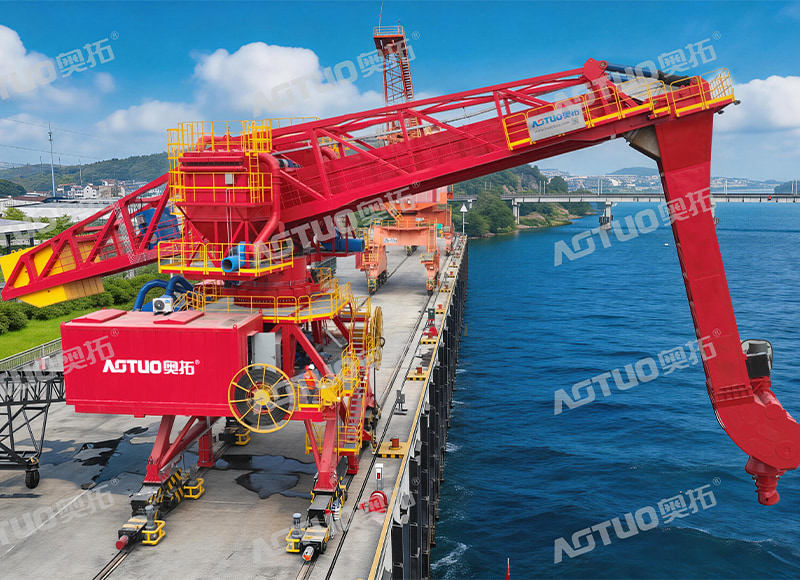 AOTUO ATSL-T Tire-Type Multi-Material Screw Ship UnloaderTire-mounted screw unloader for dry bulk terminals, handling fly ash, clinker, coal and grain at 400–1,000 t/h without rail infrastructure.View Product →
Six figures determine whether a screw unloader reaches its rated capacity in service rather than on paper.
Capacity commitments are verified in service rather than in a datasheet. AOTUO's 2 MTPA cement terminal project in the Philippines entered operation with unloader, conveying and dust control delivered as one system.
A terminal that sustains 1,000 t/h through sealed transfer points spends less per tonne on energy, dust extraction and clean-up than a terminal that reaches the same peak rate in grab cycles and pays the difference at every subsequent call.
AOTUO's cement screw unloaders are rated up to 3,000 t/h, and the sustained figure is set by cargo density, hatch layout and the receiving system: a 30,000 t parcel discharges in 30 hours at a steady 1,000 t/h. The rated capacity holds only when the quay-side conveyor and silo intake can absorb that flow.
Yes, when the intake and screw pitch are matched to the lighter material. Cement ships at about 1.4 t/m3 and dry fly ash at about 0.85 t/m3, so a machine sized only for cement under-fills on ash, and a machine sized only for ash overloads on cement. Multimaterial designs such as the ATSLT tire-type unit are built for that duty.
Design for enclosure first, then measure at the transfer points. GB 4915-2013, the Chinese cement industry air pollutant standard, sets a special emission limit of 10 mg/m3 for particulate matter, and port transfer points are normally specified against a comparable figure. A sealed screw casing is what makes that target reachable without over-sizing the extraction system.
Vessel size sets reach as much as capacity. AOTUO's unloaders are designed for ships up to 200,000 DWT, and on larger vessels the binding constraint is hatch coverage: the boom and travel system must place the screw intake across the full hatch pattern without manual trimming at the end of the discharge.
It is focused on the overall solution of dry bulk material port transfer system,
research and development, manufacturing, and service
Copyright © Hangzhou Aotuo Mechanical and Electrical Co., Ltd. All Rights Reserved.
Custom Material Conveyor Transfer Systems Manufacturers