EN
 English
 中文简体
 Français

Industry News
Home / News / Industry News / Key Factors to Consider When Selecting a Screw: Practical Applications, Selection

Article Directory
Two terminals can order screw ship unloaders with the same 800 t/h nameplate rating and end up with very different annual throughput, because the number that governs berth performance is the continuous rate the machine holds once the inlet feeder has reached the cargo at the bottom of the hold.
Hangzhou Aotuo Mechanical and Electrical Co., Ltd. (AOTUO), founded in 2003, builds screw ship unloaders rated up to 3,000 t/h for vessels up to 200,000 DWT and was the lead drafting unit of the Chinese building materials industry standard JC/T 2575 (Bulk Cement Screw Ship Unloader). The factors below decide whether a terminal project meets its throughput target: material behaviour, required continuous rate, vessel and hold geometry, berth layout, mounting configuration, dust control and wear strategy.
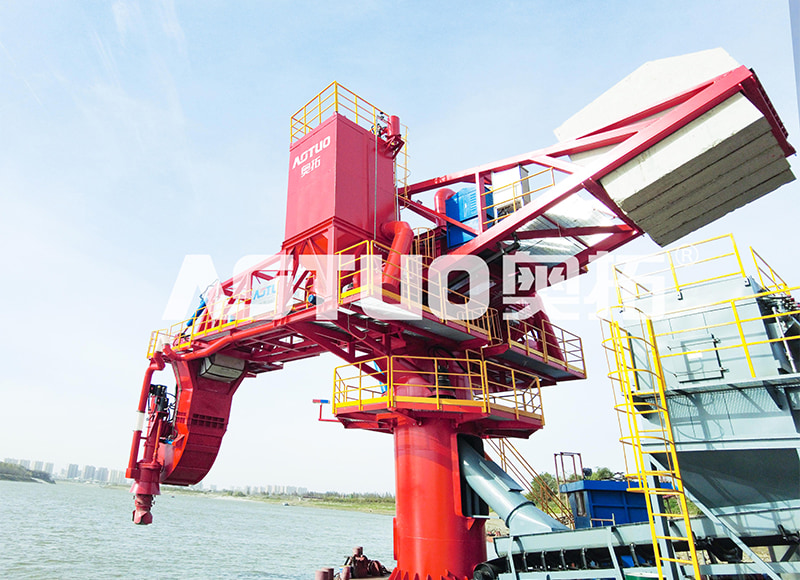
A screw ship unloader is a continuous mechanical unloader that gathers bulk material from a ship's hold with a horizontal inlet screw, lifts it through a vertical screw conveyor, and discharges it into the quay conveying system without a grab cycle.
The machine works in three stages: the inlet feeder collects material across the hold floor, the vertical screw lifts it through a casing to the boom, and a transfer screw or chute delivers it to the shore conveyor, air slide or receiving hopper. Because there is no return trip, output depends on how steadily the inlet feeder stays buried in cargo rather than on how fast a grab can swing. The closed casing also keeps cargo out of the wind between hold and quay, which is why screw systems are specified where particulate limits are tight.
Definition: a screw ship unloader is a continuous ship unloader in which a vertical screw conveyor, fed by a horizontal screw or inlet feeder, lifts dry bulk material out of a vessel's hold and transfers it to the shore conveying system. In China, this equipment family is covered by the building materials industry standard JC/T 2575.
Bulk density, abrasiveness, moisture content and allowable particle breakage determine screw diameter, pitch, flight material and installed power before any commercial comparison begins.
Throughput scales roughly with the square of screw diameter and linearly with pitch and rotational speed, so the same nominal capacity can be reached with a large slow screw or a smaller fast one. The fast, small-diameter machine is lighter and cheaper but increases particle breakage and edge wear, which matters for grain and for abrasive coal.
| Material | Typical loose bulk density | Primary design driver |
| Bulk cement | 1.0 to 1.5 tonnes per cubic metre | Aeration and dust containment |
| Cement clinker | 1.2 to 1.5 tonnes per cubic metre | Abrasiveness and residual temperature |
| Coal | 0.7 to 0.9 tonnes per cubic metre | Abrasion and dust behaviour |
| Grain | 0.70 to 0.80 tonnes per cubic metre | Breakage limits and cargo cleanliness |
Moisture is the factor most often underestimated. Cement that has absorbed water forms lumps that will not flow into the inlet feeder, and coal with high surface moisture can stick inside the casing and reduce the effective conveying section. A quotation should state the design moisture content and the rate guaranteed at that moisture, not only the best-case figure.
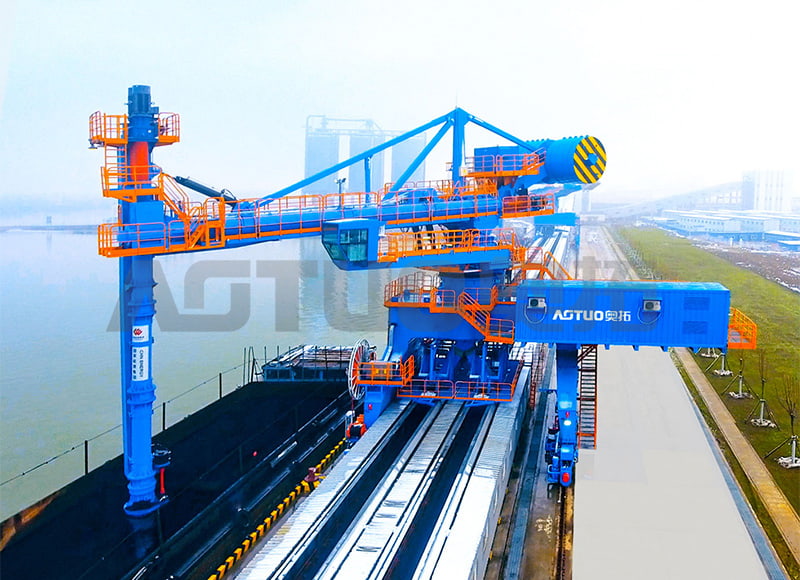
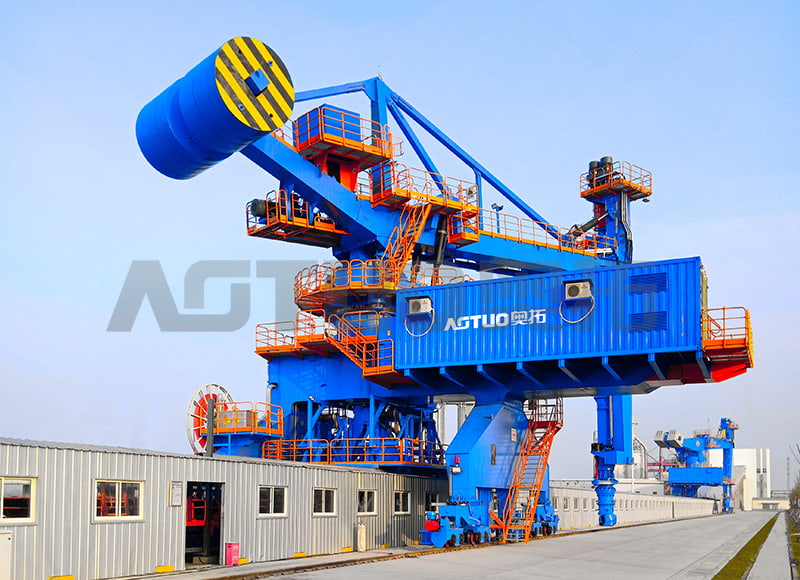 Rail-Mobile Screw Coal Ship Unloader for Abrasive CoalHandles high-moisture coal and abrasive service with enclosed screw conveying, wear-resistant elements, and capacities from 200 to 3000 t/h.View Product →
For abrasive coal service, rail-mounted screw coal unloaders are supplied with wear-resistant conveying elements and enclosed transfer points.
Size the unloader from the average continuous rate required across the berth window, then add margin for hold clean-up and hatch changes; a nameplate peak rate on its own will overstate annual throughput.
An illustrative calculation: a terminal planning 1.2 million tonnes per year of cement imports, 300 operating days, 18 productive berth hours per day and 75 percent mechanical availability needs 1,200,000 divided by (300 x 18 x 0.75), or 296 t/h average continuous rate. A 400 t/h machine then carries about 35 percent headroom for clean-up passes, hatch changes and the rate loss that occurs as the hold empties.
Vessel size drives two physical constraints. Freeboard rises with vessel size, so the vertical screw and boom must reach the hold floor at the lowest expected draft while still clearing the hatch coaming at the deepest. Hold geometry sets the rest: hatch dimensions, number of holds and internal obstructions determine how much cargo the inlet feeder reaches unaided. Berth layout then fixes the machine envelope, because quay length, bollard positions and the shore conveyor route are already in place.
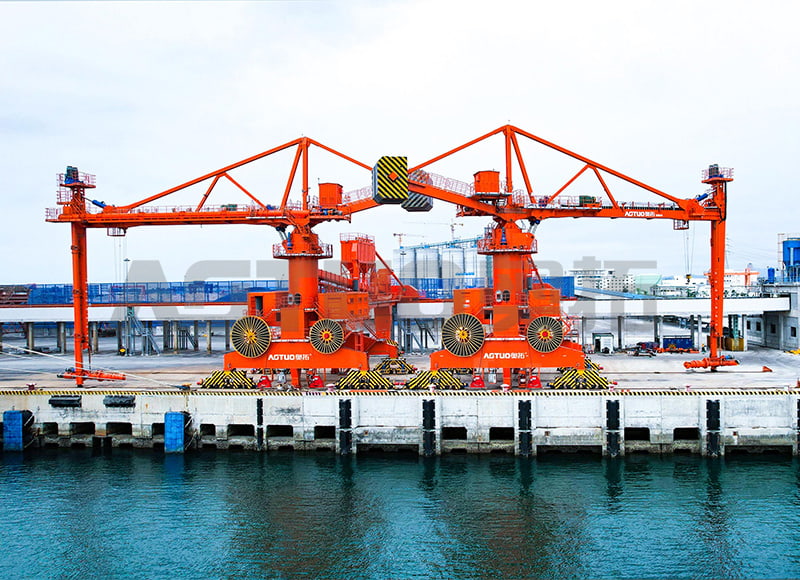
The five cement configurations, fixed, rail mobile, tyre mobile, shipborne and vehicle mounted, trade travel range against civil works cost and berth flexibility; the choice is normally settled by berth layout rather than by unloading rate.
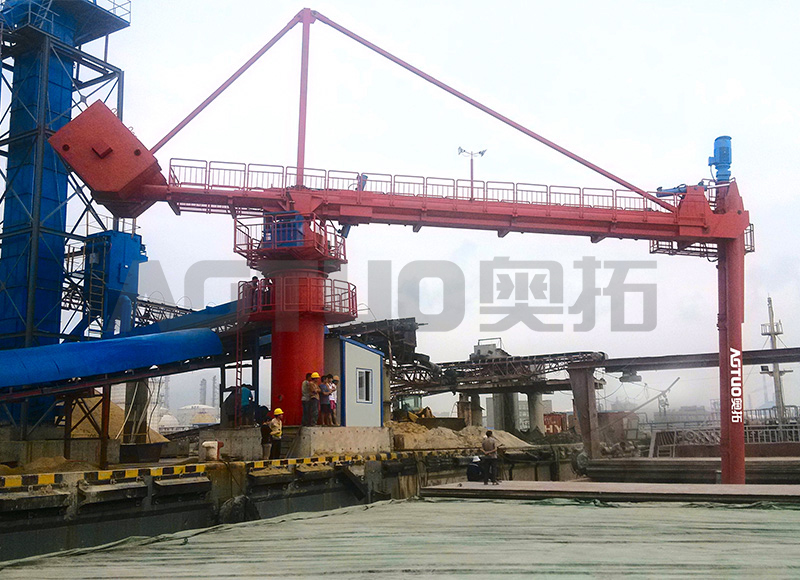 Fixed Screw Ship Unloader for Dedicated Cement TerminalsFor dedicated berths, this fixed unit eliminates rail bogies and handles 600–15000 DWT vessels at 100–500 t/h.View Product →
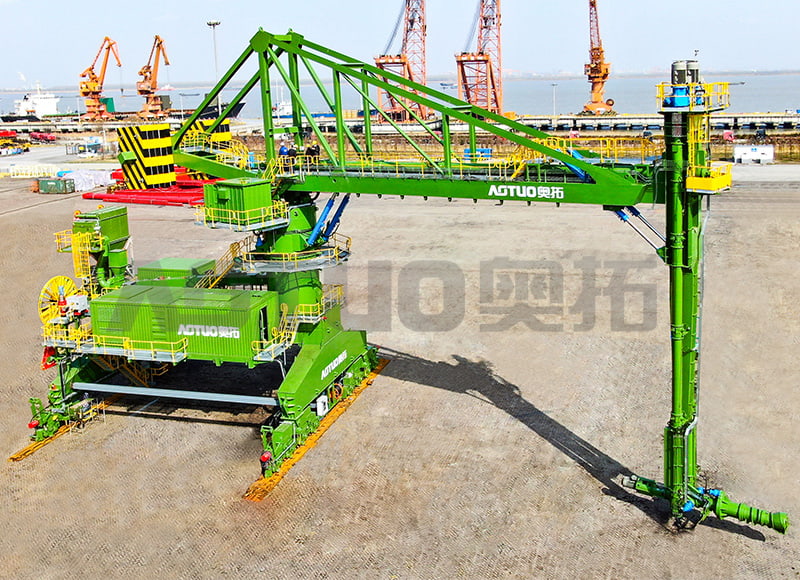 Rail-Mobile Screw Ship Unloader for Multi-Berth Dry BulkMoves between berths on rails and handles 1,000–70,000 DWT vessels at 200–1,500 t/h for cement, coal, grain, and concentrates.View Product →
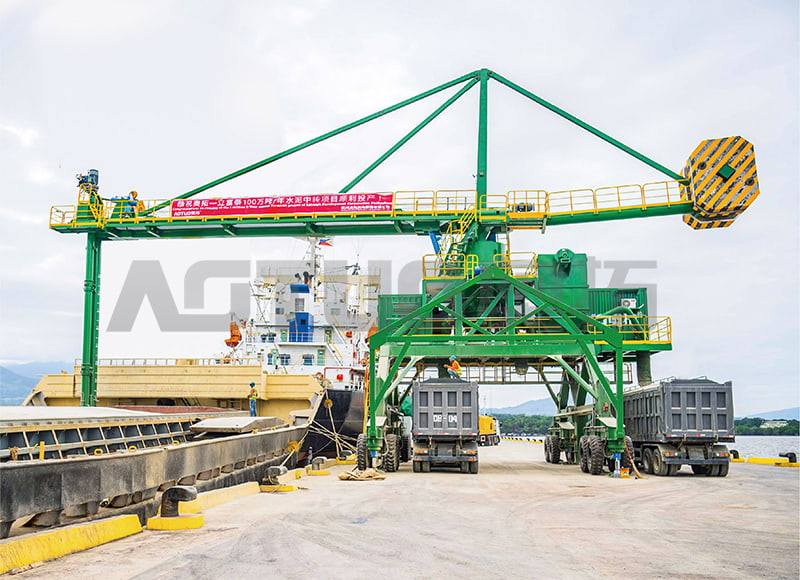
Tyre-mounted units remove the rail cost but need a hardstand with adequate bearing capacity and give less precise positioning at the hatch. Shipborne units travel with the vessel and suit terminals with no quay-mounted unloader. Vehicle-mounted units serve temporary or low-volume operations. Reference installations include the Port of Brisbane in Australia and projects at the Port of Mariveles in the Philippines.
Because the material travels inside a closed screw casing, the emission points on a screw unloader are limited to the hold inlet and the discharge transfer, which is why the technology is often specified where grab or pneumatic unloading would exceed local particulate limits.
Particulate limits are set by the terminal's operating permit, not by the equipment supplier, and they differ by jurisdiction and by port. Obtain the permit limits in writing, state them in the technical specification, and require the supplier to confirm which emission points the quotation covers.
Procurement note: inlet sealing, transfer chute enclosure and dust collector capacity are frequently excluded from a base machine quotation and priced later as extras. Ask for the dust control scope item by item, with filter media stated for each cargo the terminal expects to handle.
Compare offers on a defined cost scope over a fixed period: equipment, quay civil works, power supply and cabling, downstream conveying and dust collection, commissioning, spare parts, and the demurrage that the achieved unloading rate avoids.
| Cost element | What drives it | What to compare |
| Machine supply | Capacity, mounting type, materials of construction | Whether the discharge interface, control system and dust control sit inside the battery limits |
| Quay civil works | Fixed, rail or tyre mounting | Rail foundation, cable trenching, hardstand load capacity, storm anchoring |
| Power supply | Installed power and travel drives | Transformer capacity, cable reel or festoon scope, variable speed drive responsibility |
| Wear and spares | Abrasiveness of the cargo | Flight material, replaceable segment design, quoted lead time for imported parts |
Demurrage is the line easiest to omit and hardest to absorb. A machine delivering 300 t/h instead of 400 t/h on a 30,000 tonne cargo adds about 25 hours of berth time per call, and that time is charged against the vessel, the berth and the next customer.
At 40 calls a year of 30,000 tonnes each, the 25-hour difference per call adds roughly 1,000 hours of berth occupancy annually. That is the cost of a rate shortfall, and it is invisible in a purchase price comparison.
AOTUO has built screw unloaders since 2003 and holds more than 100 patents and software copyrights; its role as lead drafting unit of JC/T 2575 is documented in its company profile.
Screw flights, the inlet feeder and the discharge chute are the wear-critical items; on abrasive coal or clinker, replaceable or hard-faced flight segments allow refurbishment at the berth rather than in a workshop.
Maintenance planning should follow the vessel schedule rather than calendar intervals, and the spare parts list should identify which items are proprietary and what lead time applies, since imported components can extend a planned outage.
Specify the average continuous rate required across the berth window plus margin. In the calculation above, 1.2 million tonnes per year over 300 days and 18 productive hours a day at 75 percent availability requires 296 t/h, so a 400 t/h machine provides roughly 35 percent headroom. Rates above 1,000 t/h call for larger screw diameters and heavier structures, and the current upper limit of the range reaches 3,000 t/h.
In most projects the machine is configured around one material family. Cement and clinker are similar in bulk density but differ in abrasiveness and residual temperature; grain adds breakage limits and hygiene requirements between cargoes; coal adds abrasion and, for some grades, dust explosion considerations. Multi-material configurations exist, but the changeover procedure, cleaning requirement and the rate guaranteed for each cargo must be written into the contract.
Verify the continuous rate on the design cargo, the alignment and capacity of the discharge interface, dust emission at the inlet and transfer points, drive protection settings, and the spare parts list. Acceptance testing must state the cargo, moisture content and vessel condition, because a rate measured on dry free-flowing cargo will not represent performance on wet or compacted material.
Selection comes down to matching four variables that cannot be traded against each other: the cargo, the required continuous rate, the berth geometry and the emission limits set by the operating permit. A machine that fits all four will hold its rate for the life of the terminal; one that fits three will need workarounds in service.
It is focused on the overall solution of dry bulk material port transfer system,
research and development, manufacturing, and service
Copyright © Hangzhou Aotuo Mechanical and Electrical Co., Ltd. All Rights Reserved.
Custom Material Conveyor Transfer Systems Manufacturers